
Beyond Node Removal: Efficient Link Blocking to Halt Social Contamination
Blocking links to minimize contamination spread in a social network
This paper addresses the "Contamination Minimization Problem" in social networks, focusing on blocking a limited number of links to minimize the spread of undesirable entities like viruses or rumors. The authors propose an efficient greedy algorithm based on the Bond Percolation method to minimize both "average" and "worst-case" contamination, achieving significant spread reduction compared to traditional heuristics.
TL;DR
Researchers have developed a highly efficient way to stop "bad things" (viruses, fake news) from spreading through social networks by strategically blocking links rather than just deleting users. By combining greedy algorithms with Bond Percolation theory, their method can reduce contamination by half while only touching 0.2% of the network's connections—outperforming traditional "high-degree" heuristics by up to 60x.
Background: The War Against Undesirable Diffusion
In the era of viral marketing, we usually ask: "How can we maximize influence?" However, for public health or cybersecurity, the question is the inverse: "How can we minimize contamination?"
Conventional wisdom suggests removing "super-spreaders" (high out-degree nodes). But the authors of this paper argue that link blocking is the more fundamental problem. Deleting a person effectively deletes all their connections, whereas blocking specific links allows for a surgical strike that preserves network utility while halting the spread.
The Core Intuition: From IC Models to Percolation
The paper utilizes the Independent Cascade (IC) Model, where an active node has a probability of infecting its neighbor. To solve the optimization problem without hitting a "combinatorial explosion," the authors leverage Bond Percolation.
The breakthrough is a mathematical shortcut: instead of simulating the entire network every time they "test" removing a link, they use a single set of simulations to estimate the marginal gain of blocking any link in the system.
The Methodology Breakdown
- Average Contamination (): Minimizing the total expected number of infected nodes.
- Worst-Case Contamination (): Minimizing the maximum potential impact if the "infection" starts at the most dangerous possible node.

Crushing the "Out-Degree Myth"
A significant finding of this research is that targeting high-degree nodes—a strategy often used in network immunization—is surprisingly ineffective in directed social networks like Blogs or Wikipedia.
Their experiments revealed a hierarchy of effectiveness:
- The Proposed Method: Explicitly accounts for diffusion dynamics.
- Betweenness Centrality: Reasonably effective as it targets "bridges" between communities.
- Out-Degree/Random: Extremely poor performance, often requiring 20x to 40x more removals to achieve the same result as the proposed algorithm.
Experimental Evidence
Experiments on a Blog Network (12k nodes, 80k links) and a Wikipedia Network (9.5k nodes, 245k links) showed that the proposed greedy strategy maintains a steep lead as the number of blocked links () increases.
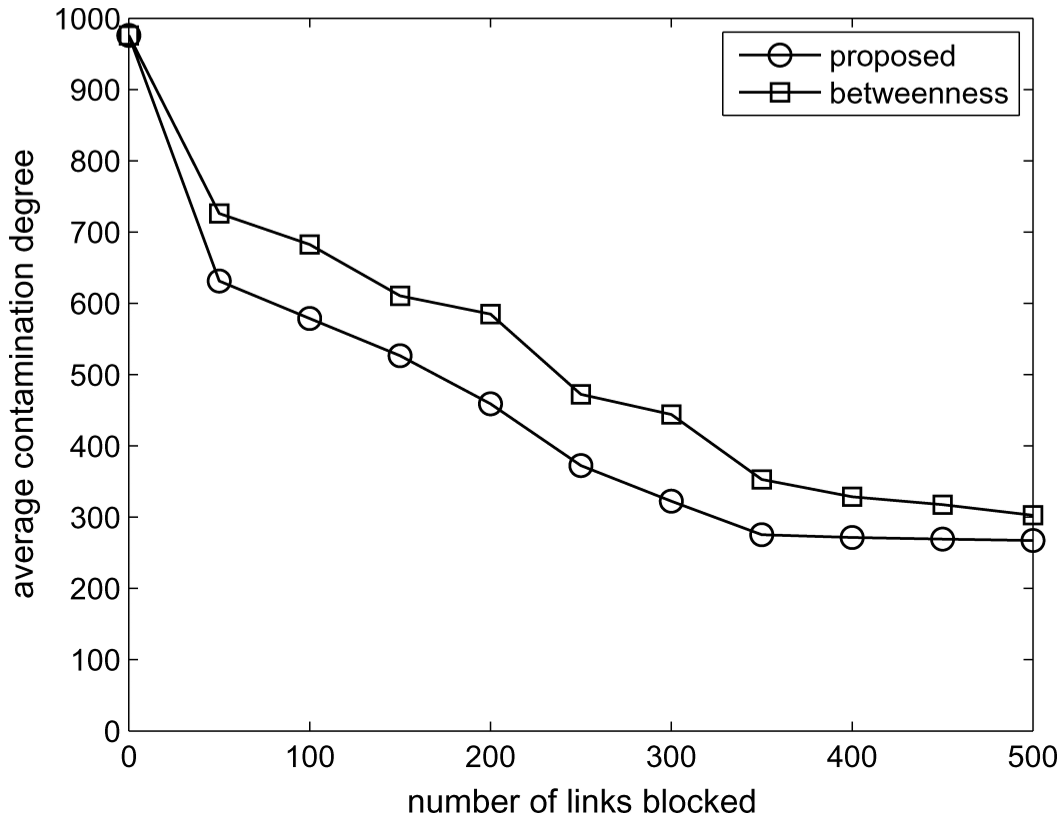 Figure: The Average Contamination Degree drops sharply with the proposed method (circles) compared to heuristics (triangles/squares).
Deep Insight: Why Does It Work?
Most heuristics rely on static topology (who is connected to whom). The proposed method relies on stochastic dynamics (how is information likely to flow). By focusing on the "expected reachability," the algorithm identifies links that act as critical bottlenecks for probabilistic spread, which are not always the links connected to the most famous or active users.
Critical Analysis & Future Outlook
While the method is revolutionary in its efficiency, it does assume a uniform propagation probability (). In reality, some links are "stronger" (trusted friends) than others (random followers).
Takeaway for the Industry: For platform moderators and IT security designers, this research suggests that "shadow-banning" or throttling specific high-risk interactions (links) is significantly more efficient than de-platforming users (nodes) entirely. It offers a path toward safer digital spaces without destroying the underlying social fabric.
Conclusion
This work shifts the paradigm of network security from structural hardening to dynamical intervention. By understanding the "physics" of how rumors and viruses flow, we can protect networks with minimal interference.