
visoLink: Quantifying Social Bonds through Reading and Writing Behaviors
Blog-based online social relationship extraction
The paper introduces visoLink, a personal social network management system that extracts and ranks social relationships using a novel user interest similarity measure. It uniquely combines Content Mining (writing) and Web Usage Mining (reading) to create a weighted "friends ranking" for personalized visualization and recommendation.
TL;DR
In the era of information overload, a simple "Friend List" is no longer sufficient. visoLink transforms the static social graph into a dynamic, weighted personal network. By analyzing not just what you write (blogs) but also what you read (usage logs), this system calculates an "interest distance" to rank your friends and visualize your social world with clarity.
Background: Beyond the Binary Link
In classical Social Network Analysis (SNA), relationships are binary: you either know someone or you don't. However, in modern digital life, the "closeness" of a relationship is a spectrum. The authors argue that as contact lists grow to hundreds or thousands, users need an intelligent way to identify active clusters and like-minded peers.
The Problem: The "Silent Majority" of Readers
Most existing research focuses on Content-based Mining, which extracts interests from blog entries. But what about the "lurkers"? A significant portion of social media users consume content without ever posting.
- Prior Work Limitation: Traditional models (like LDA or Author-Topic models) ignore users who don't write, leading to an incomplete social map.
- The Insight: Reading history is a powerful proxy for interest. If User A spends significant time on User B's posts, there is an inherent social "weight," even if User A never writes a word.
Methodology: The Hybrid Similarity Framework
visoLink employs a two-pronged approach to capture the nuance of human interest.
1. Content and Temporal Analysis
The system uses a similarity function that incorporates a temporal decay factor (). Interests change over time; someone you shared interests with last year might not be relevant today.
This formula ensures that recently published entries carry more weight in the similarity calculation.
2. The Four-Stage "Reading & Writing" Integration
To handle the privacy and data availability challenges of browsing history, the authors split the similarity calculation into four distinct paths:
- S1 (W-W): Writing vs. Writing (Blog content comparison).
- S2 (W-R): User i’s Writing vs. User j’s Reading.
- S3 (R-W): User i’s Reading vs. User j’s Writing.
- S4 (R-R): Reading vs. Reading.
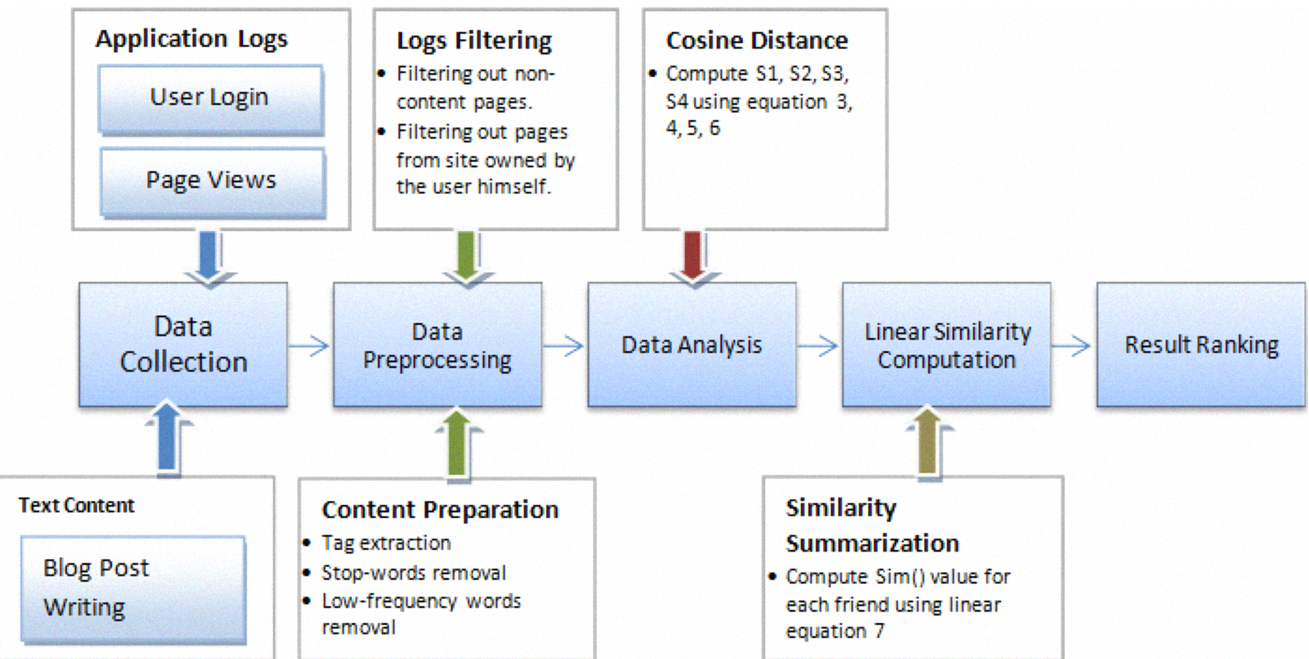
The final score is a weighted sum adjusted by , a factor representing the raw frequency of visits from the centric user to the friend.
Visualization: A User-Centric View
Global social graphs with millions of nodes are for sociologists; individuals need a "personal radar." visoLink uses vector-based graphical techniques to create "Fake 3D" views where:
- Size = Closeness: More similar friends appear larger.
- Transparency = Relevance: Less relevant contacts fade into the background.
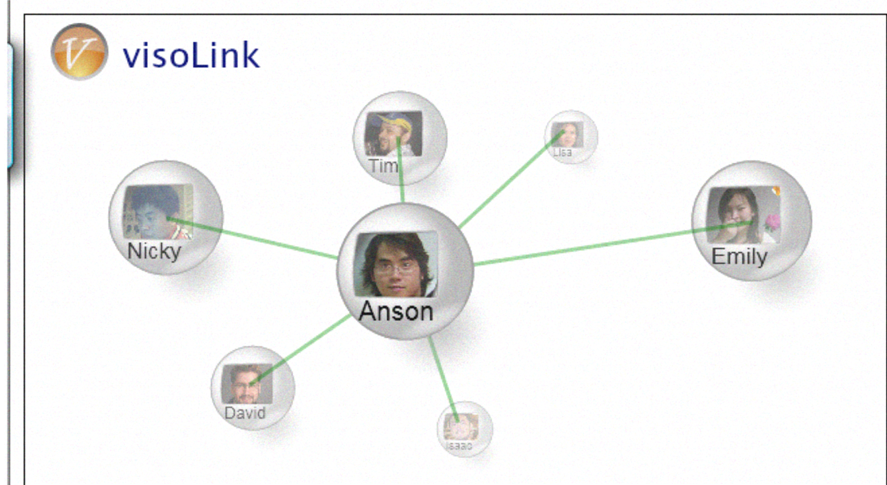
This replaces the confusing "Spring Layout" algorithms (where edge length is the only metric) with one that is much more intuitive for human perception.
Critical Insight & Conclusion
The true value of this work lies in its acknowledgement of the asymmetric relationship. John may admire an expert, but the expert may not know John. visoLink captures this by focusing on the "Personal Network" rather than an objective global truth.
Limitations: The reliance on HTTP sessions for usage tracking is increasingly difficult in modern privacy-focused browser environments (like ATT or Cookie restrictions). However, the logic remains sound for platforms that own their first-party data.
Takeaway: Future social algorithms must synthesize "consumption patterns" with "creation patterns" to truly understand human connectivity.