
Decoding Social Tribes: A Multi-Modal Approach to Blooming Human Groups
Understanding Blooming Human Groups in Social Networks
This paper introduces a multi-modal approach to identify and understand "blooming" human group concepts (e.g., Loli, Geek, Otaku) in social networks using limited positive samples. The method combines three visual streams—face, upper body, and global context—with semantic text representations derived from surrounding social media metadata via skip-gram models and sparse coding.
TL;DR
As social media evolves, so do the categories we use to describe ourselves—from "Geeks" to "Mori girls." This paper presents a specialized framework that understands these "blooming" human groups by combining deep visual features (Face + Body + Global Scene) with semantic text embeddings. By leveraging pre-trained CNNs and skip-gram language models, the system can learn new cultural concepts with as few as ten examples.
Background: Beyond Gender and Age
In the early days of computer vision, human analysis was restricted to binary or categorical labels like gender, age, or race. However, modern social networks have birthed a variety of "urban tribes"—groups defined by shared aesthetics, hobbies, and lifestyles. Recognizing a "Hikikomori" (social recluse) or a "Goddess" (Chinese slang for elegant women) requires more than just face detection; it requires an understanding of clothing, environment, and the semantic context of accompanying hashtags.
Methodology: The Tri-Stream Visual Intelligence
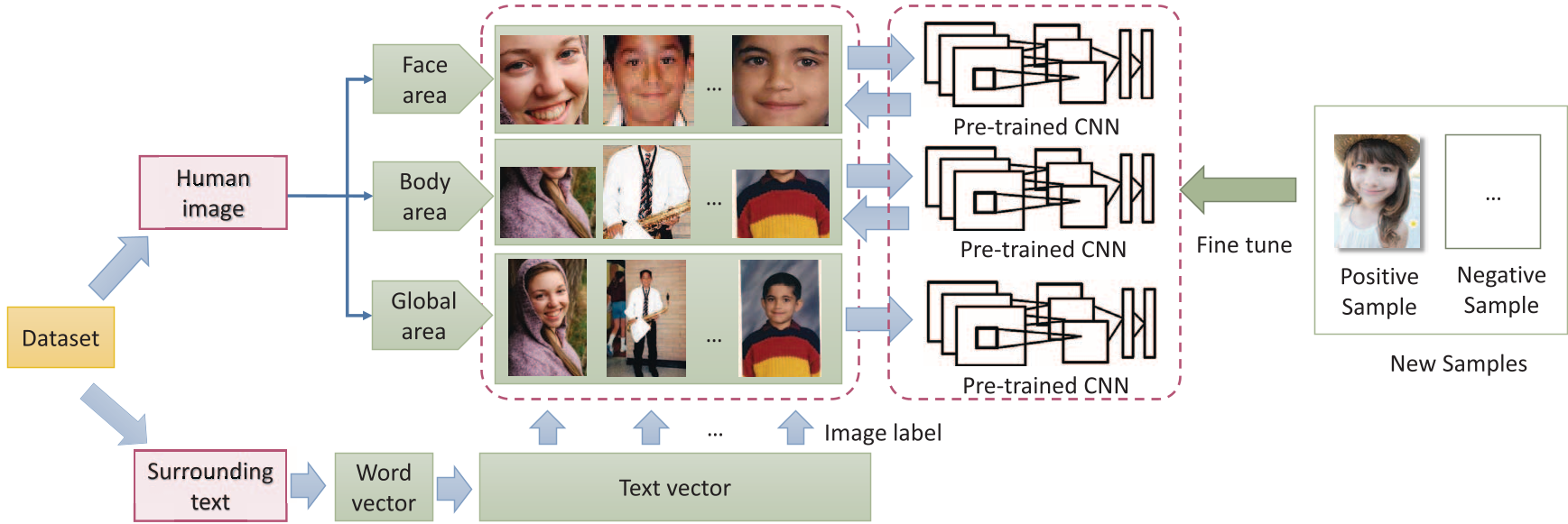
The authors argue that a human's social identity is encoded in three distinct areas:
- The Face: Captured via a Network-in-Network (NIN) architecture, capturing grooming, hair, and makeup styles.
- The Upper Body: Using a 7-layer CNN to extract features of apparel and posture.
- Global Context: Utilizing DeCAF features to understand the environment (e.g., an indoor room for a "Geek" vs. a forest for a "Mori girl").
Semantic Labeling via Skip-Gram
Instead of using one-hot encoded labels, the authors transform surrounding Flickr text into 1024-dimensional semantic vectors. They use the Skip-gram model to turn words into vectors, then apply sparse coding and max pooling to create a single representative vector for the image's metadata. This allows the model to calculate a "Euclidean Distance" between what it sees and the "meaning" of the text.
Experimental Insights & Results
The system was tested on a massive dataset of 212,400 images from Flickr. The most impressive aspect of the work is its Few-Shot Learning capability.

The researchers identified eight novel concepts (Hikikomori, Mori girls, Otaku, Syota, Geek, Loli, Goddess, Gaofushuai). With roughly 10 samples per group, the model could generalize and find similar individuals within the larger dataset.
| Concept | Accuracy |
|---|---|
| Loli | 69.6% |
| Hikikomori | 50.0% |
| Goddess | 42.1% |
| Geek | 33.3% |
The higher accuracy for "Loli" and "Hikikomori" suggests these groups have highly distinct visual signatures (specific fashion or indoor backgrounds) compared to broader terms like "Geek."
Critical Analysis & Takeaways
The core "Aha!" moment of this paper is the realization that Global Features act as a stabilizer for local features. As seen in the experimental charts, adding the DeCAF global feature significantly lowered the test error for both face and body models.
Limitations:
- The accuracy of ~43% indicates that social subcultures are still incredibly difficult to distinguish with 2015-era CNNs.
- The reliance on English/Google News embeddings might limit the understanding of highly localized Japanese or Chinese slang nuances.
Future Outlook
This work paved the way for modern "Image-Text Alignment" research. In today’s world of CLIP and Foundation Models, the "human group" problem is often handled by massive planetary-scale pre-training. However, this paper’s focus on structured human-centric parts (Face vs. Body) remains a highly efficient inductive bias that even modern transformers could benefit from when data is scarce.