
From Blurry Numbers to Clear Preferences: Redefining Reputation in Social Networks
From blurry numbers to clear preferences: A mechanism to extract reputation in social networks q
This paper introduces the PairWise Reputation Mechanism (PWRM), a novel system designed to extract reputation in complex social networks using qualitative pairwise comparisons and knock-out tournaments. By moving away from numerical ratings, the mechanism aims to achieve more accurate reputation rankings that are resilient to human subjectivity.
TL;DR
Most reputation systems (think Amazon stars or Yelp ratings) are flawed because they assume everyone uses the 1-5 scale the same way. This paper proposes PWRM (PairWise Reputation Mechanism), which replaces "fuzzy" numerical ratings with "this vs. that" comparisons organized into knock-out tournaments. By treating reputation as a ranking problem rather than an averaging problem, it eliminates the bias of optimists and pessimists.
The Problem: The Subjectivity of "4 Stars"
In a complex social network, trust is everything. However, traditional systems are passive and quantitative. They wait for ratings and then average them.
The issue? Subjectivity.
- User A (The Enthusiast): Gives a 4/5 because the movie was "okay."
- User B (The Critic): Gives a 4/5 because the movie was a "masterpiece."
When a system averages these numbers, it loses the underlying preference. Furthermore, users find it cognitively easier to answer "Do you prefer Hotel A or Hotel B?" than to assign an arbitrary number to each in isolation.
Methodology: Tournaments and Random Walks
The authors transform the reputation problem into a Knock-out Tournament.
1. The Tournament Structure
Entities (like movies or sellers) are placed in a binary tree. At each node, a "match" occurs. The system proactively asks a set of users to vote on which of the two entities they prefer. The winner moves to the next round.

2. Aggregating Results with Rank Centrality
Simply winning a tournament isn't enough to define global reputation. The authors use an adapted Rank Centrality algorithm.
- The Intuition: It constructs a directed graph where nodes are entities. An edge exists from to if they were compared.
- The Math: It models a "random walk" on this graph. The probability of moving from to is proportional to how often beat .
- The Score: The long-term frequency with which a random walker visits a node (the stationary distribution) becomes that entity's reputation score.
Experimental Battleground: MovieLens & Flixster
The researchers tested PWRM against the "Ground Truth" (the actual rankings if all objective data were known).
Resilience to Subjectivity
The most impressive part of the study involved simulating "Optimistic" and "Pessimistic" users who keep their preferences but shift their numerical ratings to extreme ends of the scale.
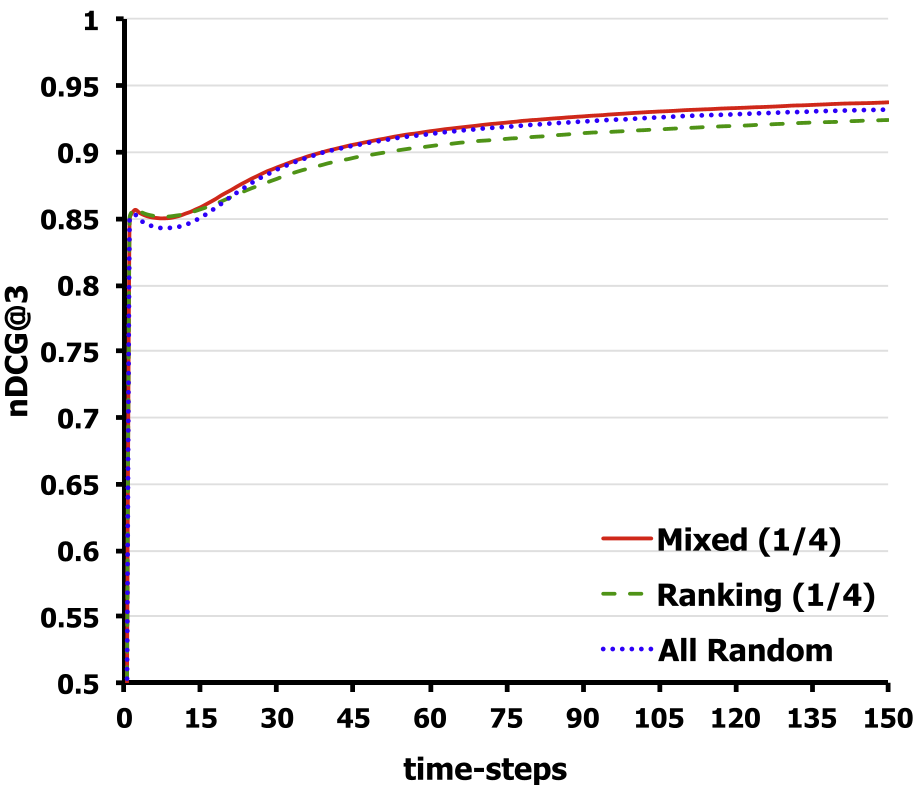 Shown above: Comparison of PWRM vs. traditional systems under biased conditions.
Key Findings:
- Robustness: In environments with 40% biased users, PWRM maintained a high nDCG (Normalized Discounted Cumulative Gain), while traditional average-based systems saw their ranking quality plummet.
- Efficiency: Smaller tournaments (4-8 entities) were found to be sufficient to achieve high accuracy without overwhelming users with queries.
Critical Insight & Conclusion
The genius of this work lies in recognizing that reputation is relative, not absolute. By using pairwise elicitation, the system bypasses the "internal scaling" problem of human psychology.
Limitations:
- Latency: Iterative tournaments take more time to resolve than simple averaging.
- Cooperation: The current model assumes users are honest about their preferences. In a hostile network, malicious users could collude to "fix" the tournament.
Future Work: The authors suggest integrating incentive mechanisms (like prediction markets) to ensure that users are "truth-tellers," paving the way for reputation systems that are not just subjective-proof, but also manipulation-proof.
This research marks a pivotal shift toward User-Centric Reputation, where the platform acts less like a calculator and more like a sophisticated pollster.