
Beyond the Screen: How Mixed Reality Reimagines Social Initiation for Children with Autism
Bodily Expression of Social Initiation Behaviors in ASC and non-ASC children: Mixed Reality vs. LEGO Game Play
This study presents a Mixed Reality (MR) full-body interaction system designed to foster social initiation in children with Autism Spectrum Condition (ASC). By comparing MR with a traditional LEGO play intervention using machine learning-based bodily cue analysis, the research demonstrates that MR can effectively mediate and alter non-verbal social behaviors in ASC/non-ASC dyads to a level comparable to established clinical play therapies.
TL;DR
This research investigates whether a large-scale Mixed Reality (MR) system can foster social initiation centerpieces in children with Autism Spectrum Condition (ASC) as effectively as traditional LEGO therapy. By utilizing automated skeleton tracking and machine learning, the authors proved that MR environments not only stimulate social engagement but also encourage non-verbal behaviors that are more "normalized" and harder to distinguish from neurotypical peers compared to traditional play settings.
The Embodiment Gap in ASC Intervention
For children with ASC, the challenge isn't just understanding social rules—it's the internal drive to initiate interaction. Traditional therapies like LEGO Play are effective but labor-intensive, requiring psychologists to manually code hours of video to track progress.
On the tech side, previous ICT (Information and Communication Technology) solutions often focused on robots or VR headsets. However, these can be isolating. The authors suggest a shift toward Embodied Cognition: using the whole body as a social interface. The core intuition is that social understanding is intrinsically tied to physical movement, proxemics (physical distance), and joint attention.
Methodology: High-Tech Play vs. High-Touch Bricks
The study compared two conditions using 18 dyads (one ASC child and one non-ASC peer):
- The MR System ("Lands of Fog"): A 6-meter circular floor projection where children use handheld "nets" to discover virtual creatures.
- The LEGO Game: A collaborative task where children build a ship together, following the "Legoff" clinical standard.
The Technical Pipeline
The researchers didn't just watch videos; they digitized human movement. Using OpenPose, they extracted skeletal "joints" to calculate:
- Individual Features: Velocity of hands, angles of elbows, and torso inclination.
- Interpersonal Features: "Torso-to-torso" distance and Visual Focus of Attention (VFOA).
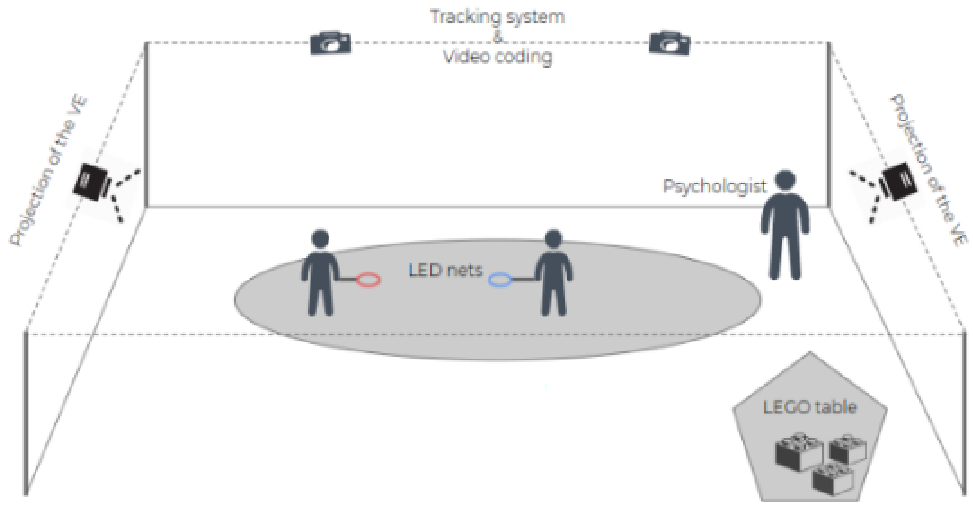 Figure 1: Diagram of the MR environment where dyadic interaction is tracked via multiple cameras.
Quantitative Insights: MR as a Social Equalizer
The statistical analysis (Mann-Whitney U tests) revealed a fascinating trend. In the LEGO setting, the differences between ASC and non-ASC children were mostly individual (e.g., how fast one child moves their hands). In the MR setting, the differences were overwhelmingly interpersonal (e.g., how the two children shared space).
Machine Learning Classification
The team trained Random Forest (RF) and Support Vector Machines (SVM) to see if a computer could "guess" if an initiation came from an ASC or non-ASC child based purely on their body language.
| Setting | Accuracy (F1-Score) |
|---|---|
| LEGO | ~69% |
| MR | ~60% |
The Insight: The lower classification accuracy in MR is actually a win. It suggests that the MR environment makes the bodily expressions of ASC children more similar to their non-ASC peers. It bridges the "non-verbal gap."
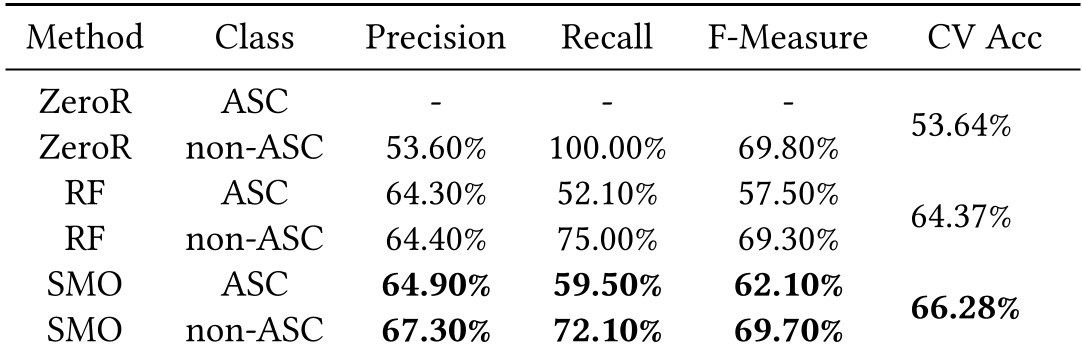 Table 1: Classification results for LEGO. Note the higher performance compared to MR, indicating more distinct behavioral patterns.
Qualitative Analysis: Leading the Way
Video analysis showed that in LEGO, children often focused on "searching" for pieces—a repetitive task. In MR, children engaged in exploration. Interestingly, in MR initiation moments, ASC children frequently took the lead or followed their peers in close proximity, a balanced dynamic rarely seen in unstructured play.
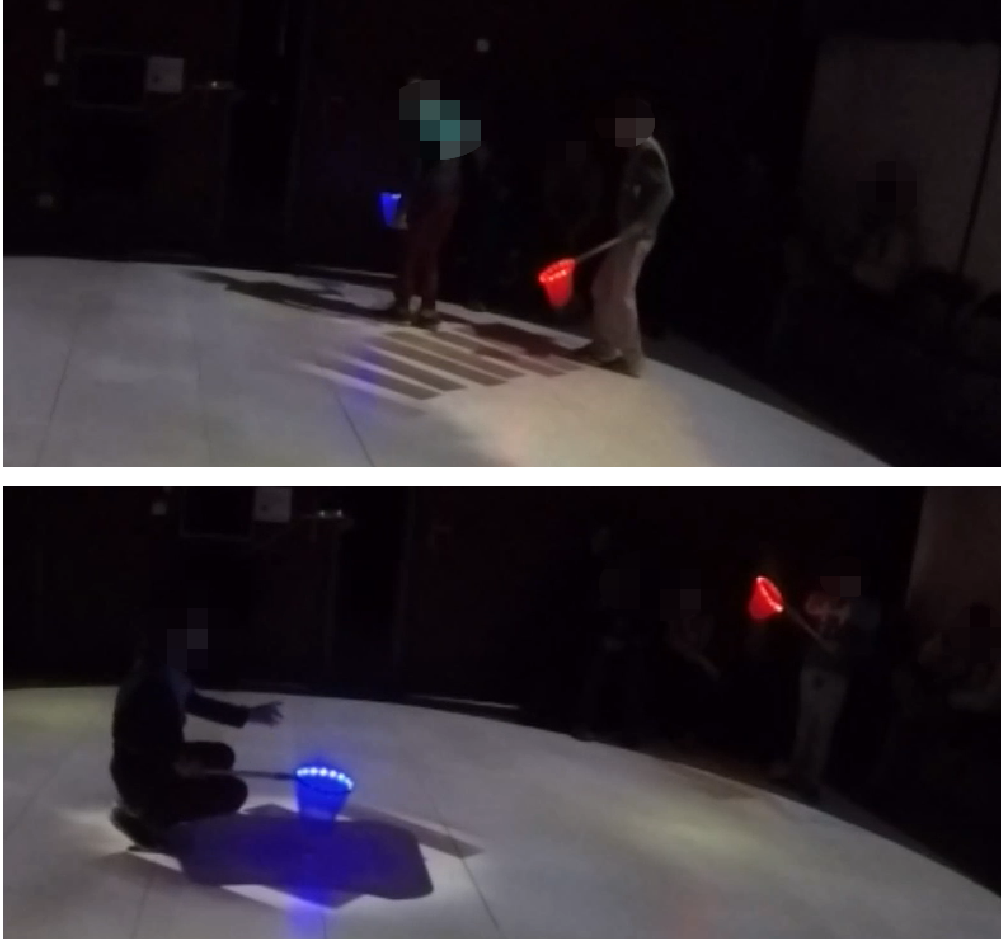 Figure 2: Top - ASC child initiating during exploration; Bottom - non-ASC child sharing a discovery.
Critical Takeaway & Future Directions
The value of this work lies in proving that MR isn't just a "game"—it's a clinical tool. By leveraging Full-Body Interaction, we can create environments where the environment itself "scaffolds" social progress.
Limitations: The study sample is relatively small (18 dyads) and predominantly male, which is common in ASC research but limits generalizability. Future iterations should integrate real-time game logs (e.g., when a virtual "event" happens) with bodily cues to understand the triggers of social initiation.
The Future: Imagine an MR system that adapts its difficulty or virtual content in real-time when it detects an ASC child is struggle to initiate, effectively acting as an automated, non-invasive therapist.