
Robust Healthcare: Mastering Human Behavior Recognition via Sensor Fusion and Deep RNNs
A body sensor data fusion and deep recurrent neural network-based behavior recognition approach for robust healthcare
This paper presents a robust human behavior recognition system for healthcare using multimodal body sensor data fusion and Deep Recurrent Neural Networks (RNN). By integrating ECG, accelerometer, and magnetometer data with Kernel Principal Component Analysis (KPCA), the approach achieves SOTA performance across three benchmark datasets (MHEALTH, PUC-Rio, and AReM).
Executive Summary
TL;DR: This research tackles the complexity of human activity monitoring by fusing data from multiple body-worn sensors (ECG, Accelerometers, Gyroscopes) and feeding it into a Deep Recurrent Neural Network (RNN). By leveraging the temporal memory of LSTM units and the non-linear feature extraction of KPCA, the system reaches a near-perfect 0.99 F1-score, setting a new benchmark for robust healthcare monitoring.
Positioning: This work moves beyond simple "classification" of movements into the realm of "sequential behavior understanding," bridging the gap between raw medical sensor data and actionable clinical insights.
The Challenge: Why Wearables are Hard
While wearable sensors offer a privacy-preserving alternative to video-based monitoring, they present unique technical hurdles:
- Signal Noise: Body movements create significant artifacts in sensitive data like ECG.
- Temporal Context: Activities like "standing up" vs. "sitting down" are identical in a static frame; their meaning lies entirely in the sequence.
- Subject Variability: Different individuals have unique gait and motion patterns, requiring a model with high inductive bias and robust feature generalization.
Methodology: The Fusion Architecture
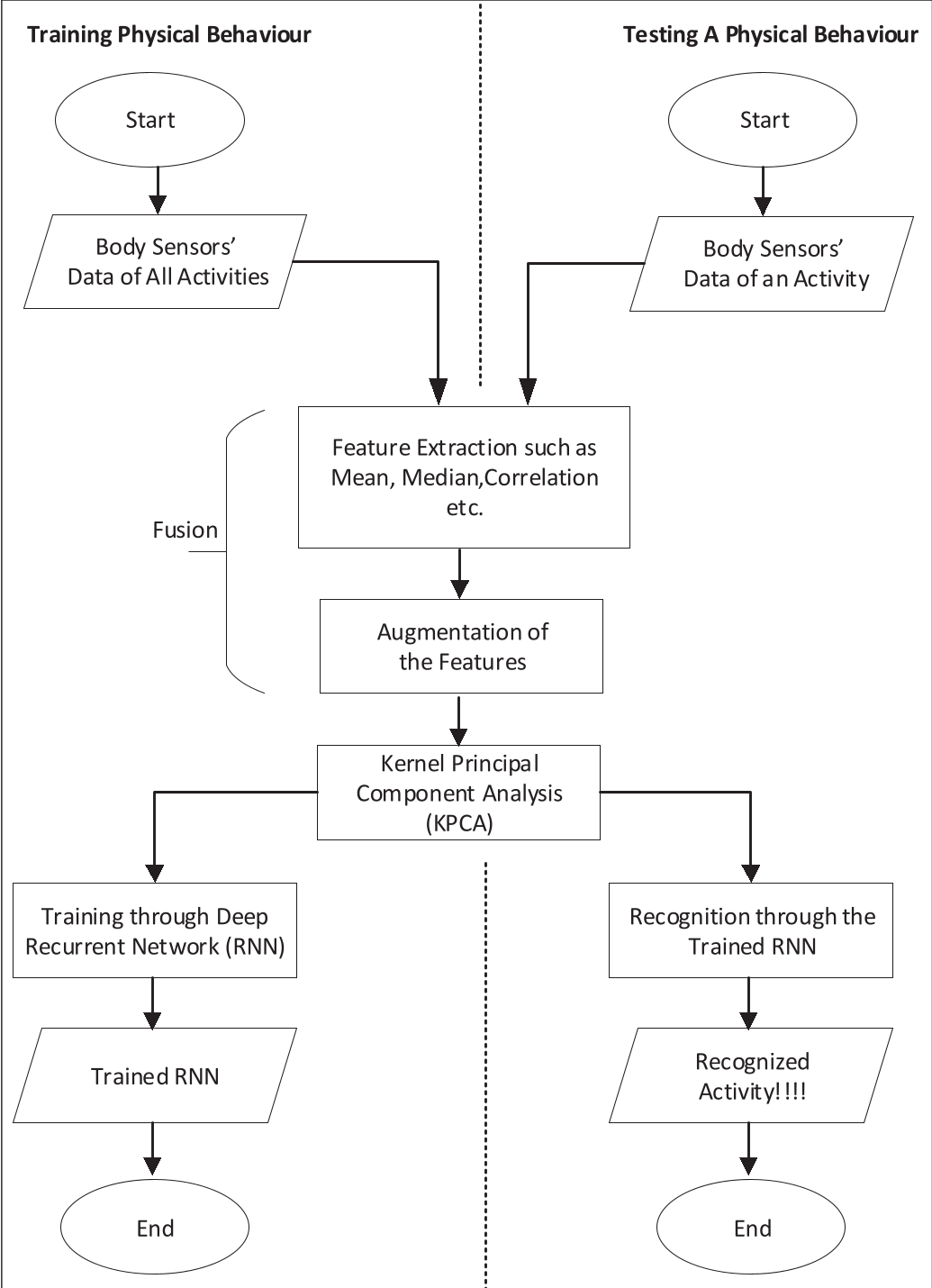
The proposed system utilizes a two-stage pipeline: Feature Enhancement and Sequential Modeling.
1. Multi-modal Sensor Fusion
The system collects data from sensors placed on the chest, wrist, and ankle. It doesn't just look at raw values; it extracts statistical descriptors including:
- Mean and Variance: For general intensity.
- Skewness and Kurtosis: To capture the "shape" of the movement distribution.
- Horizontal Augmentation: Creating a unified feature vector from disparate sources.
2. Non-linear Projection via KPCA
Instead of standard PCA, the authors use Kernel Principal Component Analysis (KPCA) with a Gaussian kernel. This allows the system to capture non-linear relationships between sensors, which is vital when combining heart rate (ECG) with physical motion.
3. The Deep RNN (LSTM) Engine
To solve the "vanishing gradient" problem common in standard RNNs, the authors implement Long Short-Term Memory (LSTM) blocks. These blocks use gates (Input, Forget, Output) to decide what information from the past (e.g., the start of a walking gait) should be retained to identify the current state.
Experimental Results: Near-Perfect Accuracy
The model was validated on three distinct benchmarks: MHEALTH, PUC-Rio, and AReM.
- Unrivaled Performance: Across all 12 activities in MHEALTH (ranging from cycling to knees bending), the system maintained a recall rate of 0.98 to 1.00.
- Superiority Over Baselines: Compared to Deep Belief Networks (DBN), which struggle with sequential data, the RNN approach showed a 6% absolute improvement in mean recall.
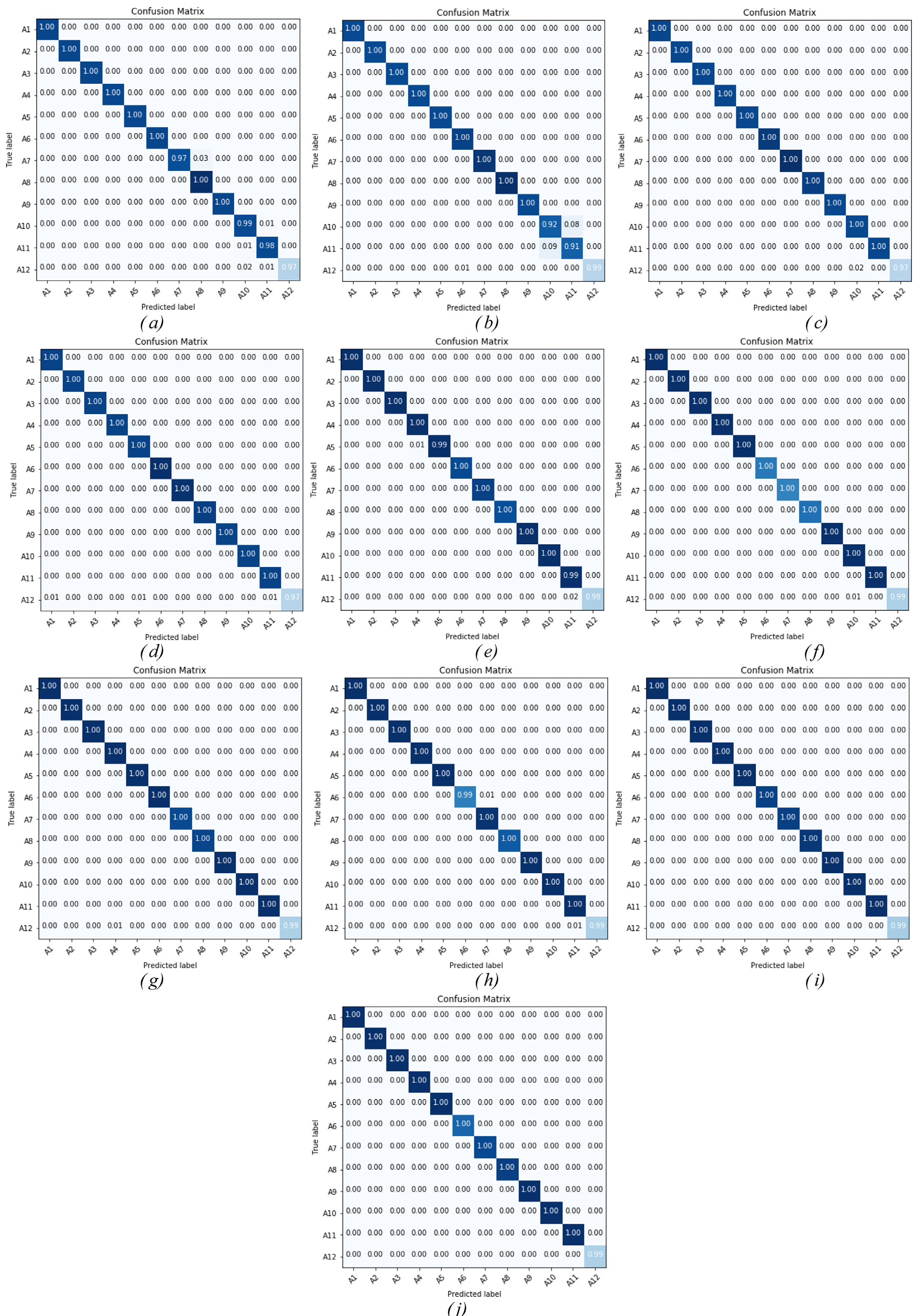 The confusion matrices above demonstrate the model's high precision, with minimal misclassification even between similar activities like 'Sitting' and 'Sitting Down'.
Critical Insight: The Value of "Memory" in Medicine
The success of this approach lies in the realization that healthcare data is not a collection of independent points, but a continuous story. By using LSTMs to "remember" the previous 250ms of data, the model effectively filters out random noise and focuses on the underlying physical intent.
Limitations and Future Work
While the results are impressive, the computational overhead of Deep RNNs on edge devices (like smartwatches) remains a hurdle. Future research could explore Model Quantization or Knowledge Distillation to bring this 99% accuracy directly to low-power wearable hardware for real-time, on-device behavior analysis.
Conclusion
This paper proves that the combination of multimodal data fusion, non-linear feature transformation (KPCA), and deep sequential modeling (RNN) creates a highly robust system for patient monitoring. It represents a significant step toward autonomous, smart clinics where patient recovery can be tracked with clinical-grade precision.