
Bonding vs. Bridging: Decoding the Social Capital of Twitter
Bonding vs. Bridging Social Capital: A Case Study in Twitter
This paper presents a computational study of social capital on Twitter, introducing a mathematical framework to differentiate between Bonding (interactions within homogeneous groups) and Bridging (interactions between heterogeneous groups). Utilizing nine distinct following strategies for artificial accounts, the authors prove that bonding via profile similarity yields the highest follow-back rates.
TL;DR
Is it better to follow "people like you" or to reach out to diverse, unfamiliar groups? This study conducts a controlled experiment on Twitter to quantify Social Capital. By deploying bot accounts with various "following" recipes, the researchers found that Bonding (targeting similar users) is 1.6x more effective at generating follow-backs than Bridging (targeting dissimilar users). However, a surprising twist: having more followers doesn't necessarily mean more people are clicking your links.
Problem & Motivation: The Science of "Birds of a Feather"
In sociology, the principle of Homophily suggests that contact between similar people occurs at a higher rate than among dissimilar people. While theorists like Putnam and Lin have long argued that bonding interactions are the "path of least resistance," empirical data from the physical world is notoriously difficult to collect.
The authors saw Twitter as a massive, live laboratory. They wanted to know:
- Can we mathematically model social capital?
- In a digital wild-west like Twitter, does the "Bonding" theory actually hold up to the data?
Methodology: The Hybrid Network Framework
The researchers defined two layers of social interaction:
- Implicit Affinity (IAN): How similar are you to someone else? (Measured via NLP unigrams/bigrams in user bios).
- Explicit Connection (ESN): Did you actually follow them?
By combining these, they derived a formula for Realized Social Capital. If you follow someone similar and they follow you back, you have accrued Bonding Social Capital. If you follow someone totally different and they reciprocate, you've gained Bridging Social Capital.
The Controlled Experiment
To test this, they created 9 "John Doe" style accounts. All looked identical except for their following strategy:
- Strategy A (Bonding): Targeted users with high bio-word overlap.
- Strategy B (Bridging): Targeted users with the least bio-word overlap.
- Strategies D-H: Random, Median, or follower-count based logic.
 Figure 1: The standardized profile used for all testing accounts.
Experiments & Results: Bonding for the Win
The data was clear. Strategy A (Bonding) reached a 32% follow-back rate. Meanwhile, Strategy B (Bridging) languished at 20%.
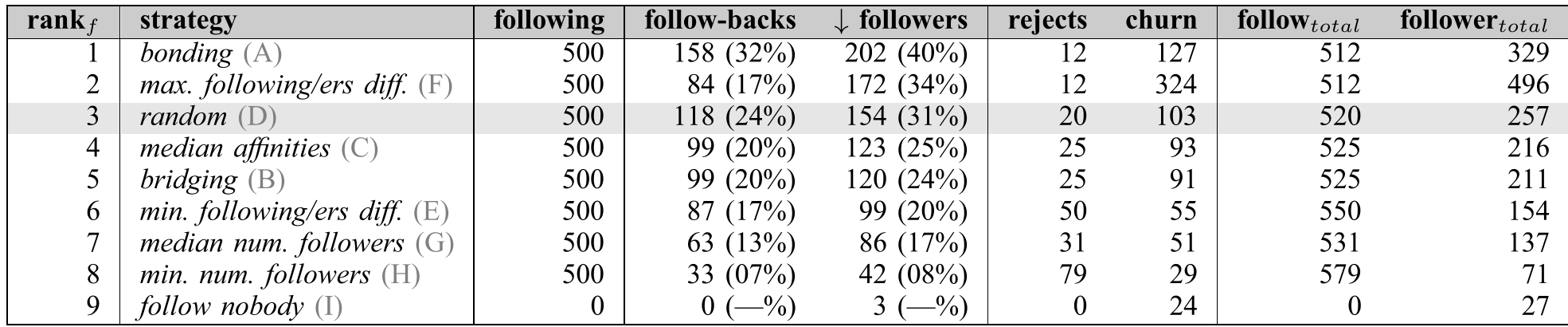 Table 1: Comparison of follow-back ratios across different strategies.
The Engagement Paradox
Perhaps the most "technical" insight of the paper is the decoupling of Network Size and Network Value. While the Bonding account had the most followers, it didn't strictly have the most clicks on its links. The Random strategy (D) actually edged it out in total clicks.
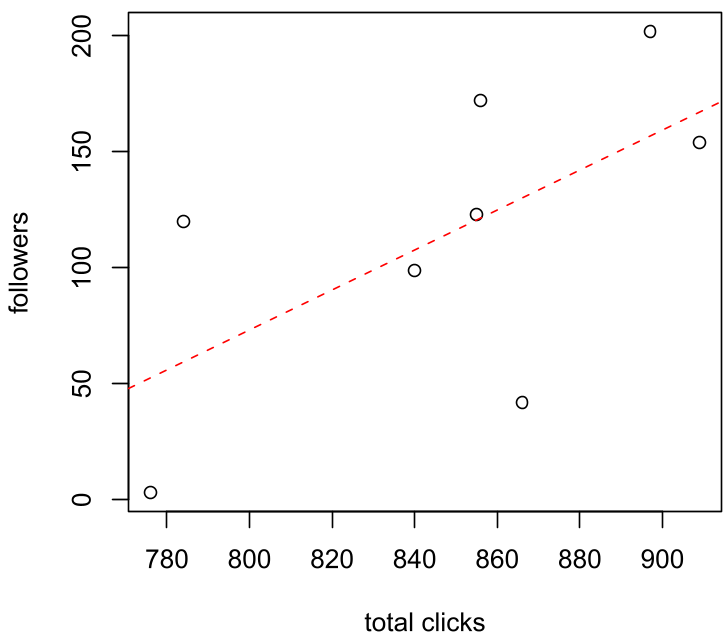 Figure 2: The weak correlation (R² = 0.28) between follower count and click-through performance.
The regression analysis shows that just because you "buy" or "hack" your way to a large following through bonding doesn't mean those users are active or attentive.
Critical Analysis & Conclusion
Takeaways
- Strategic Growth: If you are a new user or a brand, focusing on users who "say what you say" in their bios is the fastest way to build a reciprocated network.
- Capital Realization: Social capital is not a static number; it is a product of similarity and the reciprocity of the link.
Limitations
The study assumes that "you are what you say you are online," which ignores the prevalence of performance-based personas or bots. Furthermore, the similarity metric was a simple keyword match (NLP has advanced significantly since this study, using embeddings instead of unigrams).
Future Outlook
As algorithms (like the TikTok "For You" page) move away from the explicit "Follow" graph and toward purely implicit interest graphs, the distinction between Bonding and Bridging may blur. Future work should look at how Bridging Social Capital—though harder to get—might actually be more valuable for information spreading (the "Strength of Weak Ties" theory).
Final Thought: In the digital realm, similarity is the engine of growth, but consistency (tweeting) is the engine of engagement.