
BoostDream: Harmonizing Speed and Fidelity in Text-to-3D Generation
BoostDream: Efficient Refining for High-Quality Text-to-3D Generation from Multi-View Diffusion
BoostDream is an efficient plug-and-play 3D refining framework that transforms coarse 3D assets into high-quality models. By combining feed-forward generation with a novel multi-view Score Distillation Sampling (SDS) loss, it achieves SOTA visual fidelity across multiple representations including NeRF, DMTet, and 3D Gaussian Splatting.
TL;DR
BoostDream is a 3D refining framework that bridges the gap between fast-but-coarse feed-forward models and high-quality-but-slow optimization methods. By introducing a multi-view Score Distillation Sampling (SDS) mechanism and a unique three-stage refinement pipeline, it generates high-fidelity 3D assets in nearly half the time of traditional methods while effectively solving the notorious "Janus problem."
The "Janus" Dilemma and Current Bottlenecks
The field of text-to-3D generation has been divided into two camps:
- Feed-forward solutions (e.g., Shap-E): These are lightning-fast but restricted by the limited diversity and quality of existing 3D datasets, leading to "blurry" or low-detail assets.
- SDS-based optimization (e.g., DreamFusion): These leverage the massive power of 2D diffusion models (like Stable Diffusion) to "carve" 3D shapes. While detailed, they are slow and often suffer from the Janus problem—where the model mistakenly generates multiple faces or limbs because the 2D prior lacks a true understanding of 3D spatial consistency.
BoostDream's core insight is that we shouldn't choose between them. Instead, we can use the coarse output of a fast model as a spatial anchor to guide the high-fidelity refinement of an SDS process.
Methodology: The Three Pillars of BoostDream
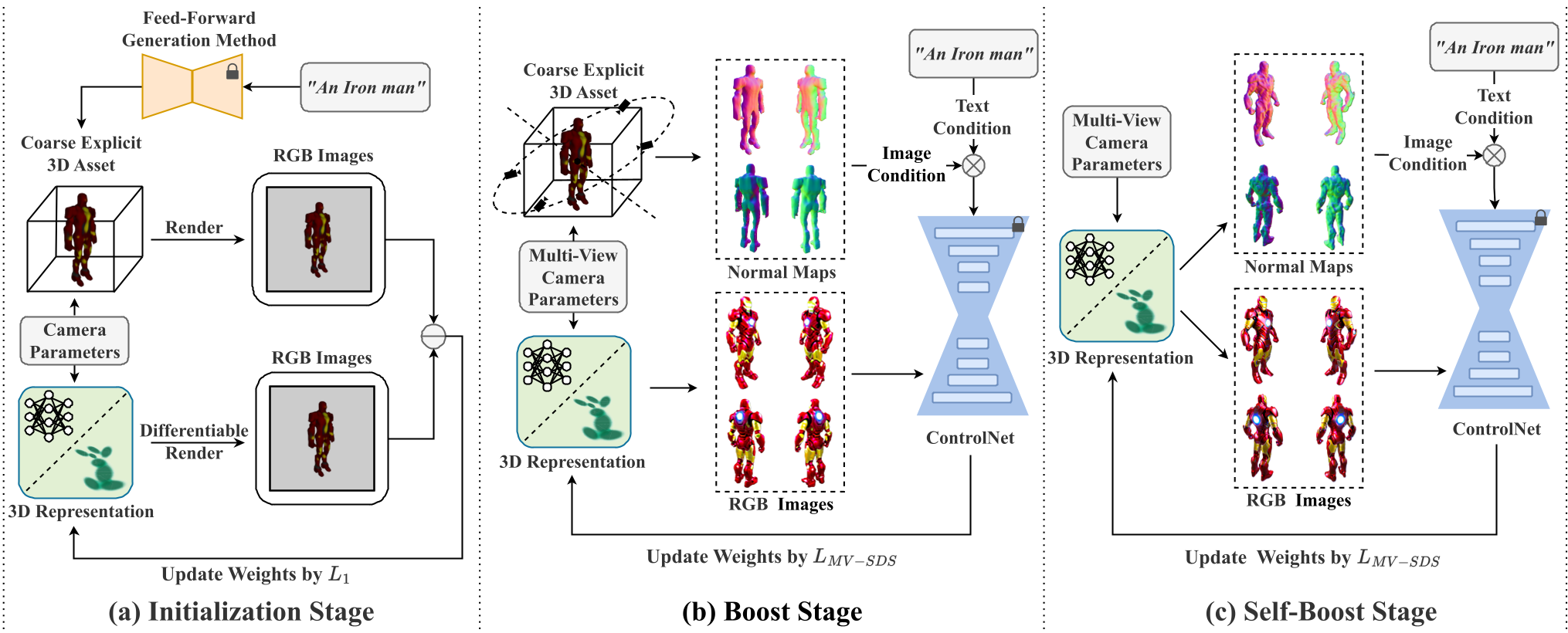
BoostDream operates through a sophisticated three-stage pipeline designed to ensure both speed and structural integrity.
1. 3D Model Distillation (Initialization)
The process starts by taking a coarse 3D asset (e.g., from Shap-E) and fitting it into a differentiable representation (like NeRF or DMTet). This provides a "warm start," ensuring the optimization doesn't begin from a cloud of random noise.
2. Multi-View Rendering & SDS
To solve the Janus problem, authors proposed a Multi-View Render System. Instead of looking at one view at a time, the system renders four orthogonal views and stitches them into a composite image. The SDS loss is then calculated on this composite, forcing the diffusion model to maintain consistency across views.
3. Normal Map Guidance (The "Secret Sauce")
Why normal maps? Unlike simple depth maps or canny edges, Normal Maps provide gradient information about the surface's orientation. BoostDream uses these maps as a ControlNet condition, ensuring that the refined texture and geometry strictly follow the intended surface structure of the asset.
Breakthrough Results
BoostDream doesn't just produce better-looking models; it does so with remarkable efficiency.
- Efficiency: Training a NeRF-based model takes only ~2038 seconds on a V100, significantly faster than DreamFusion (~3519s).
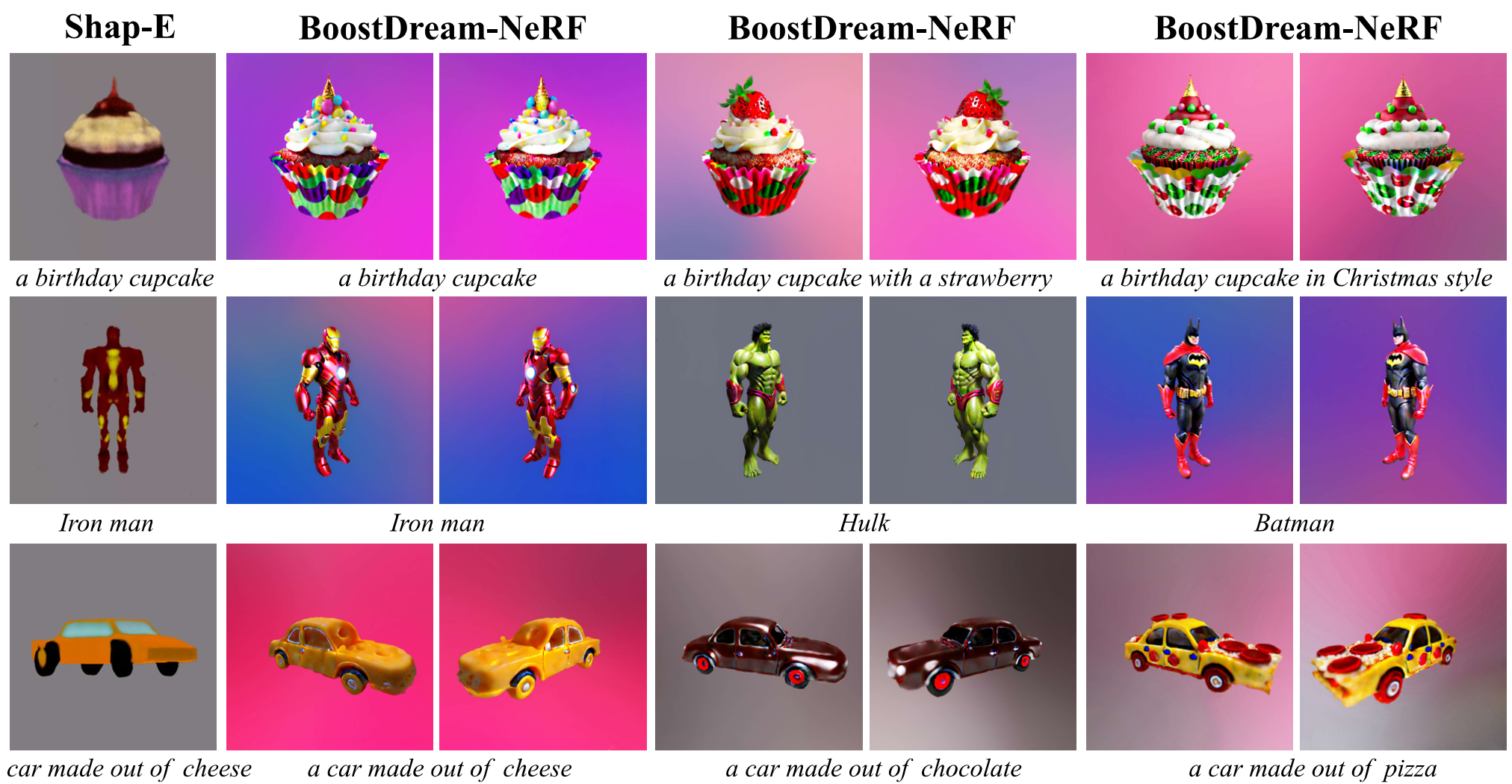
- Visual Quality: As shown in the comparison below, BoostDream eliminates the "multi-head" artifacts found in Magic3D and DreamFusion, producing clean, prompt-accurate geometry.
Critical Analysis & Takeaways
The brilliance of BoostDream lies in its representation-agnostic nature. Whether you prefer the volumetric flexibility of NeRF, the mesh-efficiency of DMTet, or the real-time speed of 3D Gaussian Splatting, BoostDream acts as a "booster" for all of them.
Limitations: While it reduces the Janus problem, the quality is still inherently tied to the 2D prior (Stable Diffusion). Any biases or limitations in the 2D model's training data will be inherited by the 3D asset. Furthermore, the first stage still relies on the coarse model having the "correct" basic topology.
Future Outlook: BoostDream represents a move toward "hybrid" 3D generation. The future of the industry likely isn't in training massive 3D-native transformers, but in creating better "refiners" that can take any rough sketch or low-poly model and turn it into a production-ready asset.