
Boosting 3D Geometric Curves: The Lean Path to Elite Face Recognition and Gender Classification
19030_Boosting 3-D-Geometric Features for Efficient Face Recognition and Gender Classification.
The paper introduces a unified framework for 3D face recognition and gender classification by combining Riemannian shape analysis of facial curves with AdaBoost-based feature selection. Utilizing level sets and radial streamlines, it extracts a compact geometric "signature" that achieves a 98% rank-1 recognition rate on the FRGCv2 dataset.
TL;DR
Researchers have developed a way to strip down complex 3D facial scans into a handful of "anatomical wires"—specifically chosen radial and circular curves. Using Riemannian geometry to measure shape differences and AdaBoost to pick the best features, they achieved a 98% recognition accuracy and 86% gender accuracy while making the process 4x faster and significantly more storage-efficient.
Background: Why 3D and Why Curves?
While 2D face recognition dominates our phones, it is notoriously fragile under bad lighting or awkward angles. 3D shape analysis is the "gold standard" for robustness, but comparing two full 3D meshes is computationally expensive. The authors of this paper ask a fundamental question: Do we really need the whole surface? Or can we find a "minimal signature" hidden in the geometry?
Methodology: From Surfaces to Elastic Curves
The core of the paper lies in its dual-strategy approach:
- Radial and Level Sets: The face is "sliced" into two types of curves. Radial curves emanate from the nose tip (like spokes on a wheel), and Level curves (circular) represent points at equal distances from the nose tip.
- The Geometry of "Elasticity": To handle facial expressions (like a smile stretching the cheeks), the authors use the Square-Root Velocity Function (SRVF). This mathematical framework treats curves as "elastic," allowing them to be stretched or bent. The distance between two curves is calculated as a geodesic on a Riemannian manifold—essentially the "shortest path" to deform one shape into another.
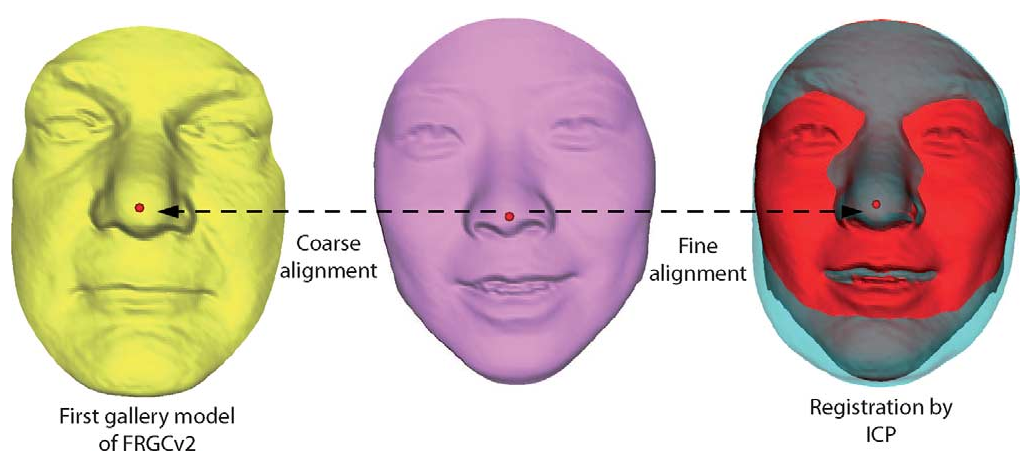 Fig 1: The preprocessing and alignment pipeline, followed by the extraction of radial and circular geometric features.
The Power of Boosting: Finding the "Golden" Features
The most impressive part of this work isn't just the geometry—it's the Feature Selection. Out of hundreds of potential curves, the AdaBoost algorithm identifies which ones actually matter:
- For Recognition: The algorithm prioritized the nose and forehead. Why? These areas are "rigid" and don't change much when you laugh or talk.
- For Gender: The algorithm shifted focus toward the cheeks and eyebrow ridges (sellion), regions where human sexual dimorphism (bone structure and soft tissue) is most pronounced in 3D.
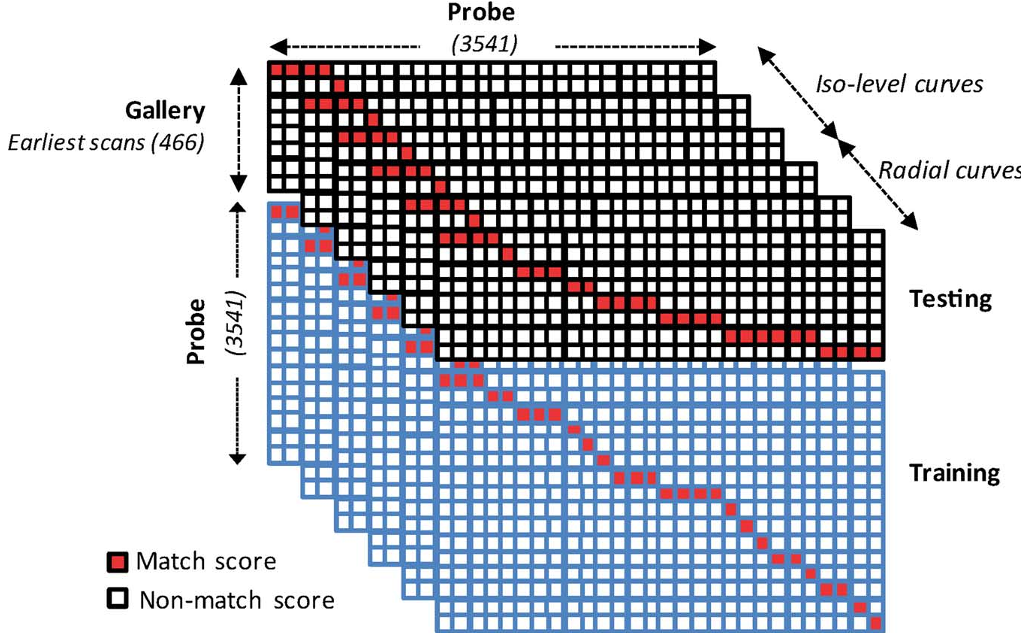 Fig 2: Visualization of the 17-19 specific curves selected by AdaBoost. Notice how they cluster around stable anatomical markers.
Experimental Performance
Testing on the massive FRGCv2 dataset, the results confirm the "less is more" philosophy:
- Accuracy: 98.02% (Rank-1 Recognition), 86.05% (Gender).
- Efficiency: By using only selected curves instead of the full set, verification time dropped from 2.64s to 0.68s.
- Versatility: The framework uses a "Karcher Mean" to create Male/Female templates, allowing a single mathematical model to solve two different classification tasks.
Critical Insight: The "Why" Behind the Success
Most 3D methods fail when someone opens their mouth or squint their eyes. By using Elastic Shape Analysis, this method doesn't just look at where points are; it looks at how the shape of the curve changes. Selecting only the nose-region curves for identity allows the system to ignore the "noise" created by a screaming or smiling mouth, while still capturing the unique skeletal structure of the nose.
Limitations and Future Outlook
While the geometric accuracy is high, the authors admit that 86% gender classification leaves room for improvement. They suggest that 3D shape alone might not be enough; adding texture information (like skin density or hair) could bridge the gap to 95%+.
In an era of massive neural networks, this paper is a refreshing reminder that elegant mathematics and careful feature selection can still produce SOTA results with exceptional efficiency.
Summary Table
| Task | Accuracy (SOTA) | Key Regions Used |
|---|---|---|
| ID Recognition | 98.02% | Nose, Forehead |
| Gender Class. | 86.05% | Cheeks, Eyebrow Arches |
| Latency | 0.68s | Optimized Subset |