
Beyond Simple Swarms: Weaving a Heterogeneous Social Fabric for Cultural Evolution
Boosting cultural algorithms with a heterogeneous layered social fabric influence function
This paper introduces the Enhanced Social Fabric Cultural Algorithm (ESF_CA), which integrates a heterogeneous layered social network into the traditional Cultural Algorithm (CA) framework. By leveraging "Knowledge Swarms" across diverse network topologies (lBest, gBest, Tree, and Hybrid), the method significantly improves information diffusion and optimization efficiency in complex real-valued landscapes.
TL;DR
Optimization is often seen as a solitary pursuit for agents in an evolutionary landscape. This paper shifts the focus from what agents know to how they share it. By introducing a Heterogeneous Layered Social Fabric, the authors boost Cultural Algorithms (CA) to solve 24 complex benchmark problems, achieving dramatic reductions in computational cost (up to 60% fewer evaluations compared to standard GAs).
The Evolution of Cultural Algorithms: Why "Social Fabric" Matters
In the world of Bio-inspired AI, Cultural Algorithms (CA) are unique because they utilize a dual-inheritance system:
- Population Space: Where individuals evolve through traditional operators.
- Belief Space: Where the collective "culture" (Normative, Situational, Domain, History, and Topographic knowledge) is stored.
The missing link in earlier versions was a sophisticated influence function. Like a human society where ideas spread through different channels (family, work, social media), agents in an optimization task benefit from different "sociometries." The authors argue that a single fixed topology (like a ring or a grid) is too rigid for the dynamic stress of hard optimization tasks.
Methodology: Weaving the Meta-Level Swarm
The core innovation is the Social Fabric. Instead of a single network, the system uses multiple layers of connectivity simultaneously:
- lBest & gBest: For local and global information sharing.
- Tree & Hybrid Topologies: For hierarchical and bus-based information flow.
The Interaction Mechanism
When multiple "knowledge sources" (KS) compete to influence an agent, the Social Fabric acts as a filter. Using Conflict Resolution (such as Most Frequently Used or Weighted Majority), the agent decides which cultural signal to follow based on its neighbors' success.
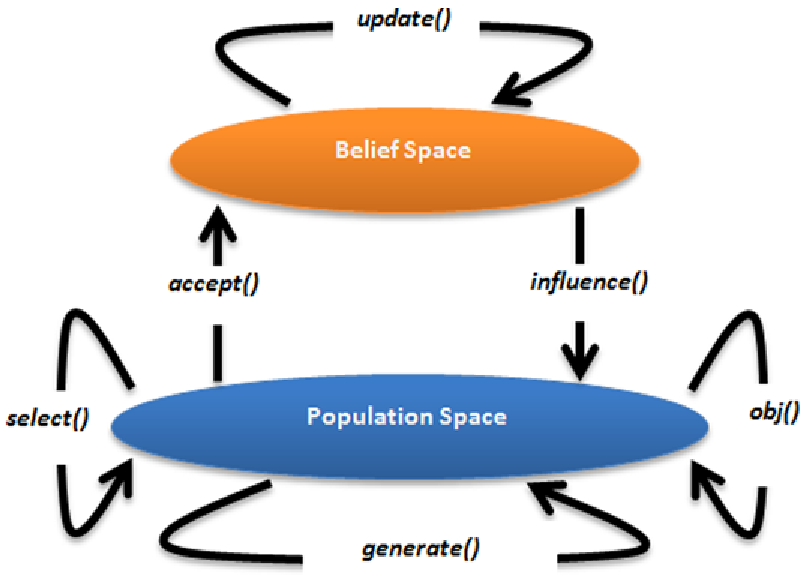
This results in "Knowledge Swarming"—where the interaction of knowledge sources in the Belief Space creates "landing strips" in the population space, effectively emulating a Branch-and-Bound algorithmic process without explicit procedural coding.
Experimental Proof: Crushing the Benchmarks
The authors pitted the ESF_CA against 24 "hard" real-world benchmark functions from the IEEE CEC2006 competition.
Key Performance Wins:
- Efficiency: In the notorious g2 problem, the ESF_CA found the best solution in 55,543 FES (Function Evaluations). Compare this to a Genetic Algorithm's 222,078 FES or the previous MVT_CA's 133,252 FES.
- Accuracy: The algorithm maintained a 100% success rate across almost all problems, even those with highly nonlinear constraints.
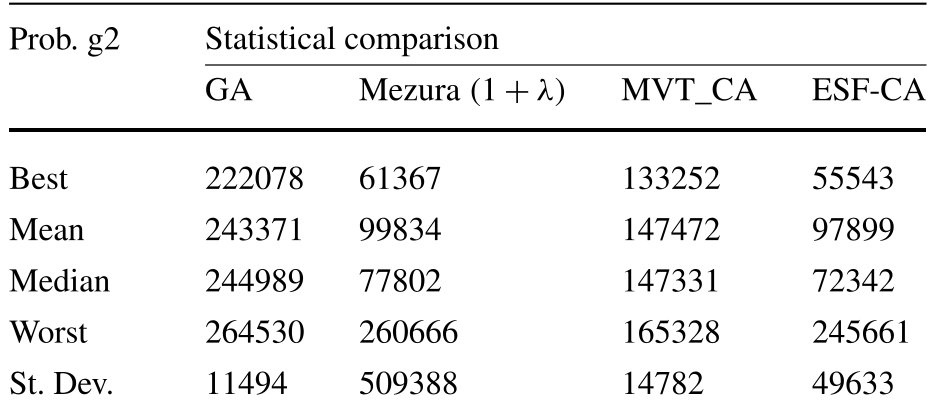 (Note the significant drop in "Best" and "Mean" FES for ESF-CA compared to competitors)
Critical Insight: The "Normal Form" of Culture
The paper posits a profound takeaway: there is a correspondence between social structure and the problem environment. The authors suggest that complex problems require complex social structures. By allowing the "social fabric" to be heterogeneous, the algorithm naturally adapts its internal communication to match the complexity of the landscape it is trying to conquer.
Limitations and Future Work
While highly effective, the "tightness of the weave" (the density of connections) can be a double-edged sword. If the weave is too tight, the system loses flexibility under stress. Future research will likely focus on self-adaptive social fabrics that can "re-weave" themselves in real-time as they detect stagnation in the search process.
Conclusion
By treating social connectivity as a first-class citizen in the algorithmic design, Ali et al. have shown that "Cultural Swarming" is more than just a metaphor—it is a powerful tool for boosting the performance of evolutionary computation in the most challenging engineering landscapes.