
Cultural Algorithms: Weaving a Social Fabric for Global Optimization
Boosting Cultural Algorithms with an incongruous layered social fabric influence function
This paper introduces an enhanced Cultural Algorithm (CA) that utilizes an "Incongruous Layered Social Fabric" influence function. By integrating heterogeneous social network topologies (e.g., ring, tree, and hybrid) with diverse knowledge sources, the method optimizes real-valued functions through "knowledge swarming," achieving successful convergence on 23 out of 24 complex CEC2006 benchmark problems.
TL;DR
Optimization in complex, constrained landscapes often requires more than just "survival of the fittest." This paper proposes a Social Fabric Influence Function for Cultural Algorithms (CA), which mimics the layered, heterogeneous nature of human society. By allowing different "knowledge sources" to compete and cooperate across various network topologies (Ring, Tree, Hybrid), the authors achieved a 2-3x efficiency gain over traditional Genetic Algorithms in standard benchmarks.
The Motivation: Moving Beyond Random Search
In nature, culture accelerates evolution. While genetic evolution relies on biological inheritance, cultural evolution uses dual inheritance: individuals pass on genes, but society passes on knowledge.
Standard Evolutionary Algorithms (EAs) often treat populations as a flat, homogeneous soup. The authors argue that this is unrealistic and inefficient. The real world consists of layered social networks where information (influence) travels differently depending on the "fabric" of the connections. The problem they set out to solve was: How can we mathematically model this social fabric to boost optimization performance?
Methodology: Weaving the Social Fabric
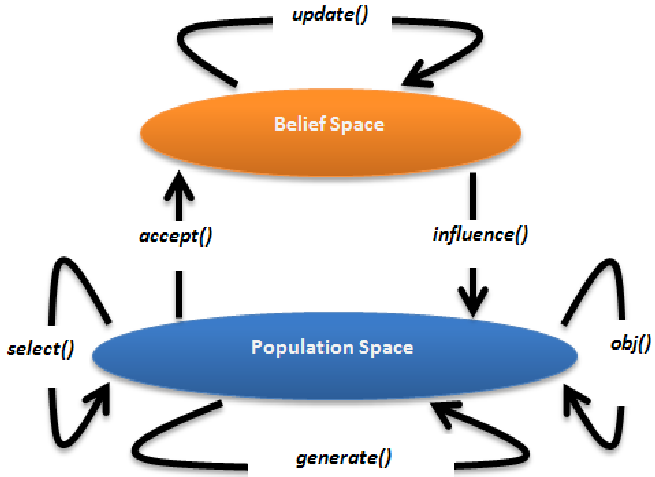
The core of this work lies in the Belief Space and the Influence Function. In a Cultural Algorithm, the Belief Space acts as a global repository for five types of knowledge:
- Normative: The "good" ranges for variables.
- Situational: Exemplary cases (the "best" solutions found so far).
- Topographical: A map of the functional landscape.
- Domain: Specific rules about the problem.
- History: Records of past search trends.
The authors' innovation is the way this knowledge reaches the individuals. They define a Social Fabric where agents are connected through various topologies, as shown in their framework:
Heterogeneous Sociometry
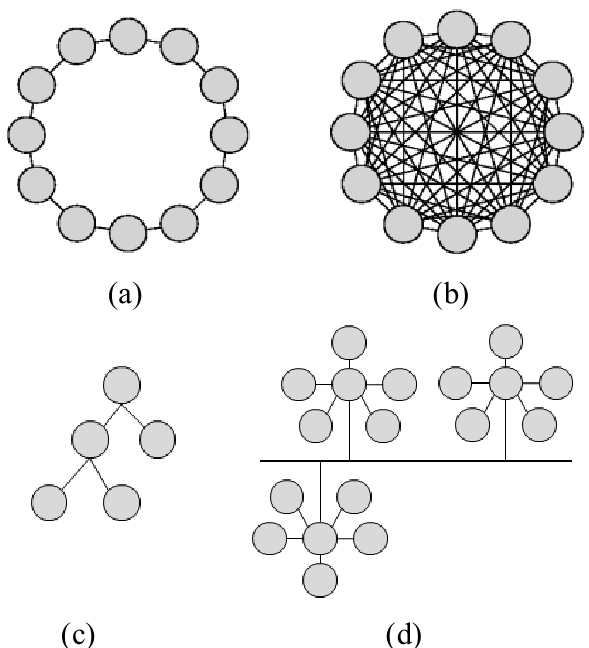
Unlike standard models that use a single topology, this paper explores:
- lBest (Ring): Local interactions for diversity.
- Tree & Hybrid Tree: Hierarchical structures for rapid information propagation.
- Update-Rule Heterogeneity: Different agents can be "explorers," "specialists," or "historians" depending on which knowledge source they prioritize.
When an individual receives conflicting signals (e.g., Normative knowledge says "go left," while Situational says "go right"), the system uses a Conflict Resolution mechanism (like MFU - Most Frequently Used) to decide the final move.
Experiments and SOTA Comparison
The researchers put their ESF_CA to the test against 24 rigorous CEC2006 benchmark problems. The results were impressive. In many cases, the algorithm found the exact global optimum (error ) with fewer function evaluations (FES) than its predecessors.
The most telling result involves Problem g2, a notoriously difficult test case. The ESF_CA version significantly reduced the number of evaluations required to reach the target accuracy compared to both standard Genetic Algorithms and older CA variants.
Performance Summary (Problem g2):
| Algorithm | Median FES (lower is better) | Best FES |
|---|---|---|
| Genetic Algorithm (GA) | 244,989 | 222,078 |
| MVT_CA (Prior Work) | 147,331 | 133,252 |
| ESF-CA (This Work) | 72,342 | 55,543 |
Critical Insight: Matching Structure to Environment
The "Takeaway" of this paper is profound: Social structure is a computational tool.
The authors demonstrated that there isn't a "one-size-fits-all" network topology. For simple landscapes, complex social fabrics might be overkill. However, for rugged, constrained "real-world" problems, the heterogeneous layered approach prevents the population from getting stuck in local optima. It creates a "Natural Form" for computational cultures.
Limitations & Future Work
While the results are strong, the paper notes that for specific problems (like g20), even this advanced CA struggled to find perfectly feasible solutions initially. The future of this field lies in adaptive social structures—where the network topology itself evolves in real-time to match the shifting challenges of the optimization landscape.
Conclusion
By treating influence as a multi-layered signal propagating through a structured social network, Ali et al. have successfully "boosted" the intelligence of evolutionary agents. This work transcends simple optimization, offering a window into how complex social interactions might have evolved to solve the most difficult survival "problems" in biology.