
Boosting Social Vitality: Maximizing Activity Probability via Smart Recommendations
Boosting node activity by recommendations in social networks
The paper introduces the Activity Probability Maximization Problem (APMP), which aims to select edges for recommendation to maximize the overall activation probability of nodes in a social network. The authors propose the "Semi-Sandwich" framework and the Difference Minimizing Greedy (DMG) algorithm to solve this non-submodular optimization problem with high efficiency.
TL;DR
Information propagation in social networks isn't just about who starts the conversation (seeds), but how the network is "wired." This paper tackles the Activity Probability Maximization Problem (APMP)—choosing new edges to add to a network to make everyone more likely to be active. By proving a unique symmetry between mathematical bounds, the authors developed a Semi-Sandwich framework that is faster and more accurate than previous SOTA methods.
The Hidden Complexity: Why "Adding Edges" is Hard
Most social network optimizations rely on "Submodularity"—a property of diminishing returns. If a function is submodular, a simple greedy algorithm can get us close to the global optimum.
However, Activity Probability is non-submodular. When you add an edge, it doesn't just help one node; it can trigger a "connectivity explosion" where the number of possible propagation paths increases exponentially. This makes finding the best edges an NP-hard nightmare. Previous attempts (like the RMPP model) tried to simplify this by only looking at the "strongest" path, but this ignored too much data, leading to suboptimal recommendations.
Methodology: The Breakthrough of Symmetry
The authors' core "Aha!" moment comes from the Marginal Increment. They found a way to "freeze" the neighbor growth in the mathematical formulation to create a submodular lower bound and an upper bound.
1. The Power of Recursive Probability
Instead of simulating millions of random walks, the paper uses a recursive formula to calculate how a single new edge affects the entire network.
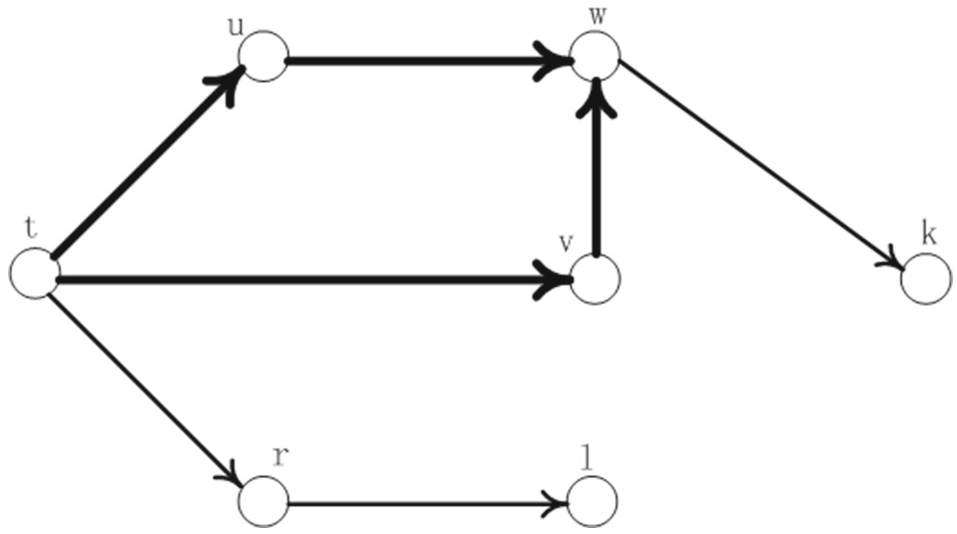 Figure 1: Illustration of multi-channel propagation where the marginal probability is calculated independent of order.
2. The Semi-Sandwich Strategy
In typical non-submodular optimization, you solve for the lower bound and the upper bound separately (The Sandwich Framework). This paper proves a stunning theorem: The optimal solution for the lower bound is the same as the optimal solution for the upper bound.
This allows the authors to ignore one side of the computation, leading to the Semi-Sandwich framework. To further refine this, they introduced the Difference Minimizing Greedy (DMG) algorithm, which picks edges that keep the original function as close to these bounds as possible.
Experimental Results: Squeezing the Gap
The researchers tested their DMG algorithm against the previous benchmark, MIS.
SOTA Comparison
In tests on the Wiki-Vote and Facebook datasets, the "gap" (the distance between what we think is the best and the mathematical maximum) was squeezed significantly.
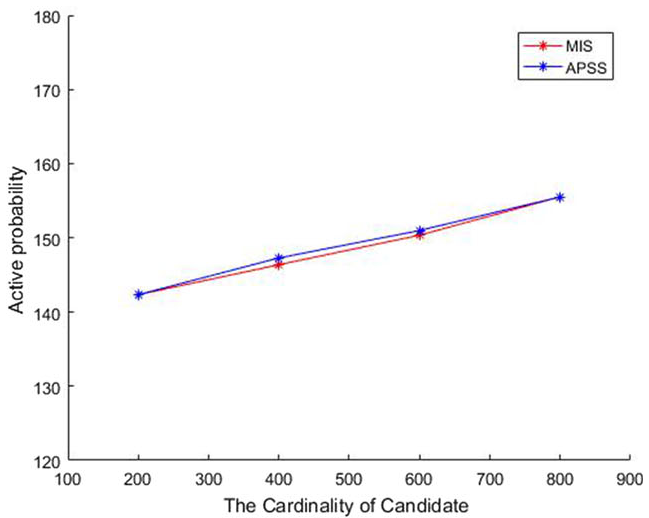 Figure 2: APSS (red) consistently maintains higher activity probabilities than the MIS baseline across various candidate set sizes.
Key Metrics:
- Relative Difference: The gap between the upper and lower bounds was reduced to <3% on Wiki-Vote and <0.1% on Facebook.
- Efficiency: Since they only solve one bound instead of two, they reduced the computation time by 33.3% compared to the full Sandwich method.
Critical Insight: Real-World Impact
This isn't just theoretical math. For platforms like Twitter or LinkedIn, "Friend Suggestions" are often based on simple heuristics (like mutual friends). This paper provides a rigorous mathematical framework to recommend edges that maximize the health of the entire ecosystem, ensuring information flows more freely and nodes remain "active" longer.
Limitations & Future Paths
The current model assumes a Directed Acyclic Graph (DAG). While the authors proposed a workaround for cycles (calculating only once), a truly robust solution for loopy networks remains an open challenge. Additionally, the transition from General Threshold to General Cascade models suggests that "weights" of influence are just as important as the connections themselves.
Conclusion
By leveraging the symmetry of submodular bounds, this paper transforms a daunting non-submodular problem into a manageable greedy optimization. It stands as a significant contribution to the field of network science and recommendation algorithms.