
Boosting Social Network Connectivity with Link Revival: Why Old Friends are the Key to Network Health
Boosting social network connectivity with link revival
The paper introduces "Link Revival," a novel recommendation task aimed at boosting social network connectivity by encouraging users to reconnect with existing but inactive friends. The authors propose a graph prediction-based strategy using Non-homogeneous Poisson Processes and the Hurst exponent to capture second-order self-similarity in communication temporal patterns.
TL;DR
Unlike traditional friend recommendation systems that suggest strangers, this paper proposes Link Revival: a system that identifies "lost" friends worth reconnecting with. By leveraging Non-homogeneous Poisson Processes and the Hurst exponent, the authors predict who you are likely to respond to, resulting in a massive 14x boost in connectivity for platforms like Facebook.
Problem & Motivation: The "Low-Connectivity" Trap
In modern social networks, we suffer from an "expansion bias." Platforms constantly push new connections (strangers), but our cognitive energy is finite. This leads to a fragmented network where many existing links go "cold."
The authors argue that a well-connected network relies on active interactions, not just static follower counts. The challenge is: Who do we recommend?
- The "least interacted" friend? (Likely someone you don't care about).
- The "most popular" friend? (Redundant; you probably talk to them anyway).
- The Insight: The ideal candidate is someone currently inactive but likely to respond based on their historical "bursty" patterns.
Methodology: Capturing the "Pulse" of Interaction
The core innovation lies in treating communication not as a static state, but as a non-stationary temporal process.
1. Categorizing Link Trends
The authors identified three types of friends:
- Rare: Low interaction, likely weak ties.
- Constant: Regular talkers (no need for revival).
- Bursty: The "sweet spot." Their interactions are event-driven and show spike patterns.
2. The Math of Memory: Non-homogeneous Poisson & Hurst
To predict future interactions (), the authors used:
- Non-homogeneous Poisson Process: Models a rate that varies over time.
- Hurst Exponent (H): A metric from fractal geometry ().
- If , the link has "long-range dependency"—meaning if you were active in bursts before, you'll likely be active again.
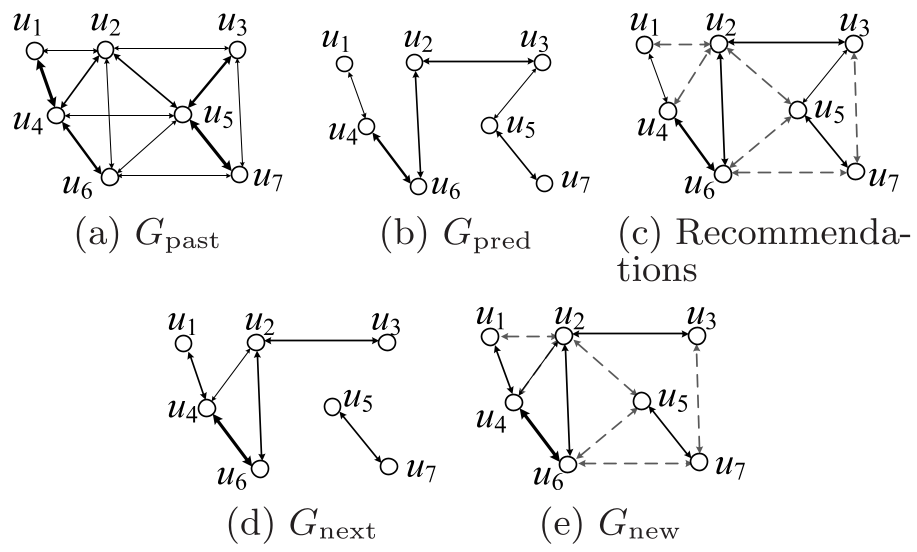
The final prediction uses a Regression Model that combines these temporal insights with topological features like Jaccard coefficients and mutual friend counts.
Experiments: Facebook vs. Phone Calls
The researchers tested their model on a massive Phone Call dataset (200k users) and a Facebook dataset.
Key Findings:
- Social "Memory": Facebook interactions have higher Hurst values than phone calls. Why? Because text on a wall is "free" and persistent, while phone calls have higher marginal costs and fade from memory faster.
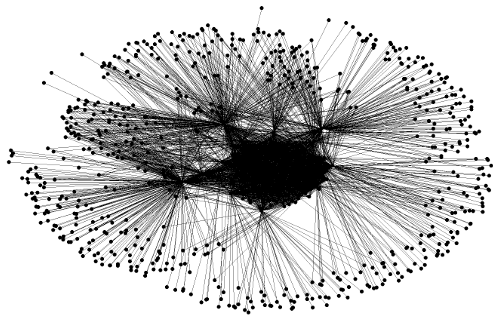
- Connectivity Gains: The "H+F" (Hurst + Features) model achieved a 1400% increase in clustering coefficients on Facebook compared to the original graph.
Deep Insight & Conclusion
The "Link Revival" problem shifts the focus from Growth to Retention. By mathematically identifying which latent relationships are "prime" for reactivation, platforms can significantly improve information propagation without the awkwardness of stranger-recommendations.
Limitations: The paper assumes a 100% adoption rate (i.e., if the system recommends a friend, the user will message them). In the real world, the "social friction" of reaching out to someone you haven't talked to in years is high, and future work would need to account for this psychological barrier.
Future Outlook: This approach is a precursor to modern "re-engagement" algorithms. In the age of AI, these models could be enhanced with LLMs to suggest the actual content of the reconnection message, further lowering the barrier to link revival.