
APFEL: Bootstrapping Ontology Alignment with Machine Learning
Bootstrapping Ontology Alignment Methods with APFEL
APFEL (Alignment Process Feature Estimation and Learning) is a machine learning-based bootstrapping approach for semi-automatic ontology alignment. It automates the configuration of alignment strategies by learning optimal weights and thresholds from user-validated initial alignments, significantly outperforming manually tuned methods like QOM.
TL;DR
The challenge of connecting disparate ontologies—"Ontology Alignment"—has long relied on hand-crafted rules or sparse instance data. APFEL (Alignment Process Feature Estimation and Learning) breaks this bottleneck by using a machine learning bootstrapping approach. It takes a "mediocre" initial alignment, asks a human to validate it, and then learns a high-performance, domain-specific alignment strategy that outperforms human-engineered methods.
Background: The Alignment Paradox
In the Semantic Web, interoperability is the holy grail. To let two systems talk, we must map o1:Daimler in one ontology to o2:Mercedes in another.
Traditionally, researchers faced a binary choice:
- Manual Heuristics: Experts guess weights for labels, hierarchies, and relations. (Fragile and hard to scale).
- Instance-based Learning: Matching based on shared documents or data points. (Fails when ontologies have few instances).
APFEL bridges this gap by focusing on the Parameterizable Alignment Method (PAM)—a framework where the alignment process itself is the object of optimization.
The Problem & Motivation
Why is this hard? Because "similarity" is context-dependent. In a travel ontology, a "River" might be similar to a "Stream" based on their taxonomic parents. In a bibliographic database, "Last Name" is infinitely more important than "Middle Initial."
The authors observed that even the best systems like QOM or PROMPT are essentially black boxes where the internal logic (weights and thresholds) is static. APFEL’s insight is to treat these internal parameters as variables to be learned from a "live" feedback loop.
Methodology: The APFEL Core
APFEL operates on a six-step generic process: Feature Engineering, Search Selection, Similarity Assessment, Aggregation, Interpretation, and Iteration.
The Bootstrapping Loop
- Selection: Start with a naive strategy (e.g., simple label matching).
- Initial Alignments: The system produces a candidate list.
- User Validation: A human marks candidates as "Correct" or "Incorrect."
- Hypothesis Generation: APFEL generates hundreds of potential feature-similarity combinations (e.g., "Is the string length of the label equal?").
- Learning: A Decision Tree (C4.5) analyzes the validated data to find which of these hypotheses actually correlate with reality.
 Figure 1: The six main steps of the generic alignment process used as the foundation for APFEL.
Feature Estimation
The "Secret Sauce" is Feature Estimation. APFEL examines both ontologies to find "overlapping" attributes (like OWL primitives or XML datatypes) and automatically creates similarity tests for them. It doesn't matter if some hypotheses are useless; the machine learner will simply assign them a weight of zero.
Experiments & Results
The authors tested APFEL in two scenarios: a "General" Russia-travel dataset and a "Specific" Bibliographic domain.
- Versus Manual (QOM): In the Russia scenario, APFEL achieved a superior F-Measure by identifying that "Domain and Range" features were more predictive than "Sub-classes"—an insight human engineers had missed.
- Domain Optimization: In the Bibliographic test, APFEL learned that
last_namewas a critical anchor, boosting performance significantly over general-purpose algorithms.
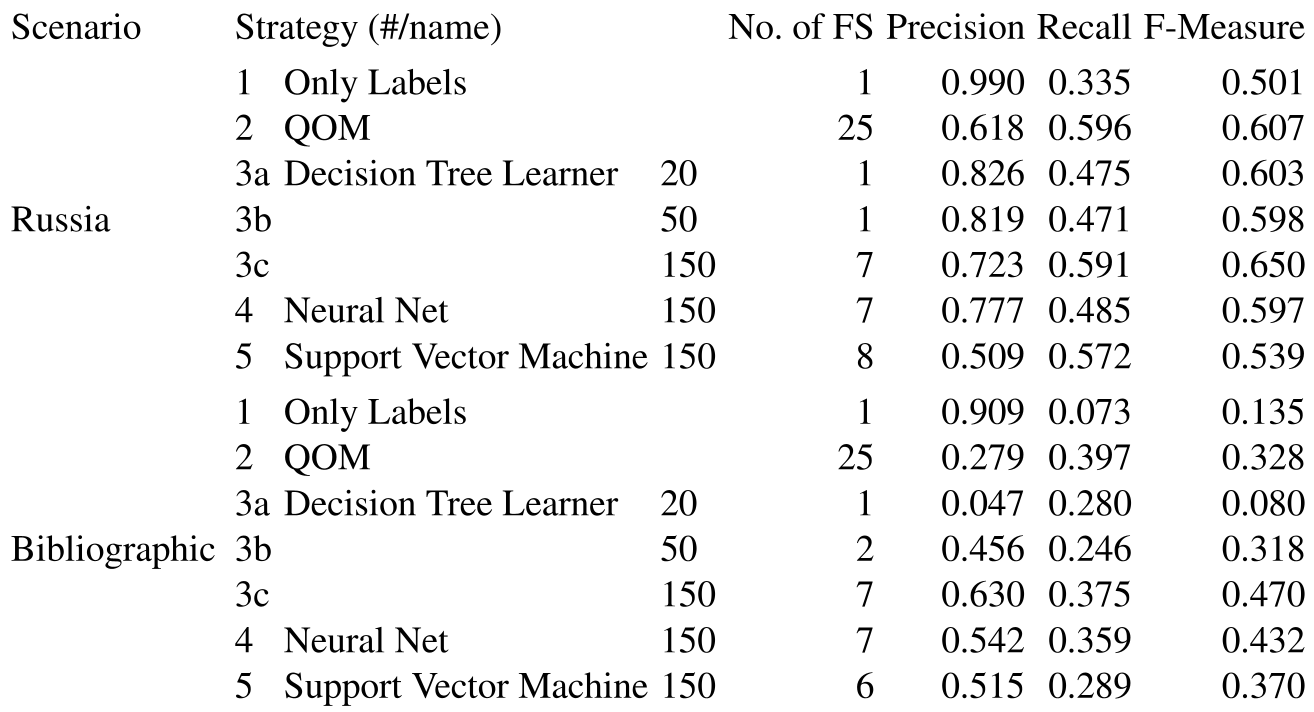 Table 1: Comparative results showing APFEL (Strategies 3-5) outperforming Only Labels (Strategy 1) and QOM (Strategy 2).
Critical Analysis & Conclusion
Takeaway
APFEL proves that meta-learning—learning the configuration of the alignment process—is more effective than manually designing the process. It successfully fuses intensional (schema) and extensional (data) indicators into a single optimized model.
Limitations
- Cold Start: The method still requires a "human-in-the-loop" for the initial validation.
- Data Volume: The authors noted that accuracy "levels off" and requires a significant number of training examples (150+) to truly capture complex semantic value.
Future Outlook
As ontologies grow into massive Knowledge Graphs, the APFEL philosophy of "Feature Generation + Automated Selection" is more relevant than ever. Future iterations could replace the C4.5 decision tree with Graph Neural Networks (GNNs) to automatically capture the "Iterative" structural propagation step that APFEL currently handles via hard-coded cycles.