
Bot Hunter: Increasing the Cost of Deception with Network Topology
Bot Conversations are Different: Leveraging Network Metrics for Bot Detection in Twitter
This paper introduces BotHunter, a tiered bot detection framework for Twitter that leverages "Tier 3" data—rich network metrics derived from two-hop snowball sampling. By analyzing conversational ego-networks rather than just profile metadata, the authors achieve high-accuracy detection capable of identifying sophisticated "hybrid" accounts and state-sponsored bot networks.
TL;DR
Researchers from Carnegie Mellon University have developed a multi-tiered framework called BotHunter that moves beyond surface-level profile analysis. By using two-hop snowball sampling to map the "conversational ego-networks" of Twitter accounts, they’ve identified that human interactions possess a structural depth and connectivity—such as Simmelian ties—that bots struggle to replicate. This approach turns the detection process into a structural analysis, making it significantly harder for malicious actors to hide.
The Evolution of the "Cat and Mouse" Game
The "marketplace of ideas" on social media is increasingly polluted by automated agents. While early bots were simple spam-bots with nonsensical names and rigid timing, modern "social bots" or hybrid accounts are sophisticated. They use human intervention for nuanced messaging while computer algorithms manage scale.
The authors argue that we must move from Tier 1 (Metadata) and Tier 2 (Timeline) data to Tier 3 (Network Patterns). The core insight is simple yet profound: Bot conversations are structurally different. Humans are part of interconnected "real-world" communities; bots typically exist in fragmented, artificial clusters.
Methodology: The 2-Hop Snowball
To capture this difference without hitting Twitter's strict API limits, the authors designed a specific sampling strategy. Instead of just looking at who a bot follows (which is easily faked), they look at the Follower's Timeline.
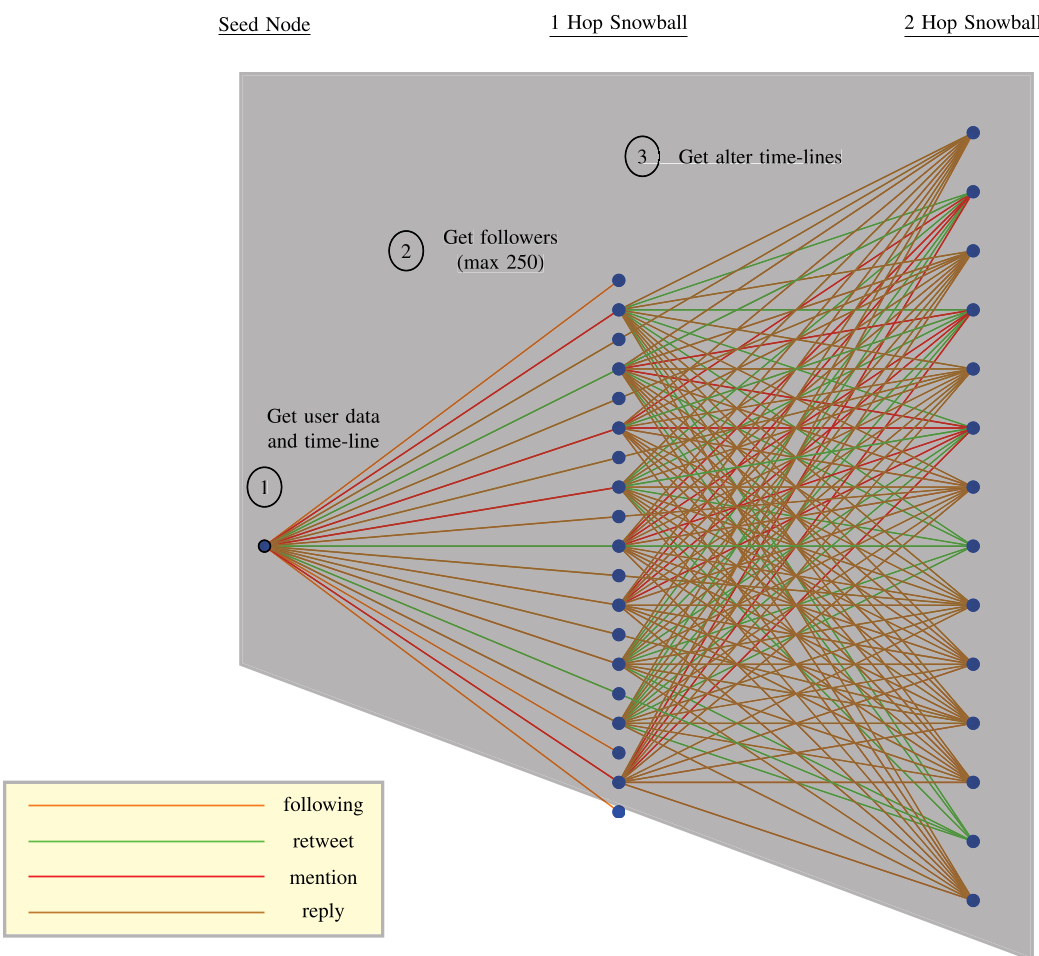
- Seed Selection: Start with the target account.
- Hop 1: Collect up to 250 followers.
- Hop 2: Collect the timelines of those followers.
- Graph Construction: Build an agent-to-agent network based on mentions, replies, and retweets.
This creates a rich graph of ~50,000 events. By excluding "follow" links and focusing only on "conversational" links, the team can see if the account is participating in a genuine social fabric or just shouting into an algorithmic void.
Human vs. Bot: A Visual Contrast
The most striking evidence of this theory comes from the visualization of the ego-networks.
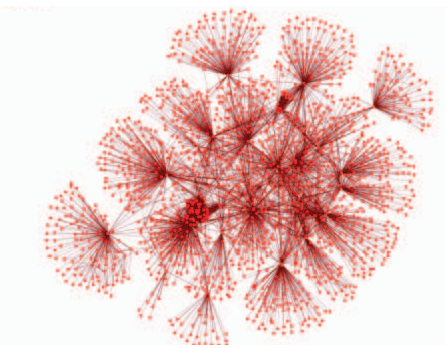
- Human Networks: Highly connected, dense with "Triadic Closure" (friends of friends talking to each other).
- Bot Networks: Highly fragmented. Followers of a bot often have no secondary connection to each other, resulting in a "star" pattern or isolated nodes.
Key Performance Metrics
The researchers tested their Random Forest model across diverse datasets, including the "Texas A&M Honeypot" and specific NATO-targeted bot attacks.
- Tier 3 Superiority: For the NATO dataset, Tier 3 metrics achieved a Precision of 0.973, significantly outperforming baseline metadata models.
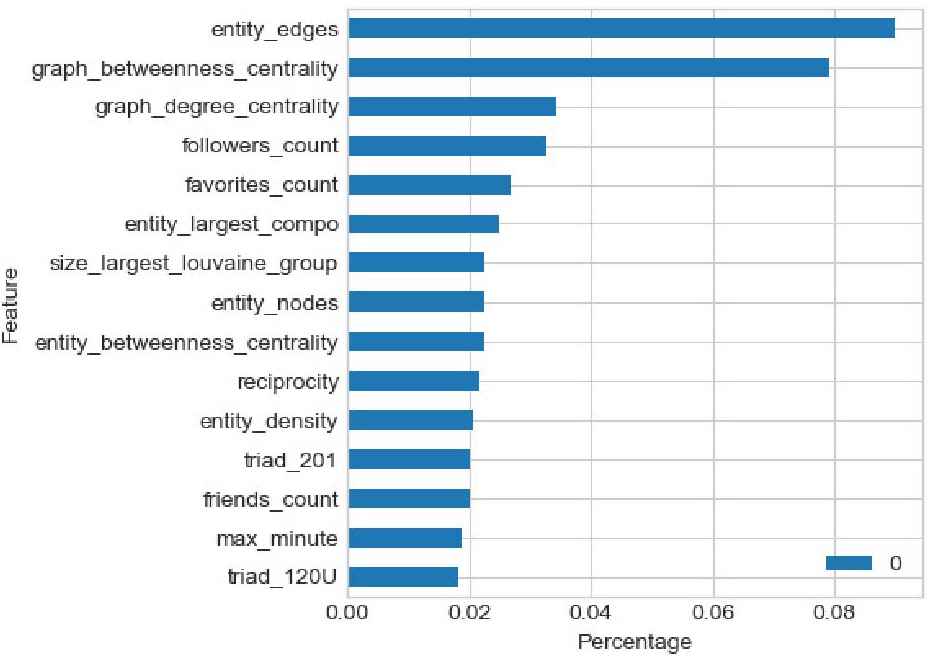
- Feature Importance: The most critical feature was Graph Betweenness Centrality. This measures how often a node acts as a bridge along the shortest path between two other nodes. In human networks, bridging is organic; in bot networks, it is often non-existent or heavily forced.
Deep Insight: Why This Matters
The value of this research isn't just a higher accuracy score; it's the Inductive Bias it introduces. Bot-herders can easily change a screen name or buy 1,000 followers. However, to spoof a Tier 3 network, they would need to:
- Ensure their 1,000 followers actually talk to one another.
- Create complex triadic relationships that mimic human "Simmelian ties."
- Maintain these patterns over time without falling into algorithmic traps.
This significantly increases the cost of deployment, potentially pricing malicious actors out of the market.
Limitations & Future Work
The primary drawback is speed. A Tier 3 collection takes roughly 20 hours for 250 accounts if done strictly (though the authors optimized this to ~5 minutes for specific sub-samples). Furthermore, the models showed a drop in performance when trained on one type of bot (e.g., spammers) and tested on another (e.g., political propagandists), highlighting that there is no "Universal Bot Signature."
In the evolving landscape of Social Cyber-security, BotHunter provides the infrastructure needed to protect the integrity of digital discourse by looking at the very shape of our social ties.