
Viral Cheating: Modeling Game Bot Diffusion in MMORPGs
Modeling of bot usage diffusion across social networks in MMORPGs
This paper presents a probabilistic diffusion model to track and predict the spread of game bot usage in the MMORPG AION. By adapting the Independent Cascade Model (ICM) and utilizing Expectation-Maximization (EM), the authors demonstrate that malicious behavior spreads via social contagion across party and guild networks.
TL;DR
Botting is not just a technical problem; it’s a social epidemic. This research analyzes data from the MMORPG AION to prove that game bot usage spreads through social contagion. Using a modified Independent Cascade Model (ICM), the study reveals that players are significantly more likely to start cheating if their "Party Play" teammates are already doing it—essentially catching the "cheating bug" from their social circle.
The Motivation: Beyond Log Analysis
For decades, game companies have played a cat-and-mouse game with bot developers. Most detection methods are reactive, focusing on whether a player’s movement is too robotic or their click-rate is inhumanly consistent.
However, this paper addresses the "Why": What makes a normal player cross the line? The authors hypothesize that social influence creates a sense of "relative deprivation." When you see your friends leveling up faster using bots, the behavior becomes normalized. This transition from a "fair player" to a "bot user" follows the mathematical patterns of a viral outbreak.
Methodology: The Independent Cascade Model (ICM)
The researchers treat bot adoption as an innovation (or a virus) spreading through two types of social structures:
- Party Play Networks: Temporal, high-intensity groups (up to 6 players) performing specific tasks.
- Guild Networks: Long-term, persistent communities.
The Math of Contagion
The authors use an adapted Independent Cascade Model. In a standard ICM, an infected node has one shot at infecting its neighbors. However, a bot user remains "infectious" as long as they continue using the bot. They utilized the Expectation-Maximization (EM) algorithm to calculate the diffusion probability (), which represents the likelihood of user influencing user to start botting.
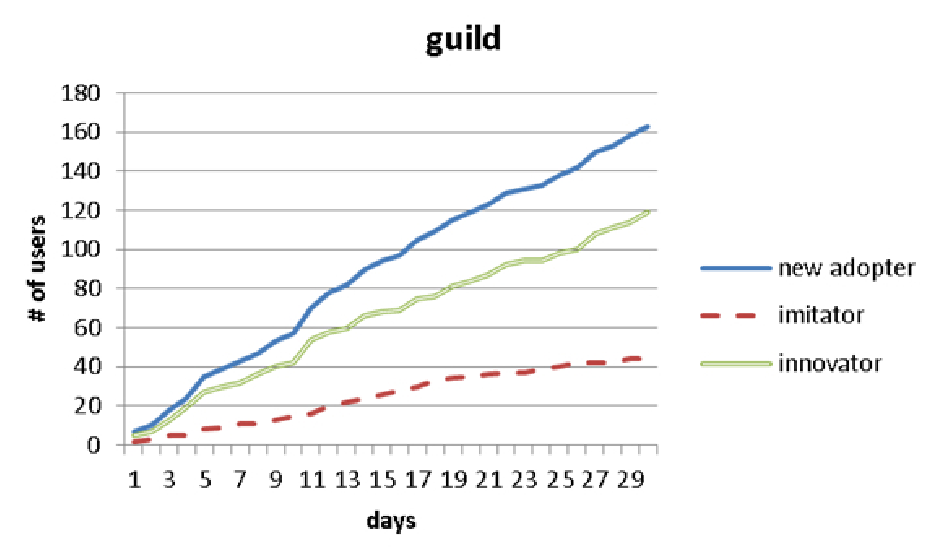 Figure 1: Cumulative curves showing the growth of new bot adopters, distinguishing between 'Innovators' (self-starters) and 'Imitators' (those influenced by peers).
Key Insights: Strong Ties vs. Weak Ties
The study challenges the common "strength of weak ties" theory often applied to information diffusion. While a rumor might spread best through casual acquaintances (weak ties), risky or controversial behavior (like cheating) requires the validation of strong ties.
- Party Play (Stronger Ties): Diffusion probability of 0.19. The intense, repetitive nature of party play creates a high-pressure environment where botting behavior is easily observed and mirrored.
- Guilds (Weaker Ties): Diffusion probability of 0.10. While guilds are persistent, the social pressure to adopt a specific bot is lower than in the immediate proximity of a party.
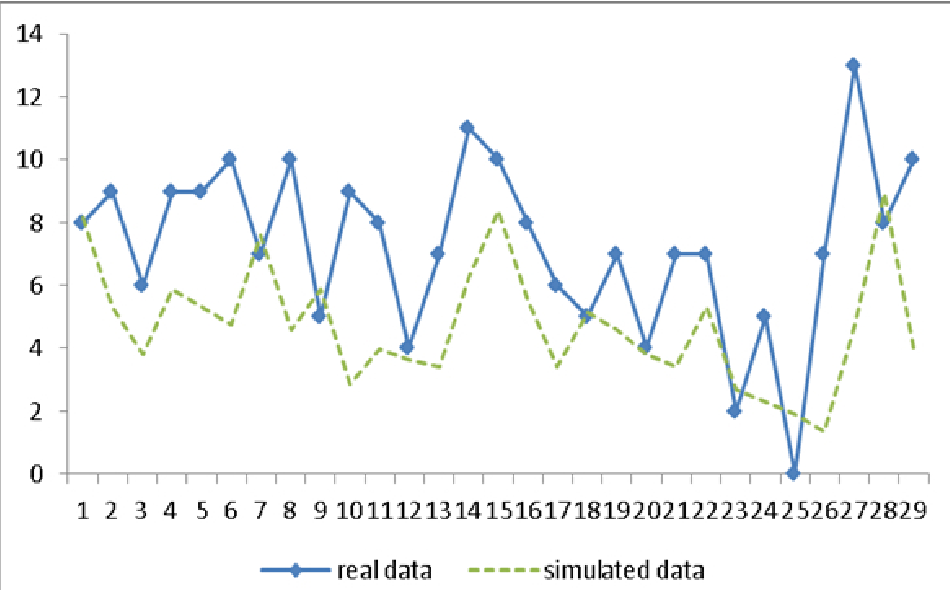 Figure 2: The model's predicted cumulative imitators (dashed line) closely follows the actual observed data (solid line), validating the diffusion approach.
Critical Analysis: A Shift in Anti-Cheat Strategy
The true value of this paper lies in its predictive potential. If a game's security system identifies one bot user in a highly active party, the system should not just ban that user; it should increase the "suspicion score" for every other member of that party.
Limitations
- Tie-Strength Definition: The paper defines tie-strength somewhat intuitively. Future work could use operational measures like chat frequency or trade volume to quantify "closeness" more accurately.
- The "Innovator" Mystery: Only ~10% of new bot users were classified as imitators. This suggests that while social contagion is real, many users seek out bots independently via external forums or advertisements, which the internal social graph cannot capture.
Conclusion
This research proves that "cheating is contagious." By modeling the diffusion of game bots, developers can move from simple pattern recognition to predictive social monitoring. Understanding the social graph allows companies to intervene before a small cluster of bot users infects an entire community, potentially saving the game's economy and player retention.