
A Bottom-Up Evolution: Scaling Job Recommendations via Gradient Boosting
A bottom-up approach to job recommendation system
This paper presents a "bottom-up" job recommendation system developed for the ACM RecSys 2016 Challenge (XING dataset). The authors evolve their approach from basic data exploration to a sophisticated ensemble model, ultimately achieving SOTA-level performance with a Gradient Boosting algorithm that reached a final score of over 1.4 million.
TL;DR
In the high-stakes environment of the ACM RecSys 2016 Challenge, team "Falcon" from UCLA developed a robust job recommendation engine for XING. By moving from raw data "Impressions" to a sophisticated Gradient Boosting ensemble, they tackled the dual challenges of data sparsity and massive scale, ultimately securing a top-20 global ranking.
Background: The professional Social Graph
Job recommendation is fundamentally different from recommending movies or products. A "click" isn't just interest; it’s a career move. This paper explores the XING ecosystem, involving 1.5M users and 1.3M job items. The authors argue that a bottom-up approach—starting with data intuition before moving to complex modeling—is the only way to build a system that actually works in production.
The Problem: Why Traditional CF Fails
Traditional Collaborative Filtering (CF) relies on finding "neighbors." In a dataset with 8M interactions spread across millions of entities, the matrix is too sparse. Furthermore:
- Computational Cost: Calculating a 1M x 1M similarity matrix is , which is intractable.
- Gray Sheep Behavior: Professional users often seek roles outside their historical patterns (e.g., a CS student moving into Music tech), which pure CF cannot predict.
Methodology: The "Falcon" Architecture
The authors solved scalability by hybridizing clustering with similarity. Instead of searching all users, they first clustered users into groups using K-Means and then applied Cosine Similarity only within those clusters.
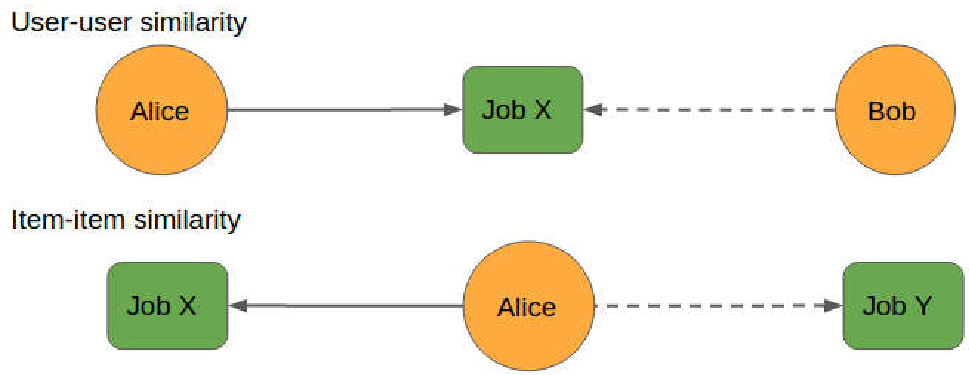
The Scoring Function
To move beyond simple similarity, they designed a weighted scoring function that accounts for:
- Impression Frequency: How often has the user seen this?
- Interaction Score: Past bookmarks or applications (weighted heavily, ).
- Attribute Match: Overlaps in Career Level, Industry, Discipline, and Region.
The final "Brain" of the system was a Gradient Boosting Machine (GBM) trained with an extended feature set of over 200 variables, using Random Forests to impute missing career level data.
Experiments and Performance
The progression of results demonstrates how each layer of complexity added tangible value. While pure CF (User-User similarity) performed poorly (Score: 85k), the inclusion of domain-specific heuristics and learned weights via Linear Regression and GBM catapulted the score to over 473k on the leaderboard.
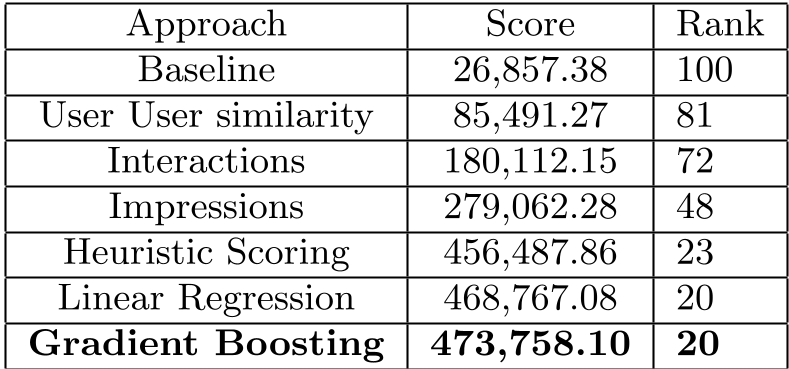
Key hyperparameters for the winning GBM model included:
- Number of Trees: 500
- Shrinkage (Learning Rate): 0.1
- Interaction Depth: 7
Critical Analysis & Conclusion
The success of the "Falcon" team highlights a critical industry lesson: Feature Engineering and Data Imputation are often more important than the choice of model. By recognizing that many users had missing career levels and using Random Forests to fill those gaps, the authors provided the GBM with a much cleaner signal.
Limitations: The model struggles with temporal "session" logic. It treats a user's history as a static bag of features rather than a sequential journey. Future Outlook: Integrating Temporal Activity Analysis (as mentioned in their future work) and moving toward Deep Sequential Models (like GRU4Rec or Transformers) would be the logical next step for this "bottom-up" pipeline.
Takeaway
If you are building a recommendation system for a large-scale platform today, start with the data (Bottom-Up). Use heuristics to find your baseline, then apply ensemble methods like Gradient Boosting to capture the non-linear nuances that simple similarity metrics miss.