
This paper introduces a scalable geometric quantization framework to study anyon interactions and bound states within the anyon Hilbert space. Applying this to Laughlin quasiholes ($ν=1/3$), the authors demonstrate that these anyons form multi-charge bound states (2e/3, e, etc.) when Coulomb interactions are screened, achieving precise agreement with Exact Diagonalization (ED) while reaching the thermodynamic limit.
TL;DR
Researchers at Harvard have developed a new "Anyon-First" computational framework using geometric quantization to solve the mystery of anyon binding. They discovered that Laughlin quasiholes, long thought to be mutually repulsive, actually form bound states when interactions are screened. This effect is not electrostatic but is purely driven by the quantum geometry (Berry phase) of the anyon Hilbert space.
Background: The Limits of "Black Box" Numerics
In the world of the Fractional Quantum Hall Effect (FQHE), we usually study anyons—quasiparticles with fractional charge—by looking at the total electron system. However, methods like Exact Diagonalization (ED) are crippled by exponential scaling; as you add electrons, the Hilbert space explodes.
More importantly, these methods don't explain why things happen. If you have two quasiholes that both have positive charges and live in a repulsive Coulomb environment, your intuition says they should fly apart. Yet, recent experiments on twisted $MoTe_2$ and shot-noise measurements hint at "clusters" of charge. This paper bridges that gap by looking through the lens of Kähler Geometry.
Methodology: Projecting into the Anyon Manifold
Instead of tracking $N_e$ electrons, the authors work directly with $N_h$ anyon coordinates $ξ$. The magic happens in two parts:
- The Kähler Potential ($K$): This encodes the overlap of anyon wavefunctions and their Berry phase. It defines the "metric" of the space they live in.
- The Effective Potential ($V$): This captures the electrostatic energy.
By using Geometric Quantization (Berezin-Toeplitz), they treat the anyon coordinates as operators. The resulting Hamiltonian acts on a space of symmetric polynomials, turning a massive many-electron problem into a elegant few-body problem that can be solved in the thermodynamic limit using Monte Carlo.
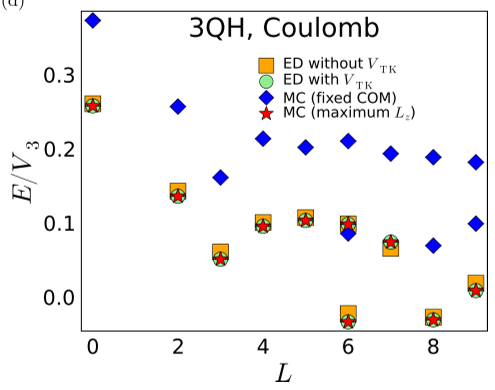 Fig 1: The Effective Potential (b) is purely repulsive, yet the resulting Energy Spectrum (a) shows a negative "dip" at L=2, indicating a bound state.
The "Invisible" Attraction: A Berry Phase Effect
The most striking insight is the origin of the bound state. In classical physics, if a potential $U(r)$ is monotonically decreasing, there is no binding. But here, the anyons "feel" an effective magnetic field (Berry curvature) that varies with their separation.
The authors show that the quantum theory probes oscillations in the anyon density profile at the scale of the magnetic length $\ell_B$. These oscillations are "washed out" in the classical potential but create an attractive channel in the quantum Hamiltonian. It's a purely quantum mechanical binding—like a signature of the underlying topological order manifesting as physical attraction.
Experimental Results & Phase Diagram
The team mapped out what happens as you change the screening length $λ$ (the distance at which the repulstion is cut off):
- Large $λ$: Anyons are free regulated $e/3$ charges.
- Intermediate $λ$: Anyons pair up into $2e/3$ molecules.
- Small $λ$: Anyons form $e$, $4e/3$, or even $2e$ droplets.
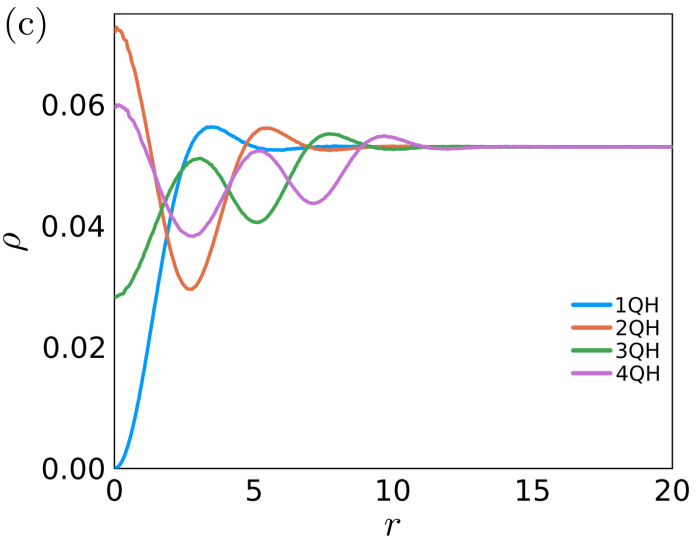 Fig 2: The evolution of bound states for 3 and 4 anyons. Note how the "Pairwise Approximation" (solid lines) matches the "Exact" Monte Carlo (dots) perfectly for low-energy states.
Why This Matters: From STM to Superconductivity
This isn't just theory. With the rise of Scanning Tunneling Microscopy (STM), we can now "image" these charge profiles. A bound state would look like a characteristic charge ring rather than a single dip in the electron density.
Furthermore, this explains the "Anyon Superconductivity" seen in MoTe2. If anyons can bind into pairs (like Cooper pairs), they can condense into a superconducting state. This paper provides the first controlled, microscopic "recipe" for how and when that happens.
Conclusion
By moving the description of the problem from the "Electron Hilbert Space" to the "Anyon Manifold," the authors have turned a computational nightmare into a geometric playground. They’ve proven that in the fractional world, your eyes (and classical potentials) can deceive you—topology and Berry phases can turn even the strongest repulsion into a tight bond.