
BPMN Task Instance Streaming: Breaking the Atomicity Bottleneck in Crowdsourcing
BPMN Task Instance Streaming for Efficient Micro-task Crowdsourcing Processes
The paper introduces an extension to the BPMN standard to support Micro-task Instance Streaming, enabling the parallel execution of thousands of crowd tasks. By introducing a new Crowd Task type and a Streaming Connector, the authors allow completed task instances to trigger downstream activities without waiting for the entire batch to finish, significantly reducing overall process latency.
TL;DR
Standard business processes (BPMN) are too slow for the "Crowd" because they wait for everyone to finish before moving to the next step. This paper introduces a Streaming Connector that lets tasks flow like a river: as soon as one worker finishes a micro-task, the next task in the pipeline starts immediately. In experiments, this moved 90% of work through a three-stage pipeline in the time it usually takes to finish just the first stage.
The "All-or-Nothing" Problem
BPMN (Business Process Model and Notation) was designed for office automation. In that world, a task is atomic—it starts, it runs, and it ends. If you have a "Multi-Instance" task (like asking 100 people to transcribe receipts), BPMN semantics dictate that the process only moves forward once the 100th person hits submit.
In crowdsourcing, this is a disaster for efficiency. If 99 workers finish in 5 minutes but 1 worker takes an hour, your entire organizational pipeline is stalled for 55 minutes. This lack of transparency into "in-flight" work prevents the massive parallelization that makes crowdsourcing powerful.
Methodology: Streaming and Transformation
The authors solve this by extending BPMN with two primary constructs:
- The Crowd Task: A specialized task type that talks to platforms like CrowdFlower/MTurk and understands that it contains many sub-instances.
- The Streaming Connector: Instead of a "Done" signal, this connector carries data as it's produced.
The Core Architecture
The system uses a middleware to bridge the gap between the BPMN engine (Activiti) and the Crowdsourcing platform.
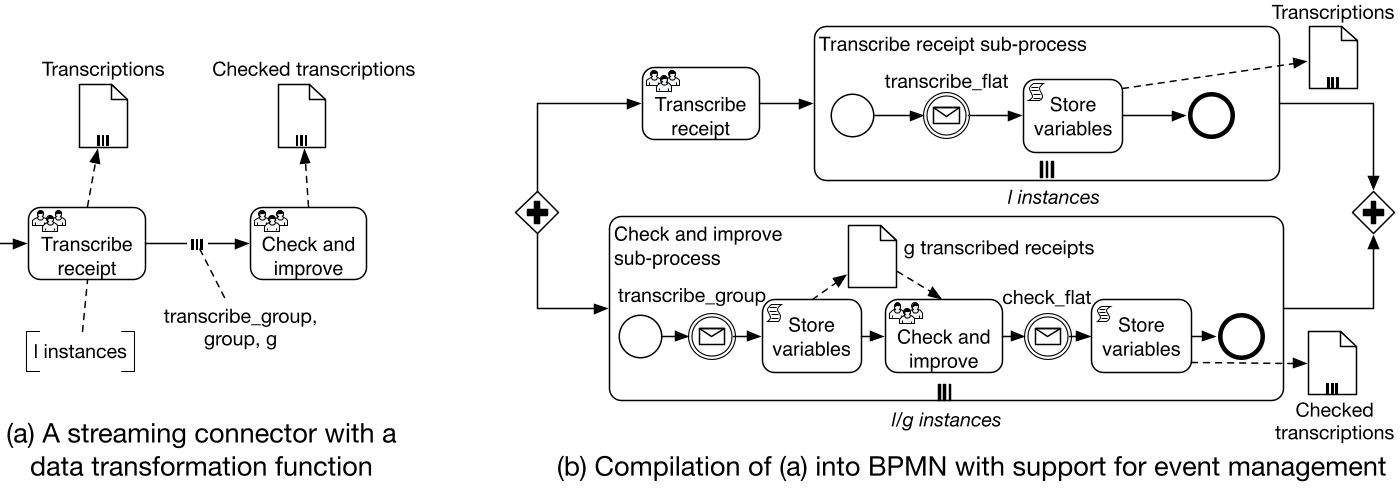
The Streaming Connector isn't just a wire; it's a transformer. It supports:
- Group: Wait for n instances before sending a batch (e.g., "Give me 4 transcriptions to classify at once").
- Split: Take one output and break it into multiple tasks.
- Multiply: Send the same result to multiple workers for quality control (redundancy).
Model Transformation
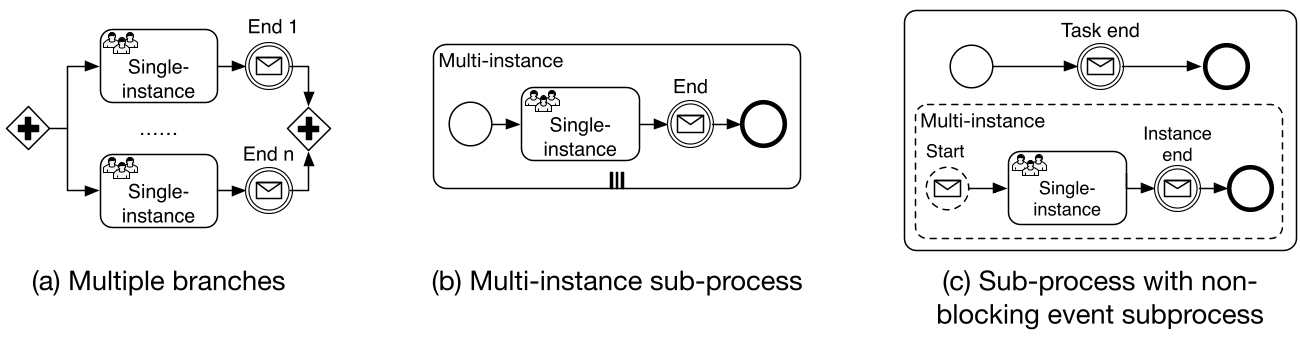
Since standard engines don't support streaming, the authors provide a compiler that turns these high-level "Stream" models into executable Multi-instance Sub-processes synchronized by events.
Real-World Impact: Receipt Transcription
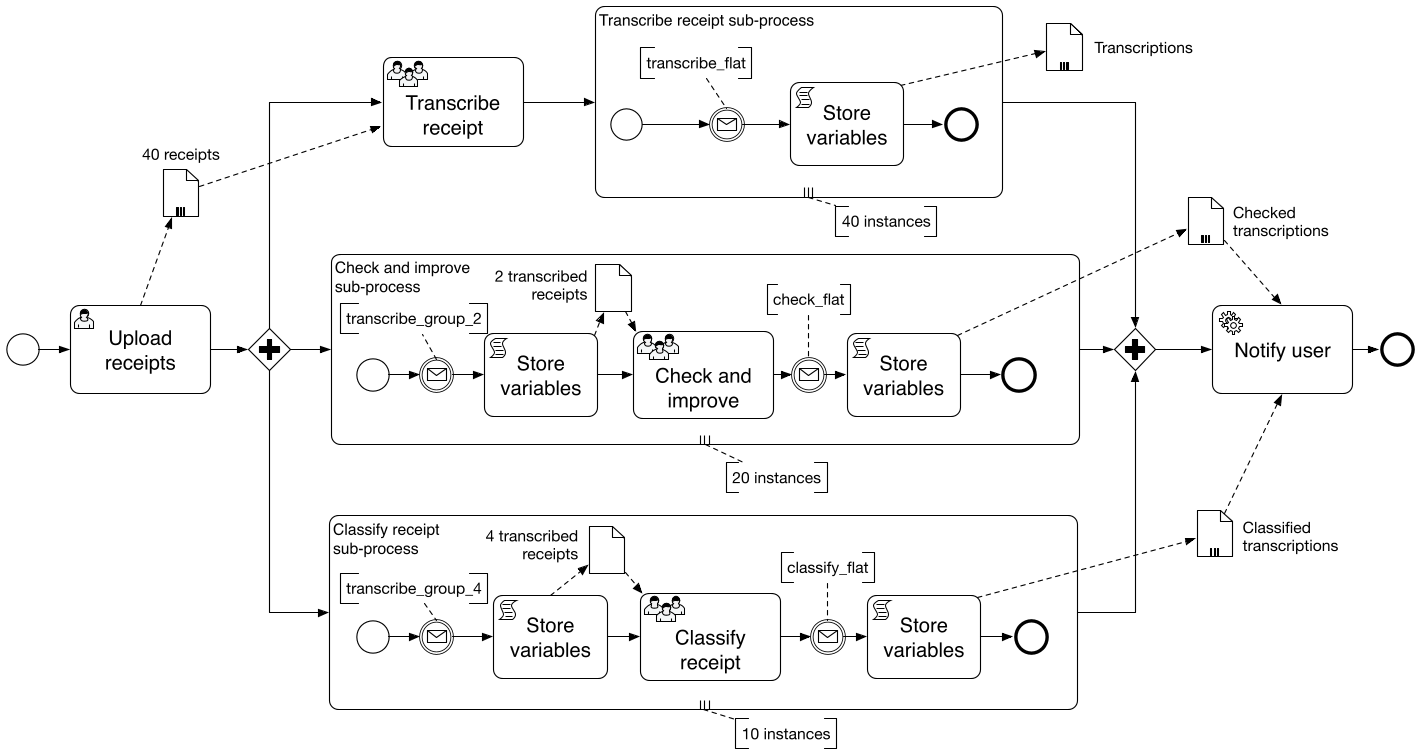
The authors tested their theory using a 3-step process: Transcribe Receipt -> Check/Fix -> Classify.
Results comparison:
- Non-Streaming: The "Check" task didn't even start until the entire "Transcribe" batch (40 receipts) was finished. Total time was dominated by the slowest worker in each batch.
- Streaming: As soon as the first few receipts were transcribed, they were immediately "streamed" to checkers and classifiers.
Visual Evidence: The "Streaming" chart (bottom) shows concurrent activity across all three task types almost from the start, whereas the "No Streaming" chart (top) shows sequential peaks.
Critical Analysis & Conclusion
The beauty of this work lies in its compatibility. By extending an existing standard (BPMN) rather than inventing a whole new language, it allows businesses to use their existing tools while gaining "crowd-scale" performance.
Limitations:
- The "Long Tail": The paper notes that the very last few instances of a micro-task often take much longer to complete because rewards are less attractive when volume is low.
- Join Logic: Currently, the system struggles with "joining" two different streams (e.g., waiting for both an image label and a text translation to arrive before a final check).
Future Outlook: This work paves the way for "Human-in-the-loop" AI pipelines where human verification and machine processing need to be interleaved at high frequencies without blocking the entire system.