
Roma Nova: Bridging the Gap Between Neural Interfaces and Historical Education
Brain-controlled serious games for cultural heritage
This paper presents "Roma Nova," a prototype Brain-Computer Interface (BCI) system designed for cultural heritage serious games. Utilizing a commercial Emotiv Epoc EEG headset, the system enables users to navigate and interact with intelligent agents in a high-fidelity 3D reconstruction of Ancient Rome.
TL;DR
The paper introduces Roma Nova, a serious game that allows players to explore Ancient Rome using only their thoughts and facial expressions. By leveraging the Emotiv Epoc BCI, the researchers created a "neurofeedback loop" where cognitive signals translated into movement, proving that brain-controlled interaction can make cultural learning more immersive and enjoyable, despite current hardware limitations.
The Motive: Beyond Simple Clicks
Cultural heritage applications frequently suffer from a "static museum" syndrome—users simply observe and click. The researchers identified that while Serious Games (games for purpose rather than pure entertainment) have potential, the interface remains a bottleneck. They hypothesized that Brain-Computer Interfaces (BCIs) could offer a more "natural" and engaging way to perceive virtual worlds, especially for history education where concentration and attention (monitored via EEG) are critical for retention.
Methodology: The Neural Interaction Architecture
The system architecture follows a closed-loop neurofeedback design. The core technical pipeline consists of:
- Signal Acquisition: Using the Emotiv Epoc (14-channel EEG) to capture raw brain activity.
- Processing (EmoEngine): Translating EEG signatures into "Cognitive" states (thoughts) and "Expressive" states (facial muscles).
- Command Execution (EmoKey): Mapping these states to keystrokes (e.g., "Think Forward" = W key) within the Unity 3D environment.
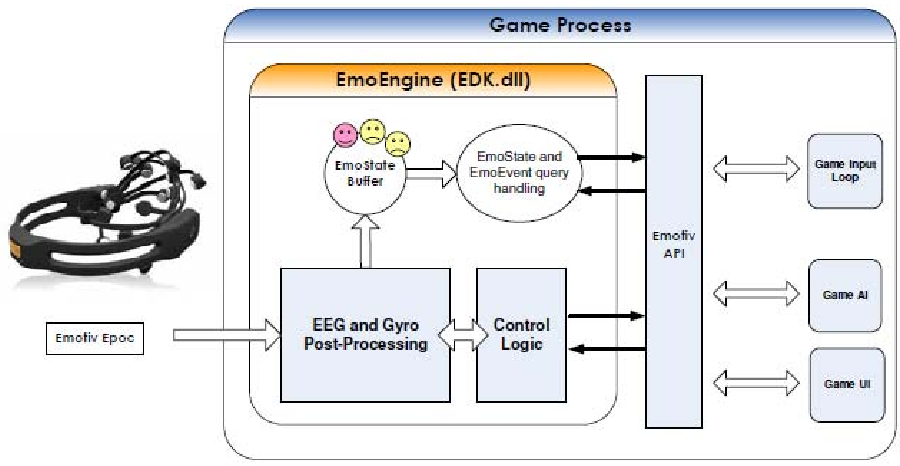 Figure: Integrating the EmoEngine and Emotiv EPOC with the Game environment.
The Level of Interaction (LoI) Framework
A standout feature of this research is how the game handles NPCs. Instead of a simple "click to talk," the authors used an LoI Framework. This creates dynamic "auras" around the player:
- Background Level: NPCs wander procedurally to provide atmosphere.
- Interaction Level: Triggered as the player approaches using BCI commands.
- Dialogue Level: Engages high-definition models and speech synthesis for deep learning scenarios.
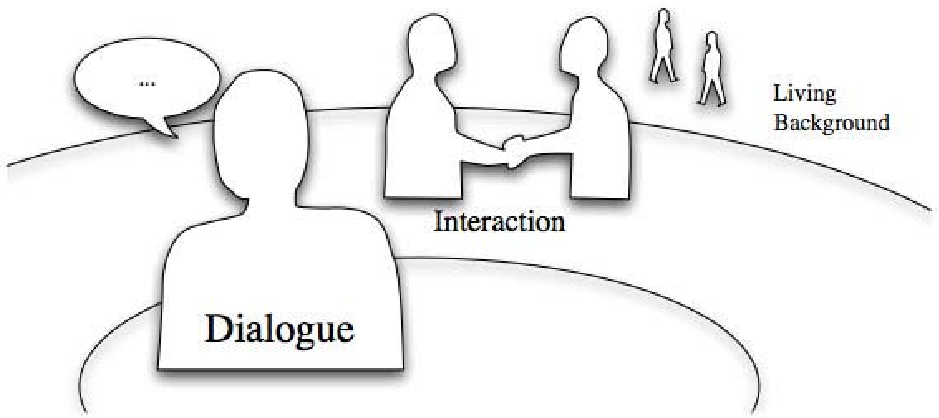 Figure: The LoI Framework illustrates spatial triggers for shifting NPC complexity.
Experiments: Does it Actually Work?
Testing with five BCI novices revealed a steep but rewarding learning curve.
- Learning & Training: Participants required 30-60 minutes to "train" the system to recognize their specific brain signatures for movement.
- Success Metrics: Users hit a ~65% success rate for navigation tasks.
- Emotional Response: While users admitted the BCI was "slower" and less precise than a mouse, they rated the enjoyability and immersion significantly higher.
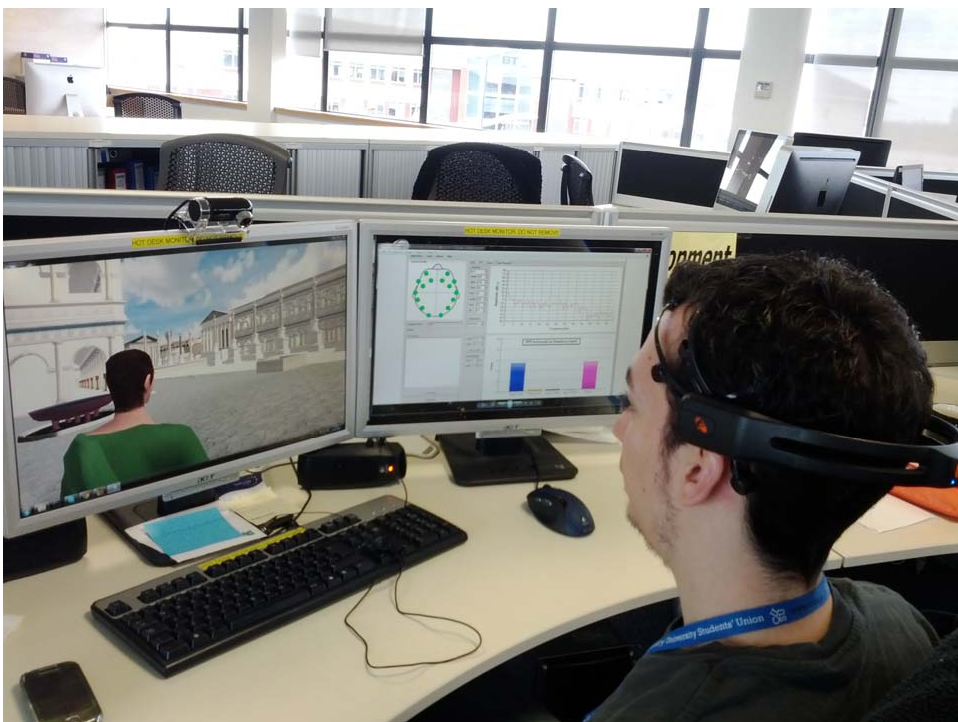 Figure: A participant navigating Roma Nova using the Emotiv headset.
Critical Analysis & Future Outlook
The "Roma Nova" project is a pioneer in moving BCIs out of the clinic and into the classroom. However, two main limitations remain:
- Susceptibility to Noise: Users reported that external stimuli easily disrupted their concentration, leading to "confused" game commands.
- Accuracy vs. Experience: There is a clear trade-off between the novelty of "thought control" and the dexterity offered by traditional inputs.
Conclusion: This research suggests that BCIs are not yet ready to replace the mouse for competitive gaming, but for Serious Games where the goal is engagement and attention-monitoring (e.g., for ADHD students or history buffs), brain-wave technology offers a transformative pedagogical tool. The next frontier? Combining this with VR/AR to eliminate external distractions and maximize immersion.