
Architecting Code Flows: Optimizing Branching Strategies via Social Network Analysis
Branching strategies based on Social Networks
This paper introduces an analytic approach to optimize software branching strategies using Social Network Analysis (SNA). By mapping dependencies between branches, teams, and resources through network matrices, it aims to align version control structures with actual organizational collaboration patterns.
TL;DR
Static branching models often fail because they ignore the human element of software engineering. This paper proposes a transition from rigid branching rules to dynamic, Social Network Analysis (SNA)-driven strategies. By analyzing how developers actually interact and share resources (code churn), organizations can design Branch Breakdown Structures (BBS) that minimize integration friction and maximize team velocity.
The "Integration Hell" Problem
In large-scale industrial projects—like the complex financial system studied here—branching is inevitable. However, the author points out a recurring pain point: Process Overhead.
When a branching strategy is misaligned with the team structure:
- Latent Defects: Bugs remain hidden until disparate branches finally meet.
- Development Freezes: Teams become isolated, unable to access "unreleasable" code sitting in a parallel branch.
- Baseless Merges: Merging code between branches without a common ancestor in the mainline leads to catastrophic conflict resolution efforts.
Methodology: Mapping the Social Graph of Code
The core insight of this research is that code dependencies are actually social dependencies in disguise. The author utilizes Glaserian Grounded Theory and SNA to bridge this gap.
The Formal Model
The approach uses matrices to represent the ecosystem:
- Agent-Branch Matrix (AB): Which developer is working on which branch.
- Branch-Branch Matrix (BB): The direct paths between branches. If , code can flow directly.
- Code Churn Integration: By linking "changesets" to "work items," the model captures who worked on what and when, providing a high-fidelity map of collaboration.
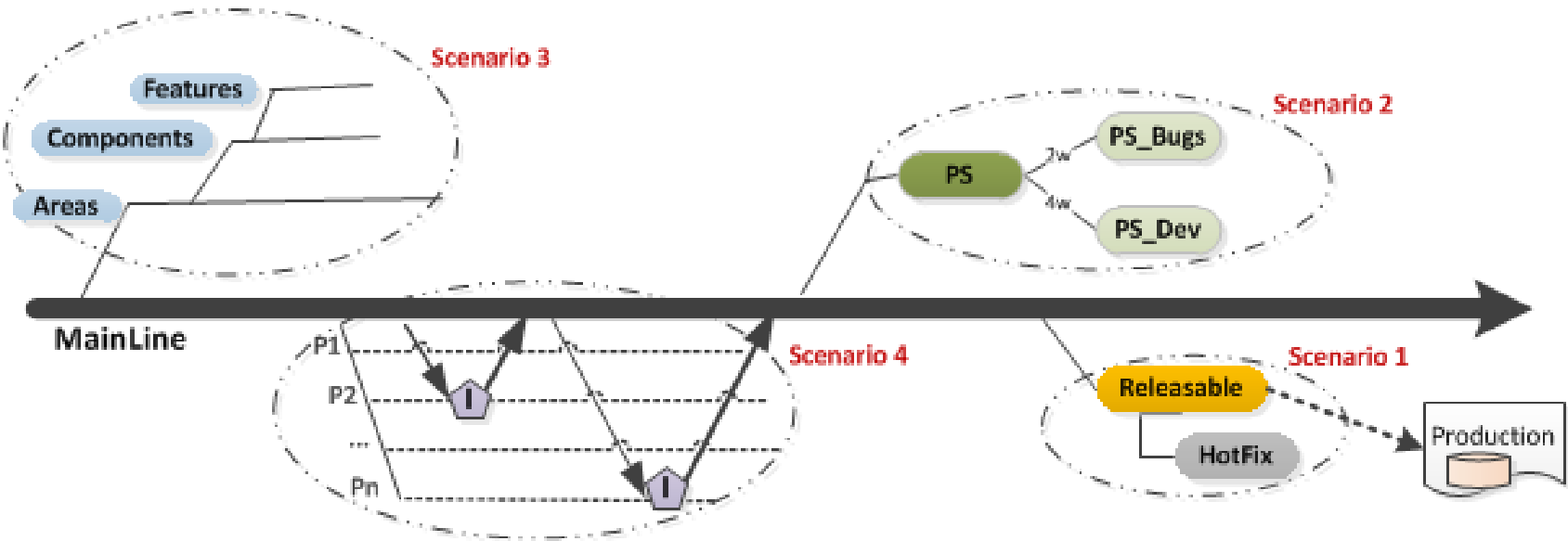 Fig 1: Real-world scenarios demonstrating how different organizational needs (Hotfixes, Scrum teams, Framework maintenance) require unique branching topologies.
Four Scenarios of Socio-Technical Alignment
The paper breaks down requirements into four distinct scenarios:
- Scenario 1 (Hotfixes): Minimal integration effort for production bugs.
- Scenario 2 (Scrum Silos): Two separate teams (Bugs vs. Dev) needing to share workspace without hitting the 'Mainline'.
- Scenario 3 (Core Frameworks): Cross-cutting architectural changes that everyone depends on.
- Scenario 4 (External Coordination): Long-lived parallel branches that must be destroyed post-release.
The "Aha!" moment occurs when a developer on a "PS-Bugs" branch needs code from a "FED-UI" branch but is blocked because the branches aren't "releasable." The SNA matrix makes these bottlenecks visible before they halt production.
Experimental Insights: Common Strategies
The research aligns these findings with established industry patterns, providing a taxonomy of branching:
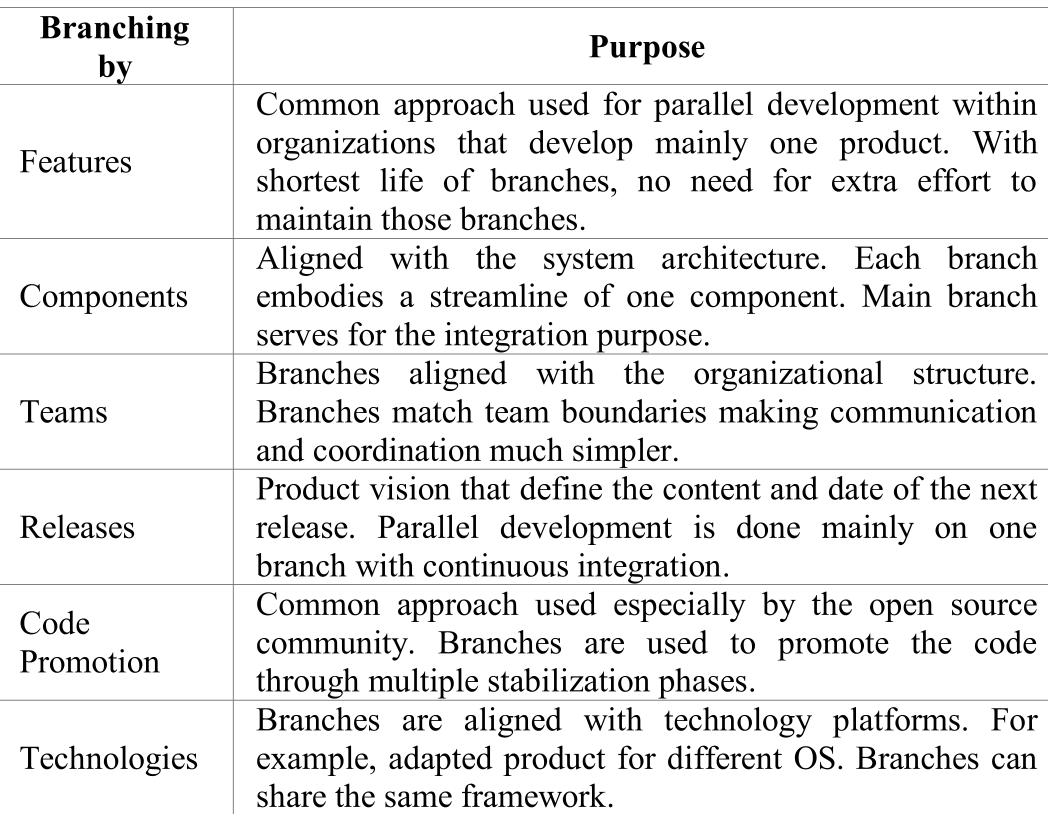 Table 1: Aligining branching types (Feature, Component, Team, Release) with their intended organizational purposes.
Critical Insight & Practical Implication
- Team Awareness: Visualization of the social network allows Release Managers to identify "isolated" teams early.
- Defect Prediction: By aggregating code churn at the work-item level within the network, we can predict post-release failures more accurately than by looking at files alone.
- Integration Overhead: SNA helps release engineers decide where and when to perform "forward merges" to keep branches synchronized.
Conclusion
The paper concludes that effective branching is not a "one-size-fits-all" configuration. Instead, it is a dynamic structure that must be adapted based on socio-technical dependencies. By using SNA matrices, release engineers can move from reactive firefighting to proactive adjustment of the development flow.
Future Work: The author suggests that further analysis of "Crosscutting Concerns" and their impact on branch-level defects will be the next frontier in minimizing the integration workload.