
Social-Smooth Multiview Embedding: Cleaning the Noise in Brand Social Media
18240_Filtering of Brand-Related Microblogs Using Social-Smooth Multiview Embedding.
This paper introduces a discriminative social-aware multiview embedding method for filtering brand-related microblogs. The core approach maps heterogeneous data (text, low-level vision, and semantic vision) into a latent subspace, achieving SOTA performance on the Brand-Social-Net dataset with 100 brands.
In the modern digital landscape, a brand's reputation can be made or broken in the time it takes for a post to go viral. For corporations, tracking brand-related microblogs (like those on X/Twitter or Sina Weibo) isn't just a marketing luxury—it's a survival necessity. However, "data gathering" is a double-edged sword: the more inclusive your search keywords are, the more noise you collect.
This paper, published in IEEE Transactions on Multimedia, presents a sophisticated solution for this "Precision vs. Recall" dilemma through a method called Discriminative Social-aware Multiview Embedding.
TL;DR
To accurately filter the noise out of millions of microblogs, the authors developed a latent subspace learning method. It doesn't just look at text; it simultaneously digests images (both low-level pixels and high-level concepts) and social context (who follows whom, where they are, and when they post). By aligning these multiple "views" while smoothing the results against a social graph, the method achieves significantly higher precision than standard classifiers.
The Core Challenge: Why is Filtering So Hard?
Identifying if a post is truly "about" a brand is deceptively difficult because:
- Heterogeneity: A post might contain a photo of a car with no text, or text with a logo in the background.
- Conversational Shift: Language changes rapidly. A fixed keyword list misses out on new slang or evolving contexts.
- Visual Overload: 40% of microblogs contain images, but many current systems ignore visual data or treat it as an afterthought.
Methodology: The Fusion of Logic and Social Intuition
The authors' insight is that a microblog is more than its content; it is defined by its position in a Social-Semantic Space. They proposed a framework consisting of three content views and two structural constraints.
1. The Three Views of Content
- Textual View: TF-IDF vectors from microblog text.
- Low-Level Visual View: Spatial pyramid matching on SIFT features for local texture.
- High-Level Semantic View: 369 visual concepts from ImageNet and automated logo detection.
2. Dual-Graph Regularization
The "magic" happens in the optimization objective. Two graphs act as "guardrails" for the learning process:
- Brand Similarity Graph: Forces posts labeled as the same brand to stay close in the latent space.
- Social Similarity Graph: Implements the "social-smooth" property. It assumes that if two users are friends, in the same location, or posting at the same time, their relevance to a brand should be similar.
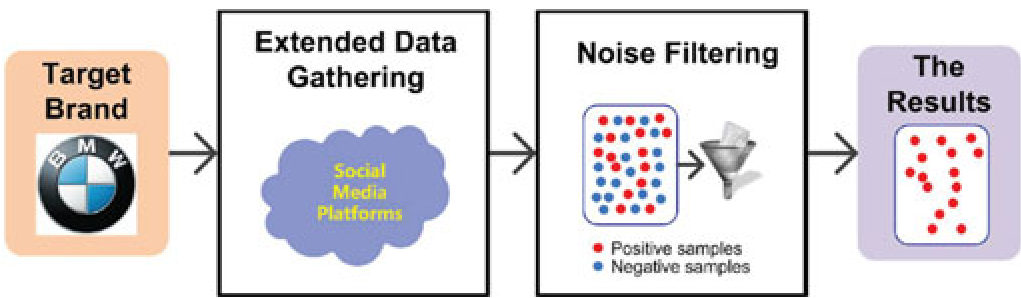 Figure: The framework transitions from raw multi-faceted data gathering to a refined latent embedding for classification.
Experiments and Results
Testing was conducted on the Brand-Social-Net (BSN) dataset, which includes 3 million microblogs covering 100 major brands (Apple, KFC, Nike, etc.).
Key Metrics Comparison
The proposed method (MVE+SR) was compared against traditional SVMs and the prior SOTA (EDG).
- Recall: Average of ~0.70.
- Precision: Drastic improvement over baselines, reaching nearly 0.80 for several brands.
- F1-Measure: Boosted by over 25% compared to the EDG method.
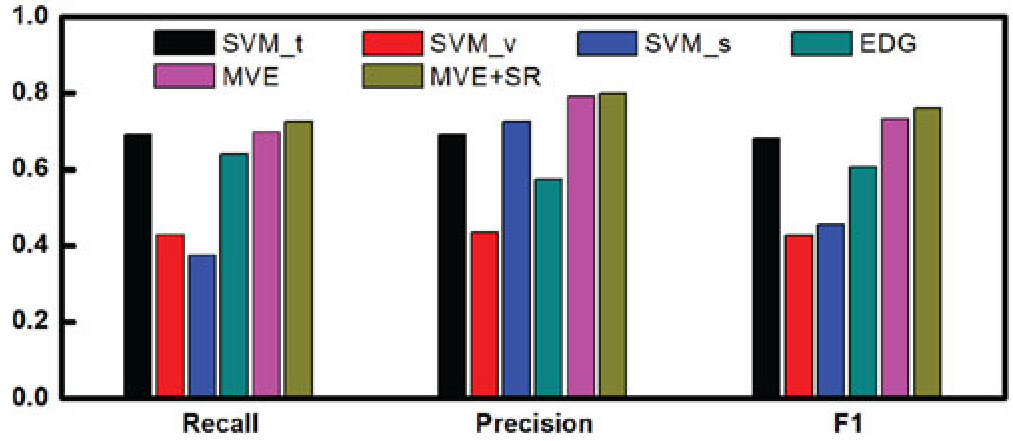 Figure: Performance comparison shows that Multiview Embedding (MVE) significantly outperforms individual feature approaches (SVM_t, SVM_v).
The "Influencer" Effect
Interestingly, the researchers found that social regularization was most effective for brands like Apple and KFC. Why? These brands have "influential users" (official accounts or power users) with vast social connections. The graph-based smoothing thrives when the social density is high.
Critical Analysis & Takeaways
The brilliance of this work lies in its admission that content is not enough. In the age of social media, the context—the metadata describing human relationships—is the most powerful filter available.
Takeaways:
- Multiview beats Single-view: Consistently, the fusion of text and vision (concepts + pixels) provides a safety net against missing information.
- Social Smoothness is Real: Using the Haversine formula for location and follower/followee relations creates an Inductive Bias that effectively suppresses noise.
- Efficiency: The model remains robust even with limited training data (np=100), making it practical for real-world deployment.
Future Outlook: While this method relies on Laplacian graphs (which can be computationally expensive for millions of nodes), it paves the way for modern Temporal Graph Neural Networks to further push the boundaries of real-time social sensing.