
To Grow or to Defend: Decoding the Brassinosteroid-Immunity Regulatory Hub
Trade-off between growth and immunity: role of brassinosteroids
This paper reviews the molecular mechanisms governing the growth-immunity trade-off in plants, centered on Brassinosteroid (BR) signaling. It identifies the transcription factors BZR1 and HBI1 as a central regulatory hub that prioritizes BR-mediated growth by negatively regulating Pattern-Triggered Immunity (PTI) in Arabidopsis.
TL;DR
Plants are often caught in a biological "zero-sum game" where resources invested in growth cannot be used for defense. This review by Lozano-Durán and Zipfel clarifies how Brassinosteroids (BR), the primary hormones for growth, act as a master switch to dial down Pattern-Triggered Immunity (PTI). The secret lies not in the competition for shared receptors at the cell surface, but in a sophisticated transcriptional relay involving BZR1 and HBI1.
The Allocation Dilemma: A Systematic Conflict
The fundamental problem in plant biology is the growth-immunity trade-off. Indiscriminate activation of immune responses (PTI) provides protection but incurs massive fitness costs. Conversely, rapid growth, such as during etiolation (growth in darkness), requires the suppression of expensive defense mechanisms. The authors argue that BRs have emerged as the crucial regulators managing this "allocation dilemma."
Methodology: Shifting from the Surface to the Nucleus
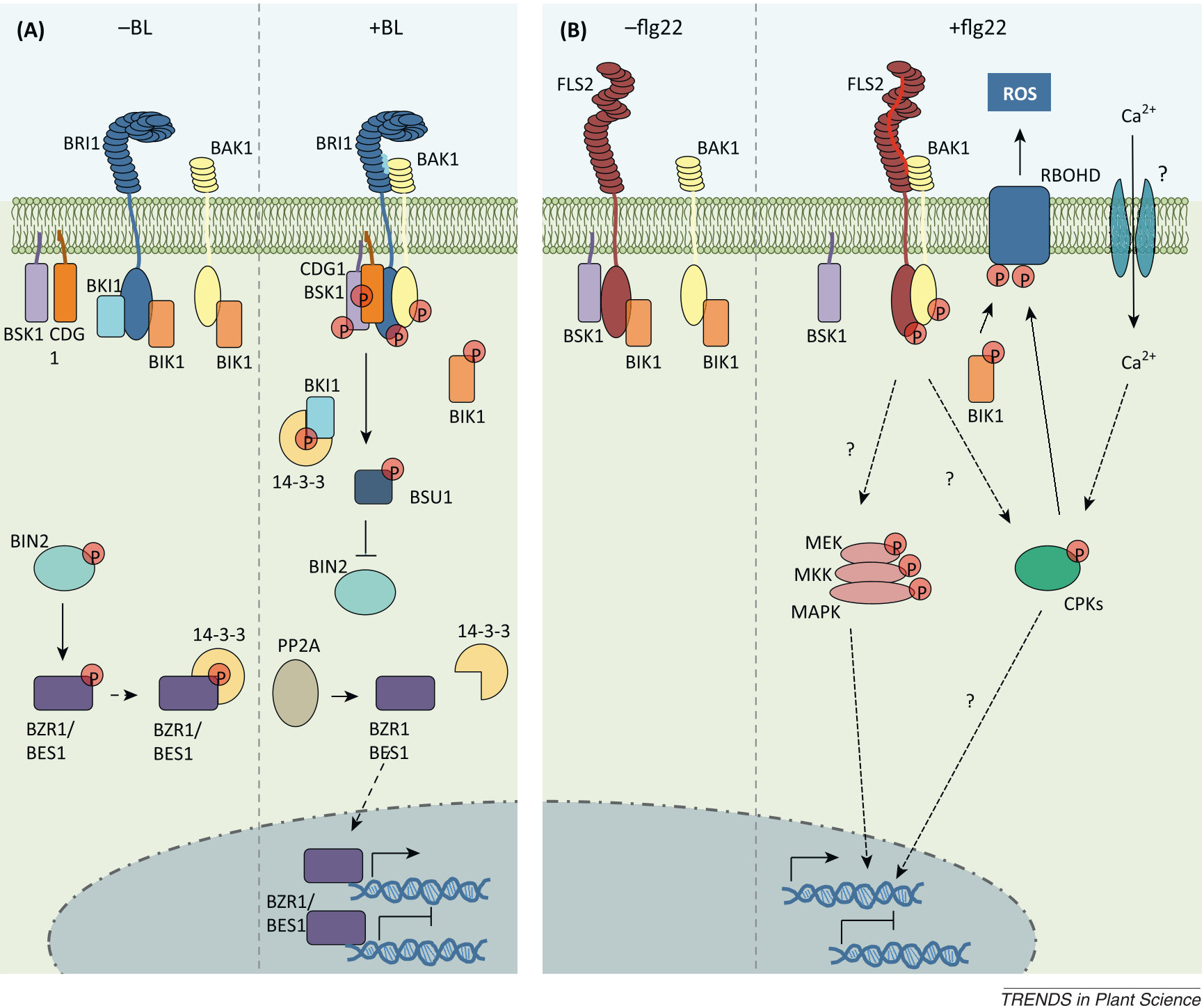
For years, the scientific community debated how BR suppresses immunity. One hypothesis was BAK1 Titration: since BAK1 is a co-receptor for both the BR receptor (BRI1) and the immune receptor (FLS2), it was thought that BRI1 might "steal" all the BAK1, leaving none for defense.
However, the authors present a more nuanced Indirect Crosstalk model:
- Receptor Level: While BAK1, BSK1, and BIK1 are shared, actual competition for BAK1 is rarely the limiting factor in physiological conditions.
- Transcriptional Hub: The real suppression happens in the nucleus. BR perception activates BZR1, which then:
- Directly activates WRKY transcription factors that function as immune repressors.
- Promotes the expression of HBI1, which inhibits immune gene expression and Reactive Oxygen Species (ROS) bursts.
Environmental Integration: The BZR1-HBI1 Hub
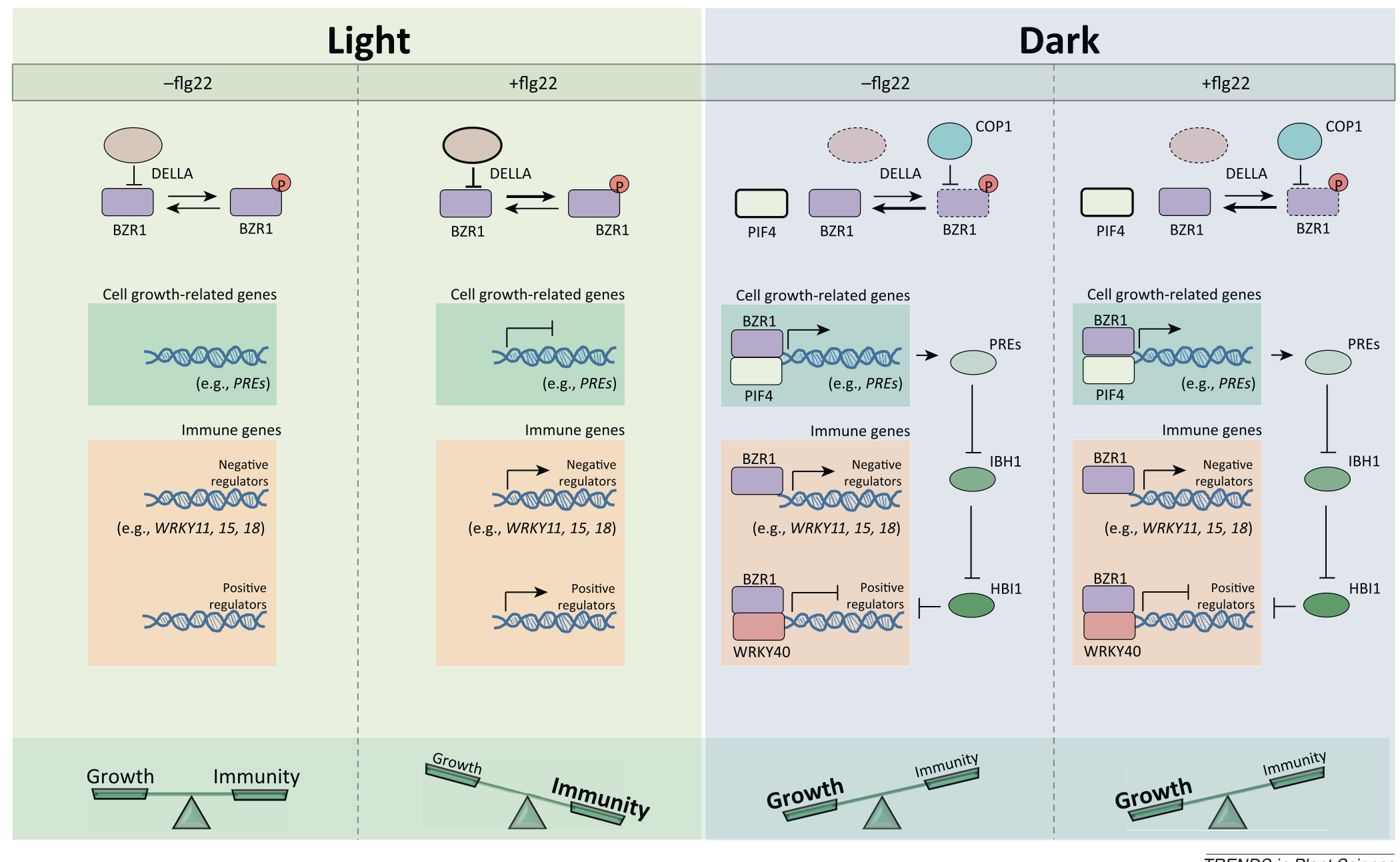
The paper emphasizes that BZR1 is not just a hormone responder but an environmental integrator. It processes inputs from:
- Gibberellins (GA): Through the degradation of DELLA proteins that otherwise inhibit BZR1.
- Light/Darkness: Nighttime conditions stabilize BZR1 and its partner PIF4, prioritizing growth (etiolation) over immunity.
- Pathogens: PAMP perception (like flg22) actually tries to downregulate BR biosynthetic genes to tip the balance back toward defense.
Deep Insight: Species-Specific Variation
While the negative crosstalk is clear in Arabidopsis, the review highlights intriguing complexities in other species. In rice, BR can antagonize JA-mediated defenses, increasing susceptibility to nematodes. However, in barley, mutations in the BR receptor (uzu mutation) actually enhance resistance to various fungi and viruses. This suggests that the BR-immunity trade-off is flexible and has been "re-wired" throughout evolution to suit different ecological niches and pathogen types.
Conclusion and Future Outlook
The BZR1-HBI1 transcriptional cascade is the "regulatory hub" that ensures plants balance their checkbooks effectively. While we now understand the "How," the "Why" regarding species-specific differences remains a frontier.
The takeaway for researchers is clear: understanding this hub offers a pathway to engineering crops that can maintain high growth rates without becoming dangerously susceptible to disease—essentially breaking the traditional trade-off.
Key Technical Terms
- PTI (Pattern-Triggered Immunity): The first line of innate defense.
- BZR1: A master transcription factor in the BR signaling pathway.
- Etiolation: The process of rapid growth in the absence of light.
- Inductive Bias: In this context, the evolutionary "preference" of a plant to prioritize one pathway over another based on environmental signals.