
Break up the Family: Architecting Efficiency in High-Recall Legal Retrieval
Break up the Family: Protocols for Efficient Recall-Oriented Retrieval Under Legally-Necessitated Dual Constraints
This paper introduces specialized retrieval protocols for eDiscovery, focusing on high-recall legal tasks governed by dual constraints: relevance and privilege protection. The core methodology advocates for "Broken Family" retrieval (PF-CAL, IP-CAL, and PH-CAL) over the industry-standard Full Family (FF-CAL) approach, achieving state-of-the-art efficiency in identifying relevant document families.
TL;DR
In the high-stakes world of legal eDiscovery, the "Document Family" (the email and its attachments) is the standard unit of production. Tradition dictates they be reviewed together. This paper proves that this tradition is a bottleneck. By "breaking up the family" and using a phased CAL (Continuous Active Learning) approach, legal teams can achieve 90% recall with significantly less effort—saving weeks of expensive attorney time.
The "Dual Constraint" Dilemma
In legal discovery, you don't just find relevant documents; you must also protect privileged communications. If one attachment in an email thread is relevant, the entire family must be produced. Conversely, if one item contains privileged info, the whole family needs eyes-on review to prevent ethical breaches.
Prior Work Pitfall: The industry standard, Full Family (FF-CAL), reviews the whole family as soon as one member is flagged. This leads to two major inefficiencies:
- Noise: Reviewers spend time on non-relevant attachments.
- Diluted Learning: The AI algorithm is trained on these non-relevant attachments early on, slowing its ability to find the "true" needles in the haystack.
Methodology: The Architecture of Broken Families
The authors tested four protocols, keeping the underlying machine learning (n-grams and a proprietary supervised learner) constant while varying the process.
1. PF-CAL (Positive Family)
Only when a document is confirmed relevant do its siblings enter the review queue. This prevents training the AI on non-relevant siblings until absolutely necessary.
2. IP-CAL (Individual Padded)
The AI ignores families entirely during training. Only after a certain recall goal is reached are the family members added ("padded") to the review set.
3. PH-CAL (Phased Review) - The Strategic Winner
Recognizing that judging relevance is faster than judging privilege, PH-CAL uses a two-step process:
- Phase 1: Quick relevance-only review of individual documents. If the first half of a doc looks relevant, stop and tag it.
- Phase 2: Full relevance + privilege review of only the families identified in Phase 1.
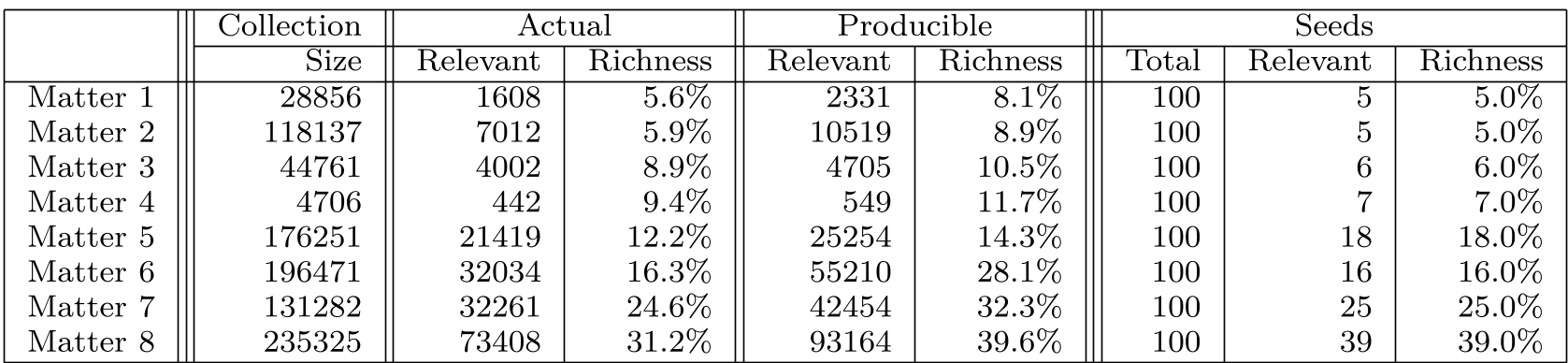 Table 1: The datasets used represent real-world litigation matters with varying "richness" (density of relevant documents).
Experiments and Results
The study compared these protocols across eight real-world matters. The metrics focused on Recall vs. Effort.
Efficiency Gains
- Broken vs. Full: In virtually every case, breaking the family was superior. For Matter 6, absolute effort to reach 75% recall dropped from 35.29% to 26.40%.
- Residual Reduction: When excluding the "minimum work" (reviewing the relevant docs themselves), the "wasted effort" was reduced by 40-60%.
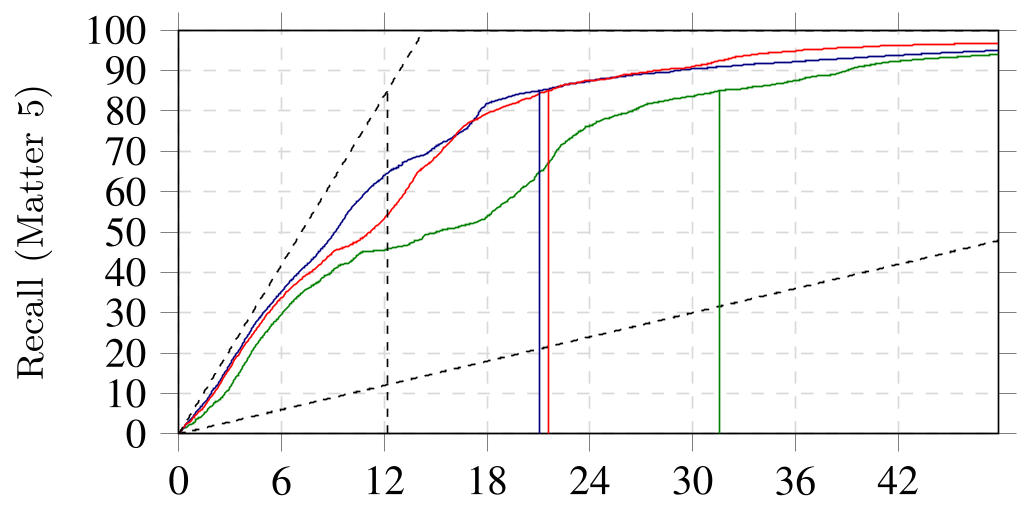 Figure 1: Comparison of FF-CAL (Green), PF-CAL (Blue), and IP-CAL (Red). The steepness of the Red/Blue lines indicates faster arrival at high recall.
The Time-Based Victory of PH-CAL
Documents are not equal. A relevance check might take 20 seconds, while a privilege check takes 60 seconds. When accounting for this speedup (sensitivity analysis from 1x to 5x), PH-CAL becomes the clear SOTA. Even a modest 3x speedup in Phase 1 saves thousands of minutes of review time.
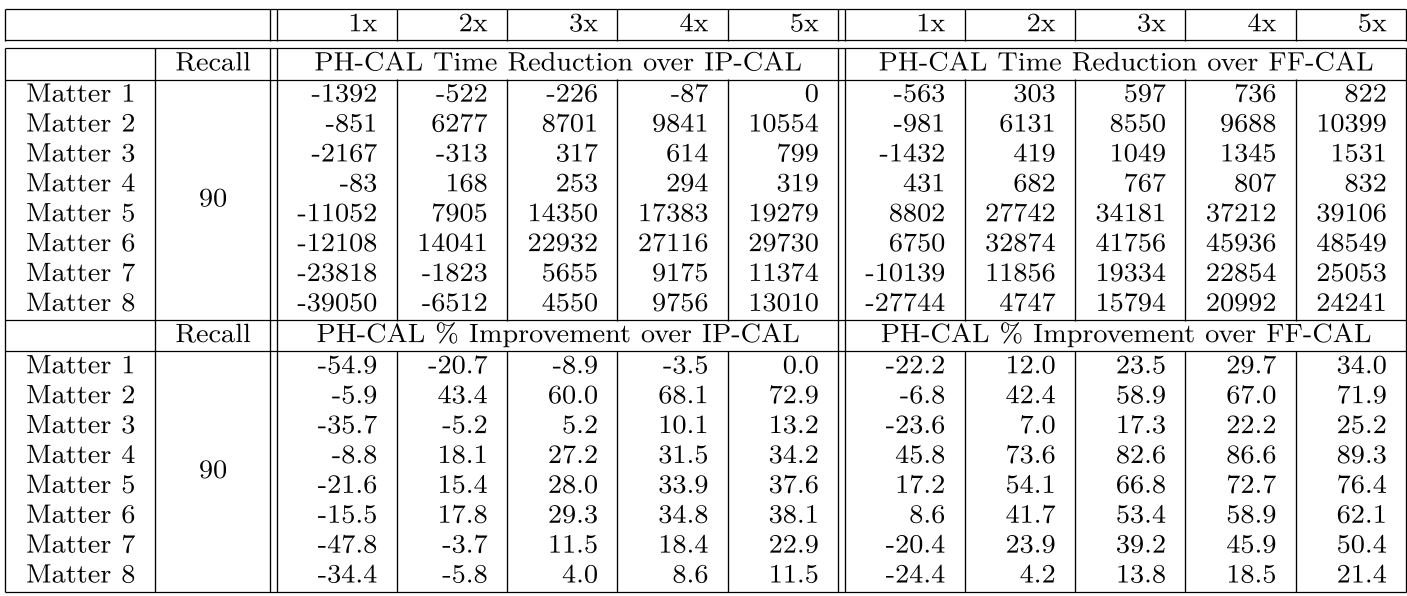 Table 3: PH-CAL shows massive time reductions (up to 48,000 minutes) when the relevance review is faster than the privilege review.
Critical Insight: Process as an Inductive Bias
This paper highlights a fundamental truth in applied AI: Algorithm tuning is often secondary to process engineering. By understanding the legal constraints (privilege) and the human labor cost (time), the authors successfully applied a human-in-the-loop strategy that outperforms even the best "black box" implementations of standard CAL.
Future Work & Limitations
While the results are robust, the success of the Phased approach (PH-CAL) depends on the accuracy of the speedup factor. Determining exactly how much faster relevance-only review is across different legal domains remains an area for further study. Additionally, how this interacts with multi-person teams and "stopping point" algorithms (knowing when 90% recall is truly hit) is the next frontier.
Conclusion: If you are in eDiscovery, the directive is simple: Break up the family.