
Software Crowdsourcing: Navigating the Tension Between Competition and Collaboration
Breaking Collaboration Barriers through Communication Practices in Software Crowdsourcing
This paper presents a qualitative mapping study identifying 36 collaboration barriers and 30 communication practices in Software Crowdsourcing (SW CS). By analyzing 241 empirical papers, the authors establish a mitigation framework that associates specific communication strategies with systemic collaboration obstacles.
TL;DR
Software Crowdsourcing (SW CS) is a disruptive paradigm where tasks are opened to a global pool of experts. However, the model’s competitive nature often constructs "Invisible Walls" that prevent effective teamwork. This research systematically maps 36 collaboration barriers and 30 communication practices, providing a roadmap for platform designers and project managers to foster more efficient virtual ecosystems.
The Paradox: Why Collaboration Fails in the Crowd
Software development is fundamentally a social and collaborative endeavor. Yet, crowdsourcing is built on a foundation of competition. This creates a paradox: how can individuals collaborate when they are vying for the same prize?
The authors identify that the primary friction point is not technical, but structural. Current platforms often restrict direct contact between the requester and the worker to maintain anonymity and process control, leading to a "context vacuum" where workers struggle to understand the broader project rationale.
Methodology: Mapping the Empirical Landscape
The research team conducted a qualitative mapping of 241 papers. The goal was to move beyond simply listing "what's wrong" and instead link problems to proven solutions.
Key Collaboration Barriers (B)
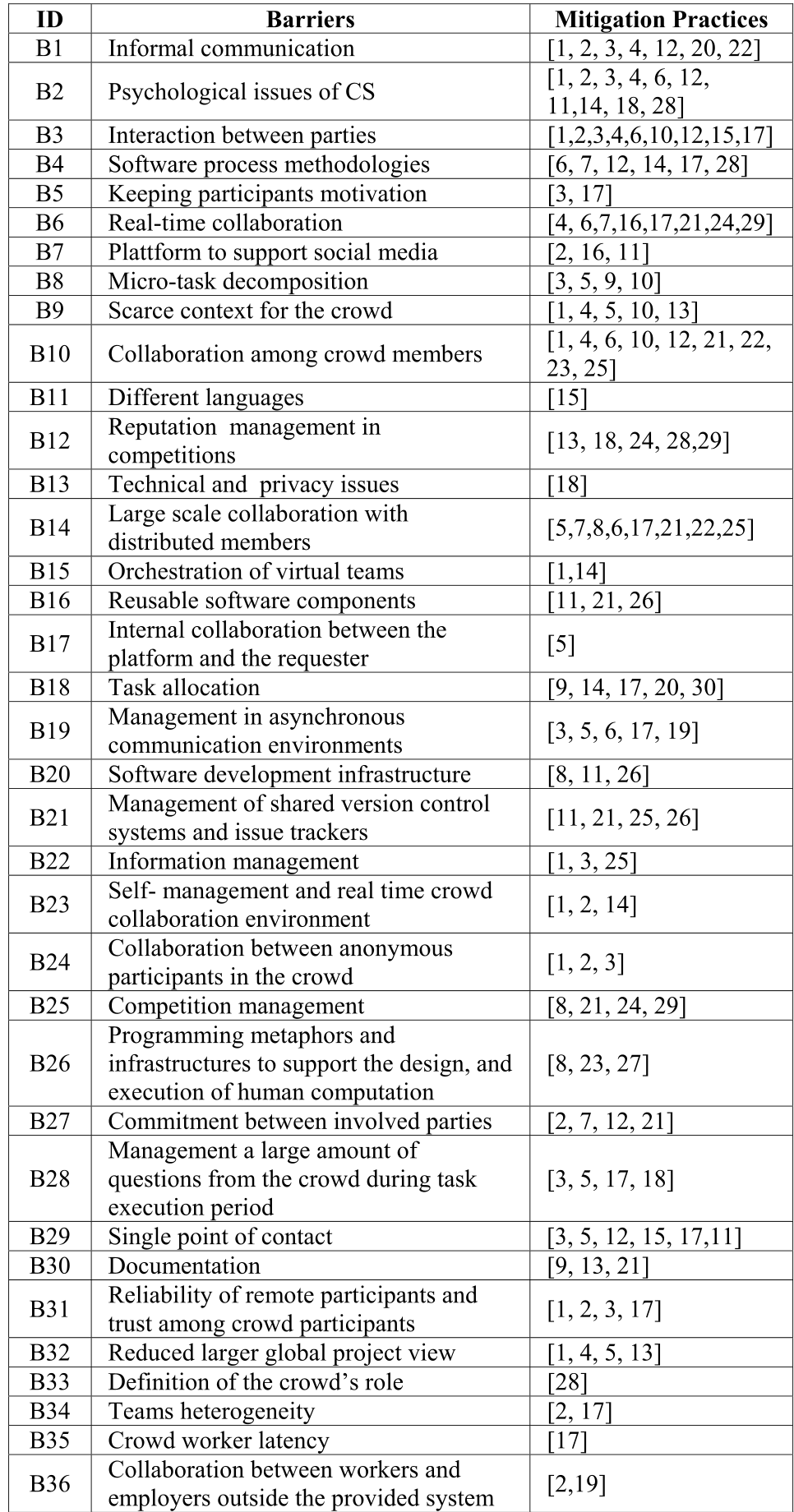
- B1: Informal Communication: The lack of spontaneous, "water-cooler" talk that typically resolves ambiguity in traditional offices.
- B2: Psychological Issues: The stress of competition and the isolation of anonymous remote work.
- B3: Interaction Between Parties: Limited bandwidth between the developers and the customers.
Key Communication Practices (P)
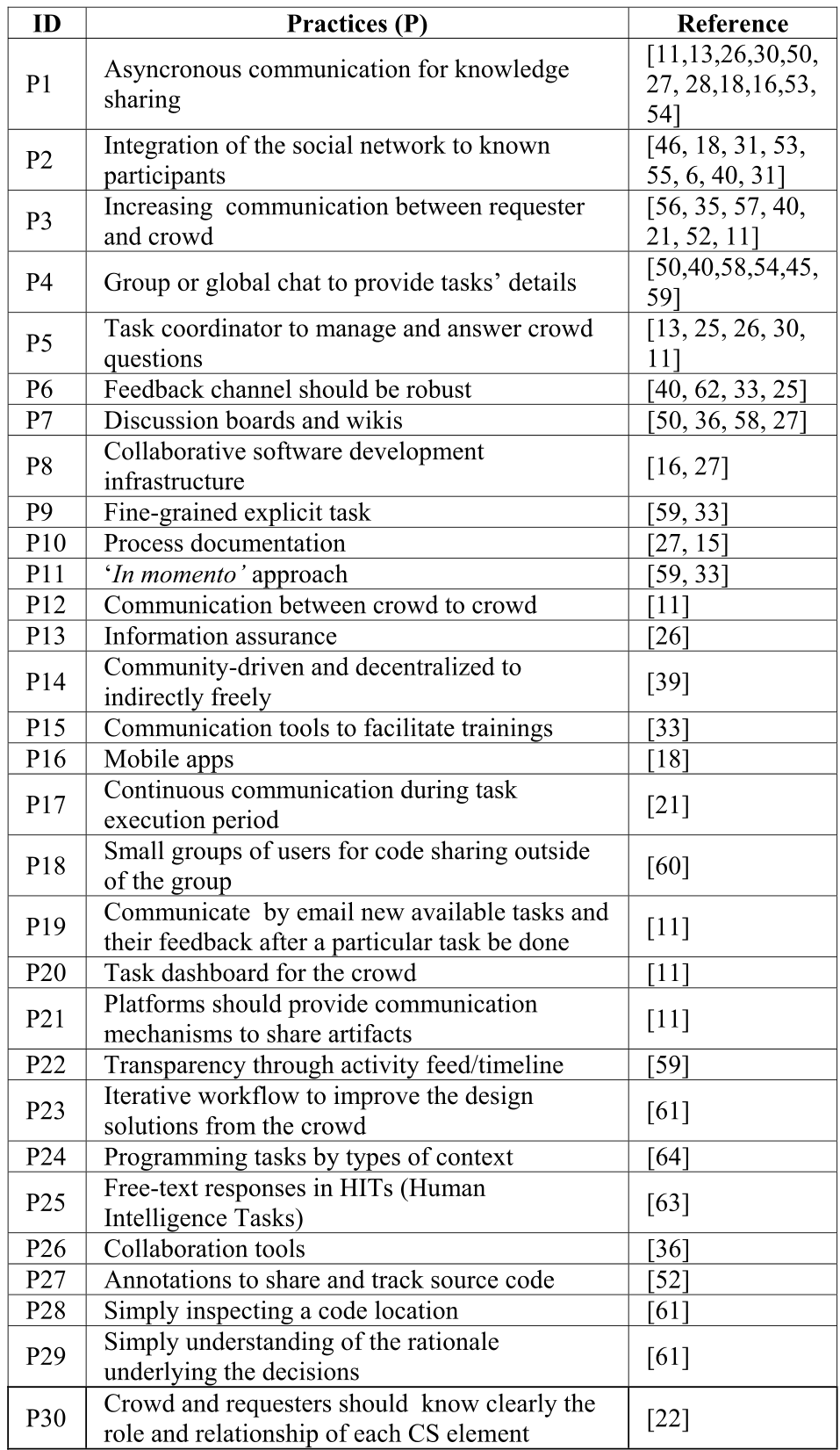
- P1: Asynchronous Knowledge Sharing: Utilizing wikis, forums, and documented threads to bridge time-zone gaps.
- P5: Task Coordinators: Human intermediaries who manage questions and provide a "single point of contact" to reduce crowd confusion.
Deep Dive: The Barrier-Practice Mapping
The most valuable contribution of this work is Table III (summarized below), which serves as a "troubleshooting guide" for software engineering managers.
- To solve Informal Communication (B1): Implement asynchronous sharing, social network integration, and robust feedback loops.
- To address the lack of context (B9): Use task coordinators (P5) and provide fine-grained, explicit task definitions (P9).
Managerial Insight: From "Crowd" to "Team"
The study reveals that the most cited solution—Asynchronous Communication (P1)—is a double-edged sword. While it enables global scale, it can lead to disjointed discussions if not managed properly. The authors suggest that the "Task Coordinator" (P5) role is critical; software crowdsourcing is not "set it and forget it"—it requires active moderation to ensure the crowd moves in the same direction.
Conclusion and Future Outlook
This paper serves as an essential baseline for understanding the social dynamics of the "Human Cloud." As we move toward more complex software tasks being crowdsourced (like architecture design or complex debugging), the industry must shift from viewing the crowd as a collection of anonymous CPUs to a distributed community of human collaborators.
Limitations: The study is based on literature up to 2016. Future work is needed to see how modern tools like Slack, MS Teams, and GitHub Copilot have altered these barriers.
Takeaway for Tool Designers: Don't just build a leaderboard; build a communication bridge.