
Breaking the Filter Bubble: Why Your Feed Needs More Conflict, Not Just "Balance"
Breaking the filter bubble: democracy and design
This paper explores the "filter bubble" phenomenon from a democratic theory perspective, proposing a Value Sensitive Design (VSD) approach. It analyzes 15 existing anti-filter-bubble tools and identifies a critical lack of designs supporting agonistic and contestatory models of democracy.
TL;DR
The "filter bubble" isn’t just a technical glitch; it’s a democratic crisis. However, most tools meant to "fix" our bubbles are based on a narrow, incomplete understanding of democracy. This paper argues that we need to stop aiming only for "neutrality" and start designing for contestability and agonistic pluralism.
Current Status: Academic critique and Design Framework. Key Insight: We are currently building tools for "polite deliberation" while ignoring the democratic necessity of "social struggle."
The "Democracy" Blind Spot
When we talk about the filter bubble, we usually assume everyone agrees on what a "healthy" information diet looks like. Bozdag and van den Hoven challenge this by pointing out that Democracy is a contested concept.
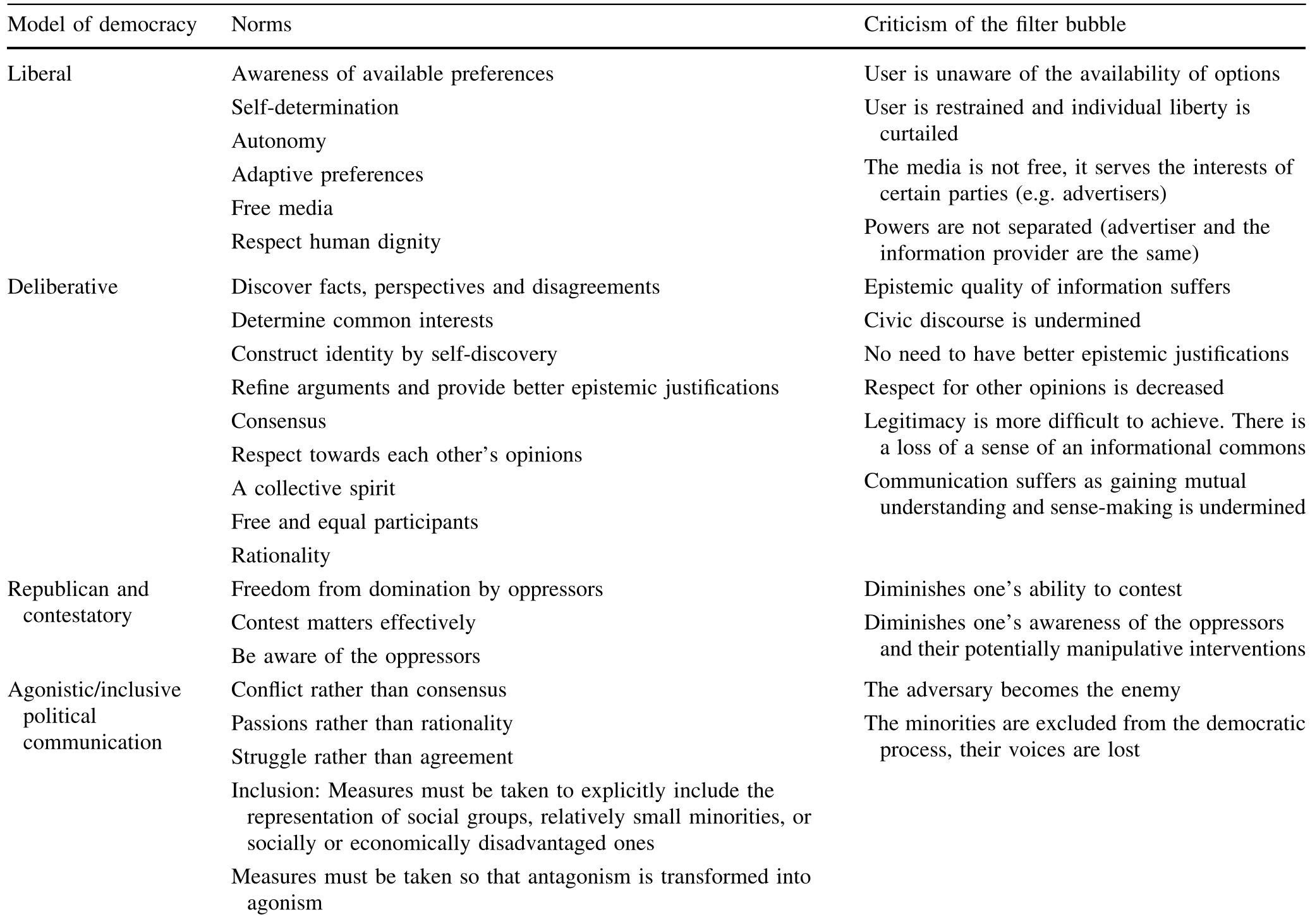
If you are a Liberal, a bubble is a problem of choice. If you are a Deliberative Democrat, it's a problem of reasoning. But if you follow Agonism, the bubble’s greatest sin is the erasure of the adversary.
Methodology: Mapping Ideology to Code
The authors categorize democratic theories into four quadrants, each with its own "benchmarks" for what a software tool should actually do:
- Liberal: Focuses on user autonomy and awareness.
- Deliberative: Focuses on finding the "truth" through rational debate.
- Republican: Focuses on "non-domination"—being able to spot and fight oppressors.
- Agonistic: Focuses on "clash"—ensuring minority voices aren't silenced by the "common good."
The Missing Norms
The meat of the paper lies in its audit of 15 tools (like Balancer, ConsiderIt, and OpinionSpace).
The researchers found a stark divide: Every single tool focused on Liberal or Deliberative norms.
- They give you a "balance meter" (Liberal/Autonomy).
- They show you "Pro/Con" lists (Deliberative/Rationality).
- Nothing was designed to specifically elevate a marginalized group or reveal the "networks of force" (hegemony) behind the news.
Why "Balance" Isn't Enough
The authors highlight a critical failure in "diverse" algorithms: Proportionality vs. Equality. If an algorithm shows viewpoints proportional to their popularity, the majority view will always drown out the minority. In an Agonistic model, this is a failure. True democracy requires "effective opportunity to influence," which might mean giving extra weight to marginalized voices to ensure they are heard at all.
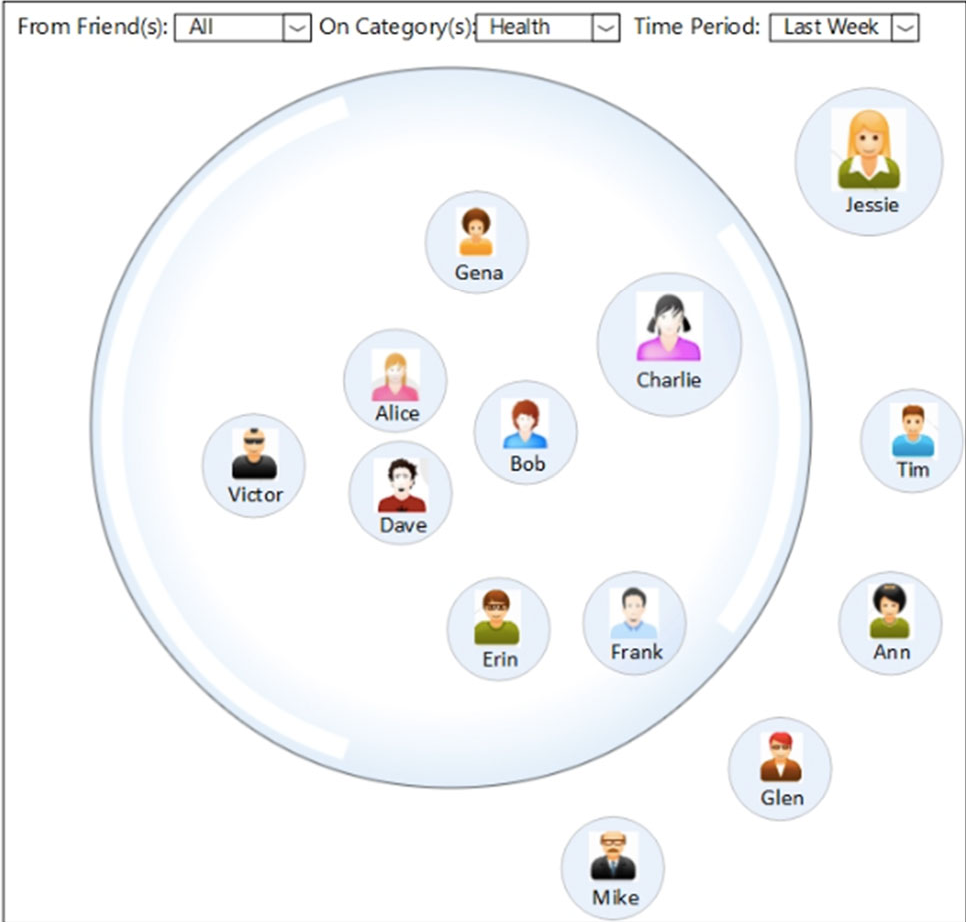 Above: Example of a tool focusing on user control (Liberal model), which allows a user to ironically stay within their bubble if they choose.
Designing for the "Adversary"
So, what would a "Republican" or "Agonistic" anti-bubble tool look like?
- Hegemony Mapping: Visualizing who owns the media outlets you are reading (revealing political/corporate power).
- Contestation Alerts: Notifying you specifically when a government action—that affects you—is being challenged by a grassroots group.
- Forced Friction: Instead of "civil discourse," these tools would allow for "vibrant clashes" where dissent is not smoothed over for the sake of consensus.
Critical Analysis & Conclusion
The paper’s core value is its call for Value Sensitive Design (VSD). It moves the filter bubble debate from a "technical accuracy" problem to a "political philosophy" problem.
Takeaway: We cannot wait for Facebook or Google to "fix" democracy. Their business models are inherently Liberal (user satisfaction). To break the bubble, we need experimental designs that treat the Internet not as a marketplace of ideas, but as a site of political struggle.
Limitations: The study primarily analyzes US-centric tools. The authors admit more cross-cultural research is needed to see how these democratic norms play out in different political climates (e.g., Turkey or the Netherlands).
Future Work: The next frontier is "Agonistic Algorithms"—code that intentionally introduces "productive friction" and prioritizes the voices that the "mainstream" algorithm naturally suppresses.