
Digital Solidarity or Information Hub? Decoding User Reactions to Terror Attacks in the Twittersphere
Breaking News Commentary: Users’ Reactions to Terrorist Attacks in English-Speaking Twittersphere
This study investigates the information behavior of English-speaking Twitter users during three major European terrorist attacks (2015-2016). It analyzes 21,000 "top" tweets to track dissemination patterns, the use of external/internal links, and the impact of these links on user engagement metrics like Retweets and Likes.
TL;DR
When tragedy strikes, does Twitter serve as a news source or a digital memorial? This study analyzes three major terrorist attacks (Charlie Hebdo 2015, Paris 2015, Brussels 2016) to reveal a surprising truth: including links in your tweets might actually decrease your reach. While the platform is a hub for "citizen journalism," the community's immediate reaction is driven more by shared solidarity than by the dissemination of external information.
Background Positioning
Unlike traditional breaking news where expert commentary is sought, terrorist attacks trigger a unique "microphone effect." This paper sits at the intersection of Information Behavior and Crisis Communication, providing a longitudinal look at how "top" tweets—the most influential content—behave in the crucial seven days following a triggering event.
Problem & Motivation: The Citizen Journalist’s Dilemma
Previous literature suggests that Twitter users act as citizen journalists—the first on the scene to report facts. However, the authors noticed a friction: does the "fact-rich" nature of news conflict with the "feeling-intensive" nature of social media? They sought to understand if the technical tools of Twitter (hashtags, @-mentions, and external links) actually help information travel faster, or if they clutter the emotional landscape.
Methodology: A Seven-Day Forensic Analysis
The researchers analyzed 21,000 tweets across three major events (TE1: Charlie Hebdo, TE2: Paris, TE3: Brussels). By sampling 1,000 "top" tweets daily for a week post-attack, they measured:
- Dissemination: Average Retweets (RTs) and Likes.
- Connectivity: Percentage of external links (URLs) vs. internal links (@-mentions).
- Correlations: Whether providing a source (link) statistically improves engagement.
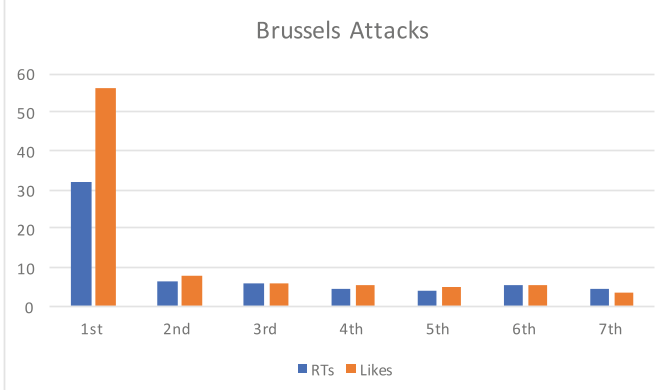 Fig 1. Left: The rapid decay of engagement after the first 24-48 hours. Right: The steady increase of external links (dark bars) as the week progresses.
Key Insights & Results
1. The "Viral Decay"
In all cases, the "impact level" (RTs and Likes) peaked early and suffered an "abrupt drop" by day two. For the Charlie Hebdo attacks, engagement actually peaked on the second day, suggesting a slower global "wake-up" compared to the instantaneous reaction seen in the Paris November attacks.
2. The Link-Engagement Paradox
The most striking finding is the negative correlation found in the Paris attacks data.
- Finding: Tweets containing links (external or internal) often received fewer likes and retweets.
- Physical Intuition: During a crisis, users look for raw, authentic expressions of grief or solidarity (e.g., #PrayForParis). A tweet with an external link feels transactional or "news-like," which may clash with the collective emotional state of the audience.
| Correlation Type | Charlie Hebdo | Paris Attacks | Brussels Attacks |
|---|---|---|---|
| @-mention x Like | -0.011 | -0.03* | -0.005 |
| URL Link x RT | 0.008 | -0.035** | -0.014 |
| (Negative values indicate that links reduced engagement) |
3. Structural Choice
Most users (up to 72%) chose to include either an external link or an internal mention, but rarely both. This suggests a functional divide: a tweet is either a "bridge" to outside news or a "shout-out" within the network, but rarely functions successfully as both in a high-velocity crisis environment.
Critical Analysis & Conclusion
The Takeaway
For researchers and social media practitioners, this paper proves that context is king. In a crisis, the typical "best practices" of social media (citing sources, tagging others) may backfire if they interfere with the perceived sincerity of the message.
Limitations
The study focused only on "Top" tweets, which may suffer from selection bias—these are tweets that already succeeded. It does not account for the "long tail" of millions of tweets that never achieved visibility. Furthermore, purely quantitative analysis misses the sentiment—did the links lead to helpful resources or inflammatory content?
Future Outlook
As algorithms on platforms like X now actively penalize external links to keep users on-site, the "Link-Engagement Paradox" identified here has likely intensified. Future research should look at how multimedia (images/videos) acts as a middle ground between cold facts and raw emotion, potentially offering a more effective way to be a "citizen journalist" without sacrificing impact.