
Beyond the Zuckerberg Myth: Why the Best Founders Spend a Decade as Employees
Breaking the Zuckerberg Myth: Successful Entrepreneurs Have 10 Years of Prior Employment Utilizing Data Science and Machine Learning to Study Socio-Economic Patterns Among Successful Entrepreneurs
This study utilizes Data Science and Machine Learning (Random Forest, Stability Selection) to analyze socio-economic traits of successful entrepreneurs. It identifies that "Years of Employment" is the most significant predictor of early-stage venture success, defined by valuation increases between Series A and B rounds.
TL;DR
Forget the "brilliant college dropout" narrative. A data-driven study from UC Berkeley reveals that the most successful founders—those who drive the highest valuation growth between Series A and B—typically have 10 to 12 years of prior work experience. Using Machine Learning techniques like Random Forest and Stability Selection, researchers found that professional longevity is a far more powerful predictor of success than having "Google" on your resume or an Ivy League degree.
Context: Quantifying the "Gut Feeling" of Venture Capital
For decades, entrepreneurship research resided in the realm of qualitative case studies. While we knew "experience matters," we couldn't quantify how much or identify which specific traits actually moved the needle on venture valuation. This paper shifts the paradigm by treating entrepreneurship as a data science problem, applying the UC Berkeley Data-X framework to public data from LinkedIn, Crunchbase, and Pitchbook.
Methodology: The Machine Learning Stack
The researchers didn't just look at simple correlations; they employed a sophisticated ensemble of features selection techniques to handle the complex, non-linear nature of business success:
- Distance Correlation: Unlike the standard Pearson Correlation, this captures non-linear relationships (e.g., if success peaks at a certain age and then plateaus).
- Random Forest Regression (RFR): Used to determine feature importance by seeing which variables most effectively reduce "impurity" in predicting valuation jumps.
- Stability Selection: A robust method that runs selection algorithms on data subsets to ensure a feature's importance isn't just a statistical fluke.
 Fig 1. The intersection of Machine Learning and Entrepreneurship Research.
Key Findings: The 10-Year Sweet Spot
The results were striking. Across almost every statistical test, Years of Employment emerged as the king of predictors.
- Work Experience > Brand Names: Surprisingly, "Worked at Google" or "Worked at Microsoft" ranked near the bottom of predictive importance. It’s the duration of professional exposure, not the prestige of the employer, that correlates with success.
- The Optimal Window: The study found a non-linear relationship where valuation increase peaks for founders who spent roughly a decade in the workforce before launching their startup.
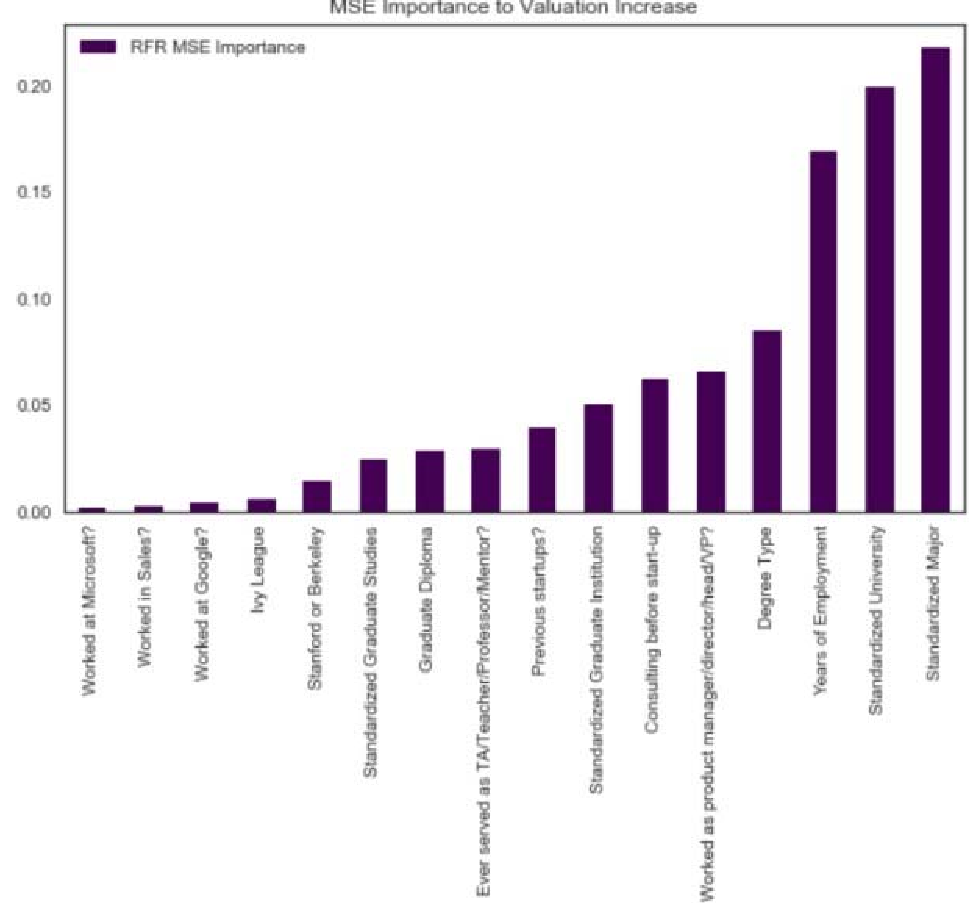 Fig 2. Random Forest Regression results highlight 'Years of Employment' and 'Standardized Major' as top features.
Analysis: Why Does 10 Years Matter?
The authors suggest that this decade of employment likely provides:
- Operational Maturity: Understanding how organizations scale and fail.
- Social Capital: A robust network of potential hires, partners, and customers.
- Risk Mitigation: Financial stability that allows for more calculated risk-taking.
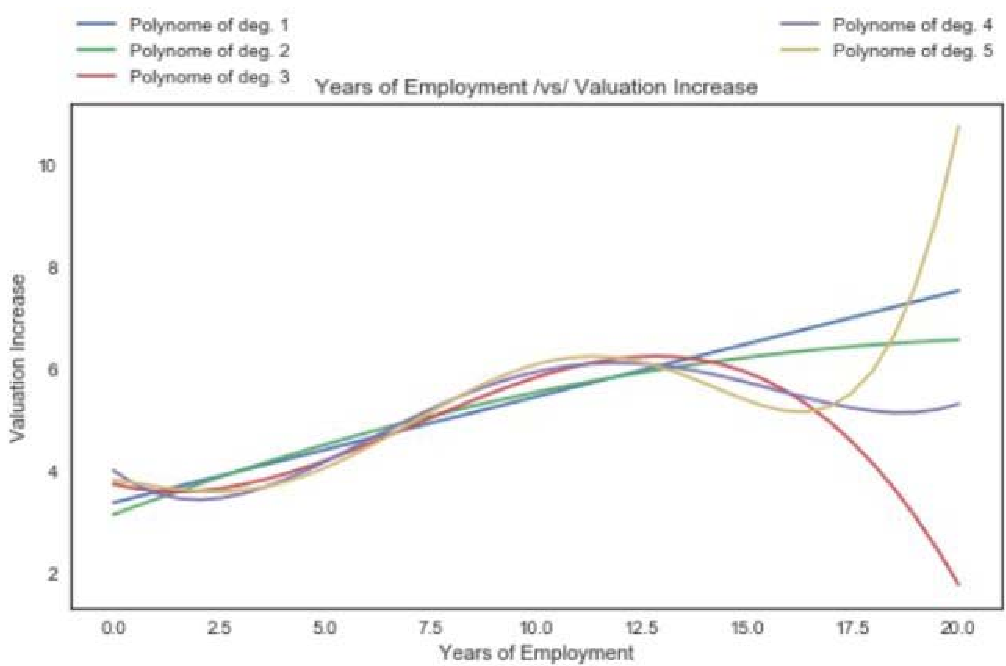 Fig 3. Polynomial regression showing the "sweet spot" of employment years for maximum valuation growth.
Conclusion and Future Outlook
This paper serves as a vital reality check for the venture capital ecosystem. While the "young prodigy" makes for a compelling headline, the data suggests that industry veterans are the ones building the most value.
Limitations: The sample size (244 founders) is modest, and the data is skewed toward US-based LinkedIn users. However, the methodology provides a blueprint for a new era of "Computational Entrepreneurship" where data, rather than myth, dictates investment strategy.
The Takeaway: If you’re a mid-career professional thinking you’ve missed the startup boat—think again. You might just be entering your prime.