
Bridging the Gap: How Pathology-Aware GANs Transform the AI-Healthcare Landscape
Bridging the Gap Between AI and Healthcare Sides: Towards Developing Clinically Relevant AI-Powered Diagnosis Systems
The paper introduces a cross-disciplinary framework to bridge the "AI-Healthcare gap" in medical imaging, specifically focusing on Pathology-Aware Generative Adversarial Networks (GANs). By combining expert workshops and physician surveys, the authors validate GAN-based data augmentation and training tools as viable solutions for medical data paucity in clinical environments.
TL;DR
Bridging the gap between a high-performing CNN model and a functional clinical tool is one of the hardest challenges in modern medicine. This paper investigates the "AI-Healthcare gap" through a unique interdisciplinary workshop and validates that Pathology-Aware GANs can solve the medical data paucity problem while serving as effective tools for physician training.
Background: The Great Divide
In the laboratory, Deep Learning models frequently match or exceed human performance in diagnosing conditions from CT or MR scans. However, the "real world" of healthcare—particularly in regions like Japan—faces massive hurdles:
- Data Silos: Rigid ethical codes and lack of unified annotation standards.
- The Trust Gap: Clinicians often find AI's "black box" nature unsettling, regardless of its accuracy.
- Commercial Viability: A lack of clear financial incentives for hospitals to adopt high-tech diagnostic systems.
Methodology: The Pathology-Aware GAN
The researchers don't just advocate for AI; they propose a specific technical solution: Pathology-Aware GANs.
1. Interpolation and Extrapolation
Unlike natural images, medical images (X-ray, CT, MR) have strong anatomical consistency. The authors use:
- Noise-to-Image GANs: Generating diverse pathological images from random noise to increase dataset diversity.
- Image-to-Image GANs: Translating benign scans into malignant ones to provide paired data for better model sensitivity.
2. Bounding-Box Conditioning
To reduce the annotation burden on busy physicians, the methodology focuses on bounding box-based GANs. This allows the model to generate realistic brain metastases or lung nodules at specific positions, sizes, and attenuations.
 Figure 1: The workflow integrating technical GAN research with clinical feedback loops.
Clinical Insights: What Radiologists Actually Want
The paper’s most unique contribution is the Questionnaire Survey and Workshop results.
High Stakes vs. High Hopes
The survey revealed that while radiologists are "AI-enthusiastic" (scoring high on interest), they have specific requirements:
- AI as an Alert: Clinicians prefer AI as a "reliable second opinion" or an alert system to prevent oversight due to fatigue, rather than a replacement for their expertise.
- Safety vs. Feeling Safe: There is a distinction between a model being theoretically safe (accurate) and a doctor feeling safe using it. Explainability (via heatmaps) is helpful but the physician’s intervention remains essential for the final diagnosis/communication to the patient.
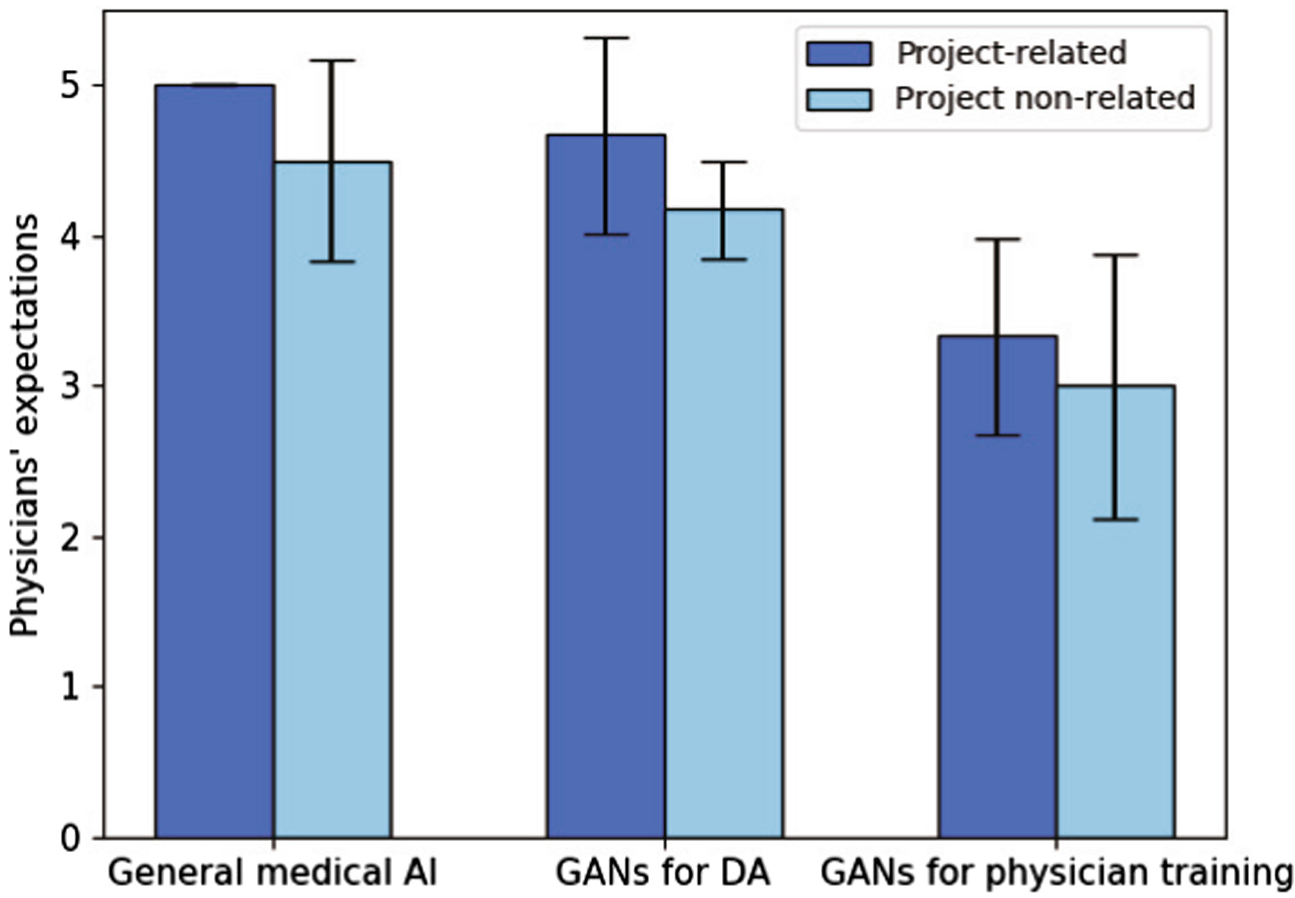 Figure 2: Survey scores showing positive reception for GAN-based Data Augmentation (DA) and Physician Training.
Experiments & Results: Validating Relevance
The authors successfully demonstrated that:
- Sensitivity Boost: GAN-generated synthetic images directly improved the detection rates of CAD systems when real annotated data was scarce.
- Training Utility: Physicians were generally positive about using synthetic "atypical" cases to train medical students, provided the realism is high enough avoid confusion.
Critical Analysis & Conclusion
Takeaway
The value of this work lies in its translational approach. It moves past the "Efficiency" metric of AI and addresses the "Human" metric. By using GANs for Information Conversion, the authors offer a way to generate infinite training data and educational scenarios, effectively bypassing the legal and ethical bottlenecks of medical data sharing.
Limitations & Future Work
The study is currently focused on the Japanese medical context. Future work needs to explore:
- Radiogenomics: Integrating genetic biomarkers with GAN generation.
- Multi-institutional Validation: Ensuring GAN-generated images don't just replicate the biases of one scanner type but generalize across different hospitals.
Ultimately, the success of AI in healthcare won't be measured by its F1-score alone, but by how well it assists the fatigued physician in the clinic.