
Designing for Diversity: How Participatory Design Bridges the Gender and Generation Gap in ICT
Bridging the gender and generation gap by ICT applying a participatory design process
This paper presents an interdisciplinary research project titled "Bridging the Gender and Generation Gap by ICT," which utilizes a Participatory Design approach to address the Digital Divide. By involving 73 participants across diverse age groups (14-65) and genders, the authors developed the "Family Wheel" concept, a gender-informed ICT service that achieves SOTA social inclusion by distributing local responsibilities and managing availability.
Executive Summary
TL;DR: This research tackles the "Digital Divide" not as a lack of hardware, but as a lack of inclusive design. By engaging women from ages 14 to 65 in a co-creation process, the researchers identified distinct "life-phase" needs—ranging from the high-stress connectivity of teenagers to the organizational "rush hour" of working mothers. The resulting "Family Wheel" concept demonstrates how ICT can promote social equality by distributing chores and managing availability rather than just increasing screen time.
Positioning: This work is a seminal case study in Human-Computer Interaction (HCI) that shifts the focus from "User-Centered" (designing for users) to "Participatory" (designing with users) to combat systemic biases in technology development.
The "I-Methodology" Trap
The authors argue that most ICT is built by a "homogeneous group" (predominantly male engineers), leading to the I-Methodology—a phenomenon where designers unconsciously build for themselves. This creates a vacuum in the market where the specific needs of women (who manage complex domestic and professional spheres) and the elderly are overlooked. The result? Technology that often feels like a burden rather than a tool for empowerment.
Methodology: Beyond Standard Surveys
To extract "tacit knowledge"—things users want but can't easily articulate—the team used Cultural Probes.
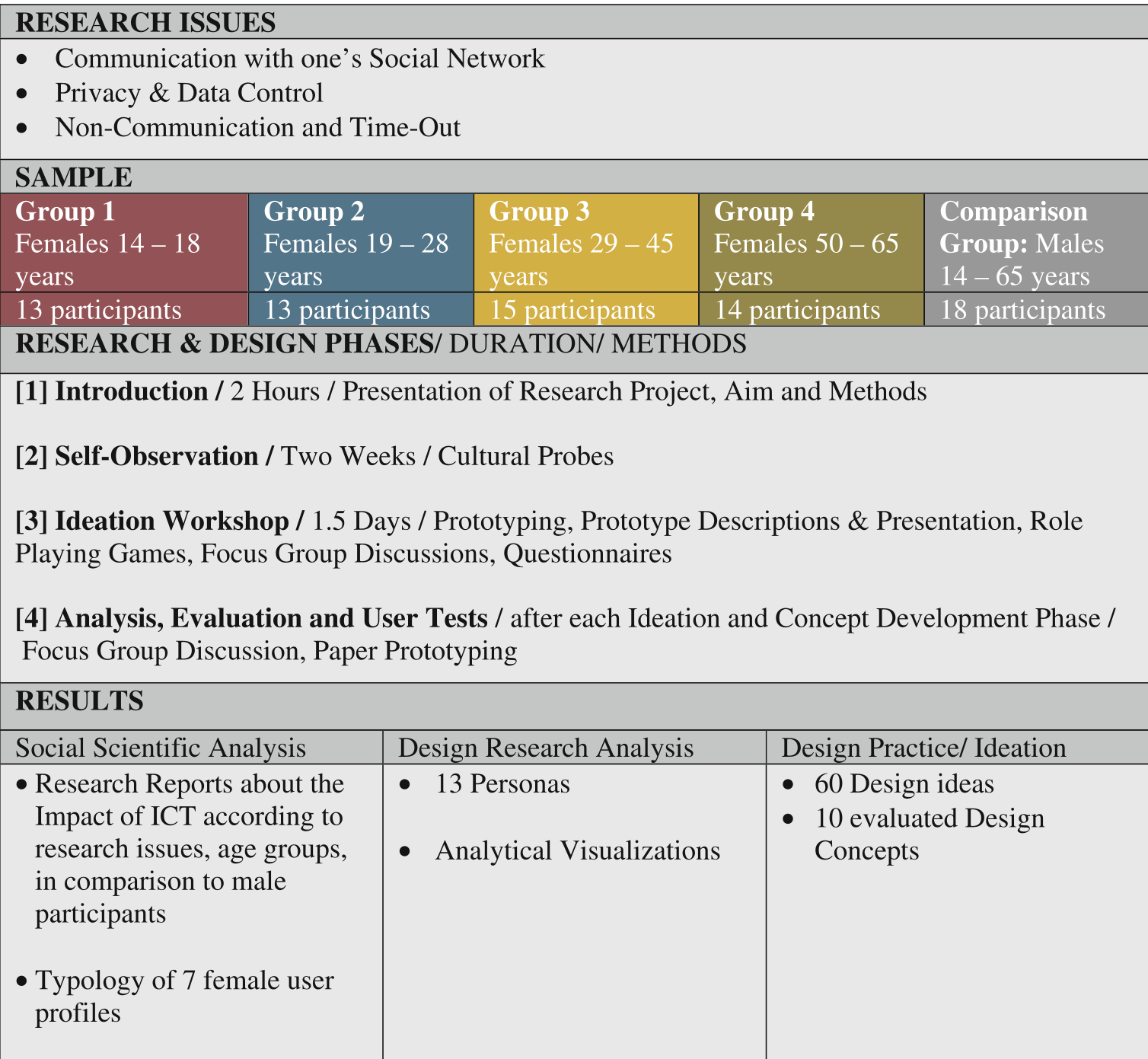
Key interventions included:
- Communication Diets: Forcing participants to switch off all devices for a day to reveal their psychological dependency on ICT.
- Ideation Workshops: Using low-fidelity prototyping (paper, cardboard) to let participants "build" their dream Life-Managers.

Core Insight: The Evolution of Use Across Life Phases
The study's most striking finding is the correlation between age and ICT stress:
- Teenagers (14-18): Use ICT for self-esteem and peer connection. They are the most "addicted" and report the highest levels of anxiety regarding "constant availability."
- The "Rush Hour" Group (29-45): Use ICT as a "Life Manager." These women coordinate household, childcare, and professional duties. They explicitly asked for ICT that could help them "disappear" or filter contacts selectively.
- The Seniors (50-65): The most autonomous. They view tech as a tool for emergencies but are much more likely to ignore the phone to protect their leisure time.
The Solution: The "Family Wheel"
Based on these insights, the researchers developed the Family Wheel. It isn't just a contact list; it's a distributed responsibility mechanism.
- The "Status Hub": Members indicate if they are "Available," "Busy," or "Away."
- The Smart Chain: If a mother needs help (e.g., picking up a sick child), the app calls members in a specific order but automatically skips anyone marked "Busy."
- Psychological Relief: Women reported that this tool reduces the "embarrassment" of asking for favors, as it turns a personal request into a transparent system of mutual aid.

Critical Insight & Conclusion
Takeaway
True innovation occurs when we move away from "one-size-fits-all" interfaces. The Family Wheel proves that by designing for the "extreme" needs of a working mother or a digital-native teenager, we end up with features (like availability management and automated calling chains) that are highly valuable to everyone, including men and professional organizations.
Limitations & Future Work
The study remains qualitative (73 people), meaning it provides "inspirational" rather than "statistically representative" data. Future research should investigate how these participatory models scale to global, cross-cultural contexts.
Overall, this paper serves as a blueprint for how to turn diversity from a "compliance checkbox" into a "design engine" for SOTA technology.