
Bridging the Divide: Why "Fun" is the Secret Weapon for High-Quality Crowdsourcing
Bridging the Utilitarian-Hedonic Divide in Crowdsourcing Applications
The paper introduces TrendRack, a mobile crowdsourcing application designed to bridge the gap between utilitarian tasks and hedonic user experiences. By integrating fashion-specific interaction metaphors and gamification elements, the study demonstrates how to engage specialized crowds (e.g., fashion customers) in everyday contexts for tasks like image similarity judgment.
TL;DR
Crowdsourcing is often viewed as a digital "sweatshop" of micro-tasks (utilitarian) or disguised as addictive games (hedonic). This paper introduces TrendRack, a hybrid mobile app for fashion trend analysis. By blending a "clothing rack" interaction metaphor with social gamification, the researchers proved that we can engage specialized, fashion-aware experts during their "spare time" without relying solely on financial incentives. Their findings suggest that a balanced system—one that is both productive and pleasurable—leads to higher engagement and better data.
The Problem: The "All Work and No Play" Syndrome
Current crowdsourcing suffers from a dichotomy. On one side, we have platforms like Amazon Mechanical Turk (AMT) that are efficient but suffer from "cheating" behavior and varying data quality because workers are only there for the paycheck. On the other side, we have Games-With-A-Purpose (GWAPs) like the ESP Game, where the "work" is hidden behind a game.
The authors argue that this divide ignores a massive opportunity: specialized crowds. You can't hire a fashion expert or a loyal customer for $0.05 a task; they aren't motivated by micro-payments. To reach them, we need to bridge the gap between utility (the task) and hedonics (the joy of use).
Methodology: Designing for Fashionistas
The researchers developed TrendRack, an app where users judge the similarity of garments (e.g., comparing a brand's skirt to a social media photo).
1. The Interaction Metaphor
Instead of boring check-boxes, the app uses a virtual clothing rack. Users drag and drop images onto hangers. This mimics the natural, "joyful" behavior of sorting clothes, making the task intuitive and contextually relevant.
2. Gamification Framework
The system employs three layers of "fun":
- Visual Feedback: Celebratory "fireworks" and chime sounds upon task completion.
- Social Status: Progression-based badges (from "Trend Observer" to "Fashion Goddess").
- Competition: A real-time leaderboard to engage the user's competitive drive.
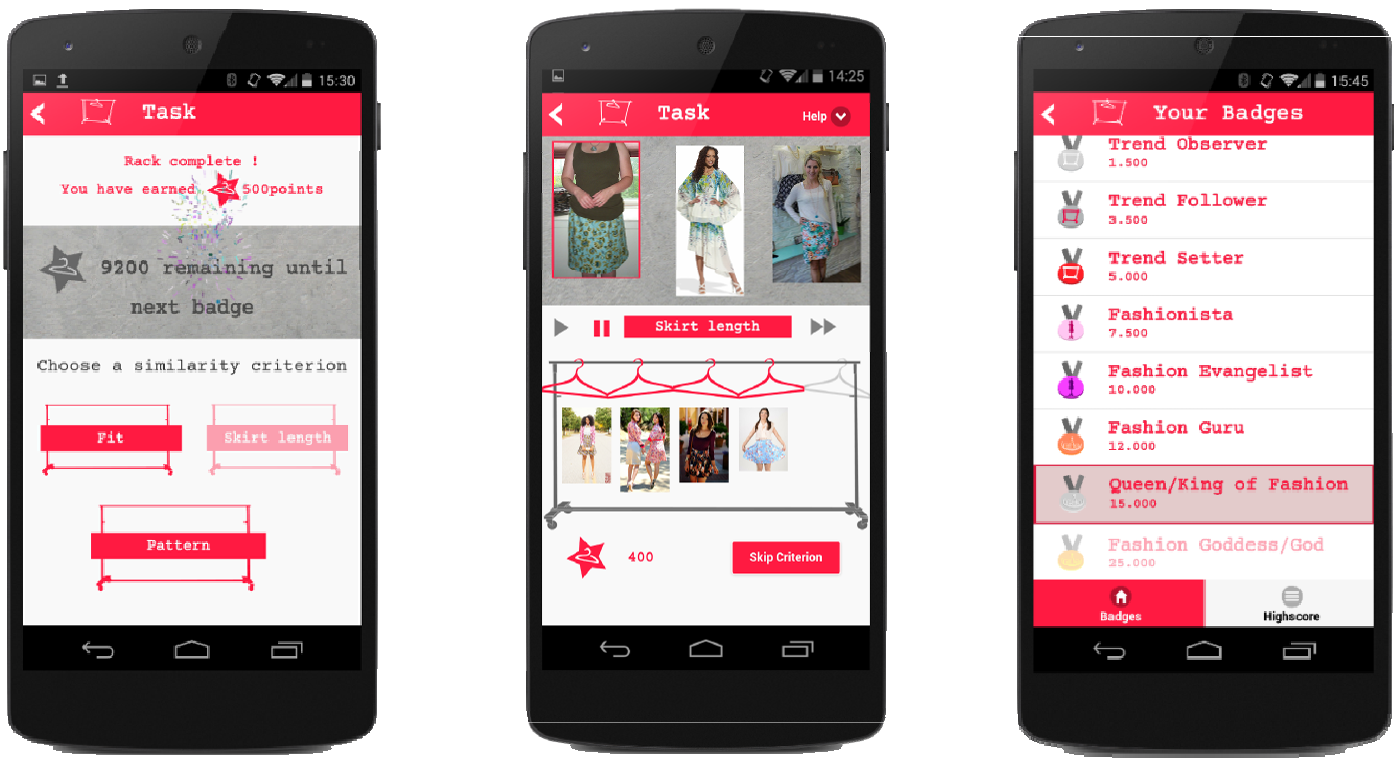 Figure 1: The hybrid design showing the similarity task (left), feedback (center), and social leaderboard (right).
Experiments & Results: Does It Actually Work?
The study compared two settings: an Online Crowd Experiment (active for 15 days) and an Offline User Study (a controlled workshop).
Key Findings:
- The "Balanced" Sweet Spot: Using the AttrakDiff2 questionnaire, the app was rated high in both Pragmatic Quality (PQ) and Hedonic Quality-Stimulation (HQ-S). This is rare; usually, as "fun" goes up, "usability" goes down.
- Natural Context Engagement: Users participated while commuting, watching TV, or even on "smoke breaks." The "high-score list" was visited almost daily, proving that social competition is a powerful hook for specialized crowds.
- Productivity: Participants skipped almost zero tasks, suggesting that when the UI is appealing, users are less likely to "drop out" than on traditional utilitarian platforms.
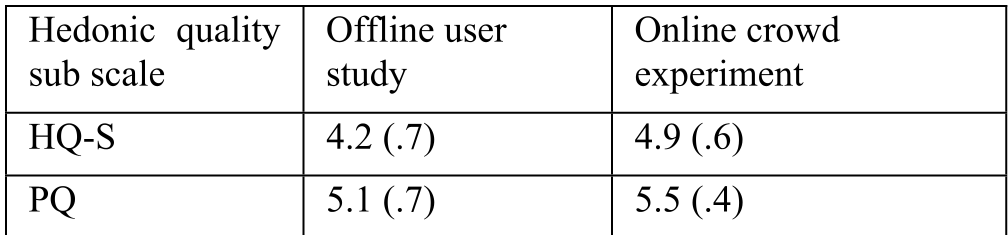 Table 1: Comparison of Hedonic (HQ-S) and Pragmatic (PQ) quality scores across study settings.
Critical Insight & Perspective
The most significant takeaway here isn't just "add points to your app." It is the holistic redesign of the task metaphor. By making the task look and feel like the hobby the users already love (fashion), the authors "lowered the barrier to entry" for human intelligence tasks.
Limitations: The sample size (17 users) is small, and the study acknowledges that we need a direct A/B test against a "utilitarian-only" baseline to quantify the exact ROI of these hedonic elements.
Future Outlook
This work paves the way for "customer-as-a-worker" models. Imagine a world where SMEs (small businesses) don't pay experts for data, but instead engage their own fanbases through "fun" interfaces that offer social status or vouchers as rewards. The "Utility-Hedonic" bridge is the key to unlocking the untapped intelligence of enthusiasts everywhere.