
Social Computing: Decoding the Computational DNA of Web 2.0
A brief survey of computational approaches in Social Computing
This paper provides a comprehensive survey of Social Computing, focusing on computational methodologies for analyzing social behaviors across Web 2.0 platforms. It categorizes the field into key social platforms and specific technical tasks like social network analysis, collaborative filtering, and sentiment analysis.
TL;DR
Social Computing is not just "computers being social"; it is a multi-disciplinary paradigm that uses machine learning to model human behavior. This survey explores how we move beyond treating data as isolated points to treating it as a linked social fabric, utilizing everything from graph mining to "human-centric" games.
Background: The Shift to Contextual Intelligence
In the era of Web 2.0, connectivity is ubiquitous. Unlike traditional data mining where each record is an island, Social Computing assumes that every piece of data is enriched with personal and social context. The authors identify three pillars:
- Connectivity: The medium and relations among people.
- Collaboration: Positive (filtering) and negative (adversarial) human interactions.
- Community: The collective wisdom formed by clustering similar interests.
The Social Platforms: Where Data is Born
The paper categorizes the "arenas" of social computing into several critical domains:
- Social Networks: Platforms like Facebook or LinkedIn where explicit (friendships) and implicit (group participation) links define influence.
- Human Computation (GWAP): An ingenious approach where humans solve tasks computers find difficult (like image tagging) through games like the "ESP Game."
- Social Bookmarking/Tagging: Using "folksonomies" to index the web faster and more accurately than traditional crawlers.
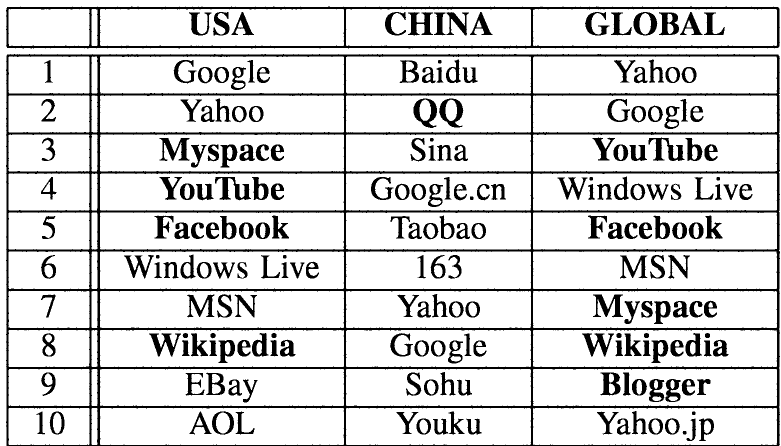 The table above highlights how social platforms (Google/YouTube/Facebook) dominate global traffic, necessitating sophisticated computational analysis.
Methodology: The Core Computational Tasks
The authors dive deep into the algorithms that power modern social platforms:
Ranking and Link Analysis
Standard PageRank is no longer enough. The survey discusses TrustRank and DiffusionRank, which use link structures to filter spam. By treating the web as a graph, these algorithms can isolate "reputable" nodes from "spam clusters."
Collaborative Filtering (CF)
This is the engine of recommendation systems (e.g., Amazon, Netflix). The paper breaks CF down into:
- Memory-based: Using neighbors (user-to-user or item-to-item) to predict interests.
- Model-based: Utilizing latent factor models (like Matrix Factorization) to handle sparse data.
Sentiment Analysis
How do we know if a review is positive or negative? The paper reviews NLP techniques, ranging from lexicon-based approaches (dictionaries of "good" vs. "bad" words) to unsupervised methods using Pointwise Mutual Information (PMI).
Experiments & Results: Fighting the "Anti-Social" Tagger
A major challenge in social systems is "spamming." The researchers highlight how integrating content relevance with social interaction models creates robust ranking. For instance, DiffusionRank acts as a "penicillin" for web spam by simulating heat diffusion across the web graph to identify the most robustly connected, high-quality pages.
Conceptual visualization of how link analysis identifies community structures and isolates noise.
Critical Analysis & Future Outlook
Takeaway: The survey emphasizes that the "Latent Information" in human communities is the next frontier. We aren't just mining text; we are mining the intent and reputation behind the text.
Limitations: Written in 2008/2009, the paper pre-dates the explosion of Transformers and Deep Graph Learning. While the "Social Theory" remains solid, the "Computational Tasks" have since moved toward high-dimensional embedding spaces (vectors) rather than simple graph metrics.
Future Directions: The integration of Social Computing with Large Language Models (LLMs) offers a fascinating path. Crowdsourcing (Human Computation) is now central to RLHF (Reinforcement Learning from Human Feedback), proving that the authors' focus on "Human Brain Power" was ahead of its time.