
Breathing Life into the Past: Heterogeneous Crowd Simulation for Digital Heritage
A proposed methodology of bringing past life in digital cultural heritage through crowd simulation: a case study in George Town, Malaysia
2019-07-12
Summary
Problem
Method
Results
Takeaways
Abstract
This paper proposes a multi-layered methodology to virtualize past life in digital cultural heritage using heterogeneous crowd simulation, exemplified by a case study of 19th-century George Town, Malaysia. The core framework integrates a hierarchical state machine and a high-level controller with a particle-based Boid algorithm to simulate complex inter-ethnic interactions among four distinct groups (Indian, Malay, Chinese, and British).
## TL;DR
Researchers have developed a sophisticated methodology to "re-populate" historical sites with dynamic, culturally specific digital crowds. By combining classical flocking algorithms with Hierarchical State Machines and real-time parameter controls, they successfully recreated the bustling 19th-century trading port of George Town, Malaysia, featuring realistic interactions between diverse ethnic groups.
## The Missing Link in Digital Heritage
Most virtual heritage projects excel at building beautiful, but empty, 3D models of ancient cities. To truly understand a site like Weld Quay in George Town, one must see the **interaction**: Indian coolies carrying goods, Malay vendors haggling, and British soldiers patrolling. The "Past Life" is not just about buildings; it is about the **social atmosphere**.
The challenge is that historical records rarely provide individual-level movement data. This paper addresses this by using **microscopic crowd simulation** to generate emergent behaviors from simple, ethnically-distinct social rules.
## Methodology: The Three Pillars of Believable Simulation
### 1. Heterogeneous Steering (How they move)
The system utilizes a particle-based "Boid" algorithm but extends it with **inter-ethnic interaction formalism**. Each ethnic group is assigned specific steering weights for behaviors like alignment, cohesion, and separation.
* **Malay Sellers**: Exhibit "Seeking" and "Wandering" behaviors to find customers.
* **Indian Coolies**: Use "Queuing" and "Path-following" to load/unload ships.
* **British Soldiers**: Utilize "Leader-following" for disciplined patrols.
### 2. Hierarchical State Machine (What they do)
To handle complex logic (e.g., a thief deciding to rob a vendor), the authors implemented a **Hierarchical State Machine (HSM)**. This allows for individual "storylines." An agent might be in a "Wandering" state, shift to "Stealing" if the "isPoliceNearby" condition is false, and then transition to "Being Caught" and "Following Police."
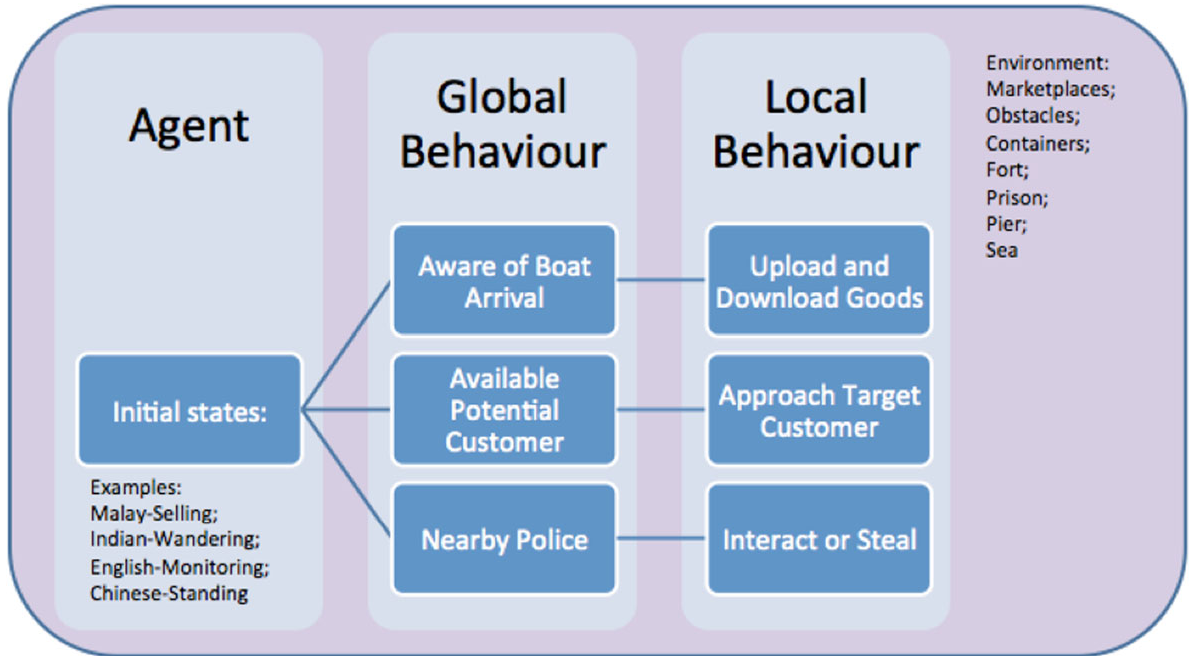
*Fig 1. Inter-ethnic interaction models showing global and local event triggers.*
### 3. High-Level Controller (Real-time Adaptation)
A custom "Flock Manager" allows designers to tweak parameters—like speed, mass, and vision angle—in real-time during the simulation. This is vital for "look-and-feel" validation where mathematical precision is secondary to visual believability.
## Strategic Experimental Results
The methodology was tested in a reconstructed 19th-century George Town environment. By introducing **Mass as a dynamic variable** (e.g., Indian coolies becoming 200% heavier when carrying goods), the simulation achieved realistic acceleration and momentum changes.

*Fig 2. Validation of specific social interactions: A British captain greeting a client while his soldiers follow in formation.*
Key Achievements:
- **Scale**: Real-time simulation of heterogeneous groups ranging from 200 to 20,000 agents.
- **Complex Formations**: Successful "V-like" and "Line-Abreast" formations for military parades and escorting missions.
- **Navigation Utility**: A new "Smooth Turning" algorithm based on angle prediction prevented the common "deadlock" problem where agents get stuck at narrow pier corners.
## Critical Insight: Why This Matters
The paper highlights a shift from **Tangible Heritage** (buildings) to **Intangible Heritage** (behaviors). By formalizing social interactions as computable states, the authors provide a template for "Virtual Museums" where visitors don't just see the past—they participate in its rhythm.
### Limitations & Future Work
While the "look-and-feel" is strong, the model lacks a **Chaotic System** or **Economic Model** to drive emergent behaviors based on resource scarcity or fatigue. Future iterations plan to integrate "Crowd Patches" for distant, more deterministic crowds to save computational resources while focusing real-time microscopic simulation on agents near the user.
## Conclusion
This methodology proves that digital heritage is most effective when it is **alive**. Through the lens of 19th-century Malaysia, we see how ethnic diversity informs the global motion of a city, providing a more profound historical narrative than a static model ever could.