
Beyond Unicast: Revitalizing Mobile Social Networks with Broadcast-Based Caching and D2D Multi-Hop
Enabling Broadcast-based Offload and Distributed Caching for Mobile Social Networks
2020-01-01
Summary
Problem
Method
Results
Takeaways
Abstract
This paper introduces a novel framework for offloading social networking traffic using MBMS-based broadcast and distributed caching within RAN and device clusters. By leveraging UE mobility dynamics and proactive multi-hop D2D communication, the system optimizes content placement to reduce backhaul pressure and latency.
## TL;DR
Social media consumption is drowning modern Radio Access Networks (RAN). This paper from Samsung Electronics proposes a paradigm shift: instead of serving every "Like" and video via unicast, we should **broadcast** popular asynchronous content to a subset of mobile devices. By using these devices as distributed cache holders and leveraging **multi-hop D2D communication**, the network can dramatically reduce backhaul congestion and meet strict latency requirements.
## The Problem: The Asynchronous Traffic Nightmare
Current mobile networks are optimized for real-time streams, yet social media (Facebook, WhatsApp) is largely **asynchronous**. When a million users check their feeds at different times, the repetitive unicast transmissions create a "bottleneck" at the RAN and backhaul level.
Previous edge-caching research focused on static nodes. However, in a Mobile Social Network (MSN), the "nodes" are users on the move. Ignoring **UE mobility** and specific **Quality of Service (QoS)** bounds leads to "stale" caches or missed delivery deadlines.
## The Methodology: Broadcast Meets Proactive Multi-Hop
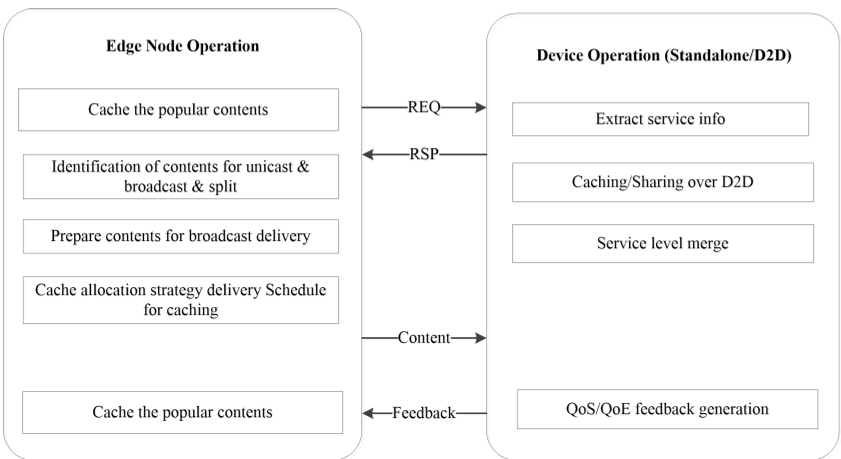
The authors propose a structured framework that bridges the gap between the core network and the device cluster.
### 1. Hybrid Delivery Modes
The system categorizes traffic into three paths:
- **Synchronous (Live):** Standard Broadcast.
- **Popular Asynchronous:** MBMS-based Initial Cache Placement.
- **Specific/Private:** Conventional Unicast.
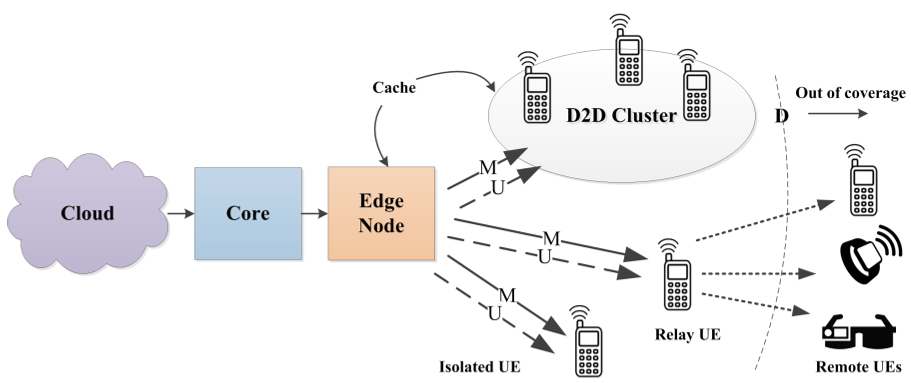
### 2. Mobility-Aware Cache Selection
Not all devices are built equal. The framework uses a **Two-Step Filtering** process:
- **Step A:** Filters by hardware capability and user willingness.
- **Step B:** Groups UEs by cluster connectivity and mobility state (Low, Medium, High).
Interestingly, the authors find that **high-mobility UEs** can actually be superior cache holders because they "encounter" more peers, facilitating faster content dissemination across the network.
### 3. Proactive Multi-Hop for QoS
To meet a latency deadline ($T$), the system doesn't wait for a 1-to-1 encounter. It uses **proactive multi-hop communication**. If a requesting UE can't reach a cache holder directly, the content is "relayed" through the cluster. This essentially creates a living, breathing mesh of social data.
## Performance: Efficiency through Skewness
The research highlights that the strategy is most effective when content popularity follows a **"Long Tail" distribution** (Zipf profile).
- **RAN Cost Saving:** Multi-hop approach keeps the infrastructure load low even when latency requirements are tight.
- **High Mobility Advantage:** High-speed UEs acting as "data ferries" significantly boost the probability of content hitting the target within the QoS window.
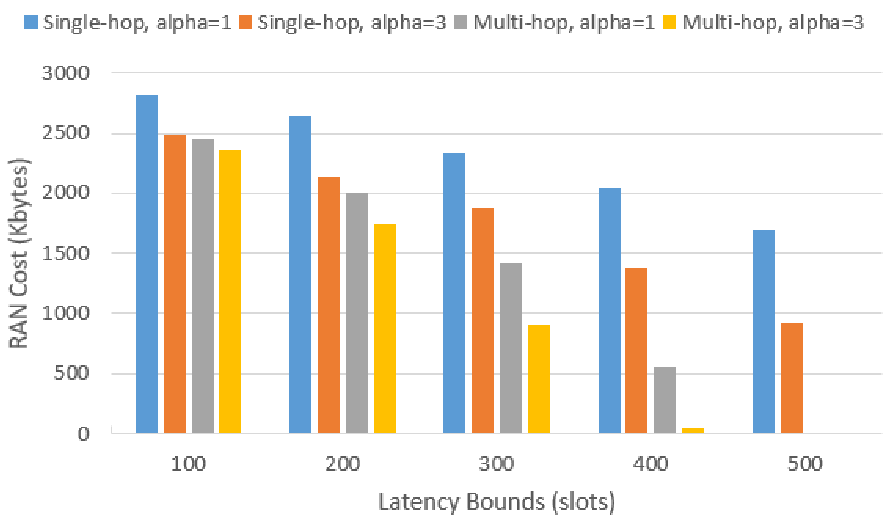
*Note: The results indicate that skewed popularity ($\alpha=3$) significantly enhances content availability.*
## Critical Analysis & Future Outlook
**The Takeaway:** This research proves that "Crowdsourced Caching" is not just a theory but a scalable architecture when combined with 3GPP standards like MBMS.
**Limitations:**
- **Battery & Privacy:** The paper assumes UEs are "willing" to cache. In reality, incentivizing users to spare their battery and bandwidth remains a hurdle.
- **Security:** Multi-hop D2D introduces potential "Man-in-the-middle" risks for social data.
**The Road Ahead:** As we move toward 6G, the integration of **Sidelink (D2D)** and **AI-driven mobility prediction** will likely make these broadcast-offload frameworks the standard for managing the next explosion of social media traffic.