
Spkr: Breaking the Echo Chamber with a "Pushy" Smart Home Assistant
Broadening Exposure to Socio-Political Opinions via a Pushy Smart Home Device
The paper introduces Spkr, a "pushy" smart home device designed to combat filter bubbles by proactively broadcasting diverse socio-political opinions from Twitter into the domestic space. Using the two-dimensional Nolan Chart for content alignment, the study demonstrates that unpredictable, voice-based "pushes" can successfully bypass selective exposure and trigger meaningful household debates.
TL;DR
Researchers have developed Spkr, a smart home device that doesn't wait to be spoken to. Instead, it "pushes" diverse and often conflicting socio-political opinions from Twitter into your living room. By utilizing a two-dimensional political model and the inherent social dynamics of the home, Spkr successfully forces users out of their "filter bubbles" and sparks real-world family debates.
The Problem: The Walls of the Filter Bubble are Thicker Than We Think
Despite the internet’s promise of a digital public sphere, we are increasingly trapped in echo chambers. Current solutions often fail because they require active user effort—most people simply won't click on a news article that challenges their core beliefs. Furthermore, categorizing politics as just "Left vs. Right" is a reductionist approach that ignores the complexities of modern ideology.
Methodology: The Power of Proactive Interruption
The authors took a radical approach: Adversarial Design. They built Spkr using an Amazon Echo and a Raspberry Pi, but with a twist—the device is "pushy."
1. Beyond the Left-Right Binary: The Nolan Chart
To ensure true ideological diversity, the team used the Nolan Chart. Unlike a simple spectrum, this two-dimensional chart plots Economic Liberty against Social Liberty. This allowed the researchers to serve a nuanced mix of content:
- 40% Aligned with the user's view.
- 40% From the diametrically opposite quadrant.
- 20% Centrist/Neutral to provide context.
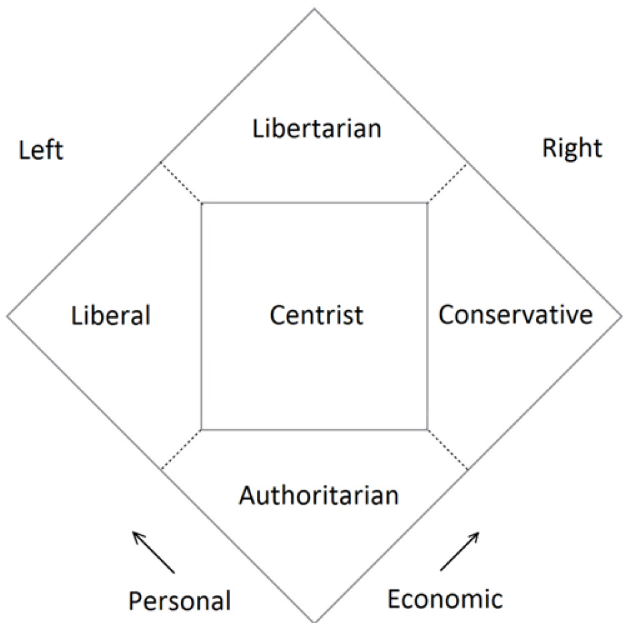 Figure: The Nolan Chart used to map political diversity (Image source: Paper Figure 2).
2. Ephemerality as a Feature
Spkr broadcasts are ephemeral. There is no "Replay" button. This design choice capitalizes on the "scarcity of the moment," forcing household members to stop what they are doing and listen carefully, often leading to immediate verbal reactions or "shushing" others in the room to catch the broadcast.
Experimental Results: From Passive Listening to Active Debate
The 28-day "in-the-wild" study revealed that Spkr transformed the home from a private retreat into a space for agonistic reflection.
- The Catalyst Effect: Spkr didn't just provide info; it provoked conversation. Participants reported discussing topics with partners and even children that they would usually ignore.
- Critical Inquiry: Hearing a variety of viewpoints (sometimes in a single hour) led participants to ask, "Am I right in thinking that?" Many engaged in "secondary research," Googling the topics Spkr mentioned to form their own conclusions.
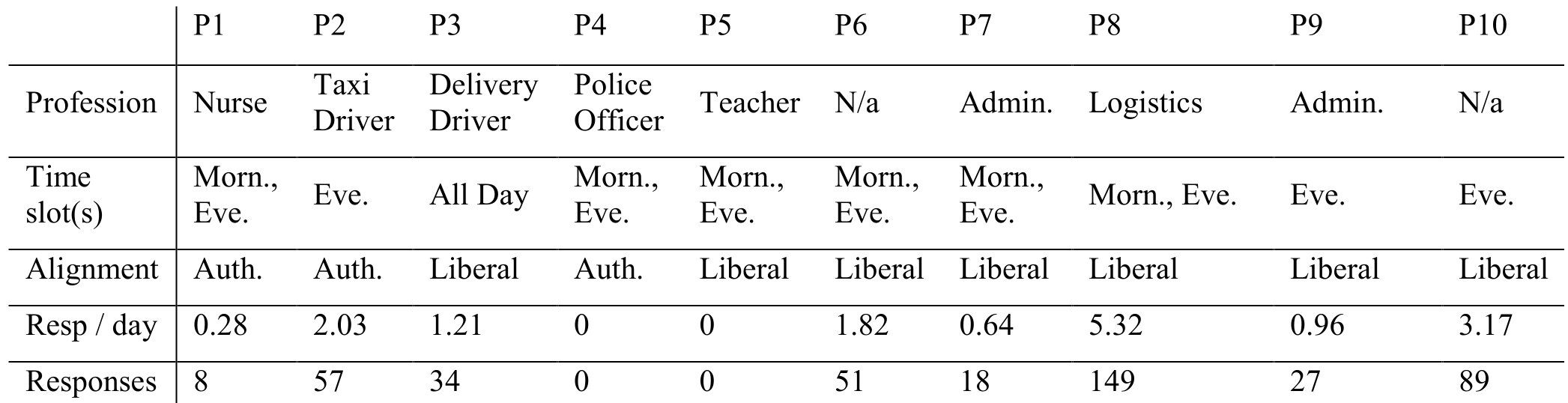 Table: Data showing the high frequency of user responses across the 10 households (Image source: Paper Table 2).
Deep Insights: The Ethics of a "Pushy" Future
The brilliance of Spkr lies in its disruption of the "subservient AI" trope. Current assistants like Alexa or Siri are designed to be "polite" and "helpful," which often means reinforcing user preferences. Spkr argues that for democracy to thrive, technology must sometimes be uncomfortable.
Caveats & Ethical Concerns: While effective, a "pushy" device carries risks. Who controls the "push"? If a device can influence political thought in the home, it becomes a powerful tool for potential propaganda or surveillance (becoming a "political sensor").
Conclusion: A New Blueprint for Digital Democracy
Spkr proves that the smart home is not just for turning off lights—it is a potent site for socio-political engagement. By reintroducing serendipity and confrontation into our most private spaces, we can begin to puncture the filter bubbles that social media algorithms have spent a decade building.