
Beyond Fixed Servers: Crowdsourcing Global Website Monitoring via Browser Extensions
17677_Browser Extension-based Crowdsourcing Model for Website Monitoring.
This paper introduces a browser extension-based crowdsourcing model for global website monitoring. By utilizing a network of real-user browser extensions as checkpoints, the system achieves unprecedented coverage across diverse geographical locations and Internet Service Providers (ISPs), surpassing the limitations of traditional server-based monitoring services.
TL;DR
State-of-the-art website monitoring often fails because it uses "perfect" servers in data centers to simulate "imperfect" users in homes. This paper introduces a crowdsourcing model that transforms standard browser extensions into global monitoring checkpoints. By leveraging millions of actual internet users, the system provides granular insights into how websites perform across specific cities, ISPs, and browsers—at a fraction of the cost of traditional infrastructure.
The "Data Center Gap" in Website Monitoring
If you are a webmaster in New York, your monitoring service might tell you your site is "Up" because their server in an Asian data center can reach it. However, a user in Hanoi using a specific local ISP might find your site unreachable due to a local DNS failure or a routing bottleneck.
Current SOTA tools suffer from three fatal flaws:
- Sparse Vertices: Too few checkpoints (mostly continental, rarely city-level).
- ISP Homogeneity: Monitoring servers use high-end backbone connections, failing to replicate the "last-mile" issues of residential ISPs.
- Synthetic Bias: High-performance servers don't reflect the varied resource constraints of real-world browsers.
Methodology: The Browser-as-a-Sensor
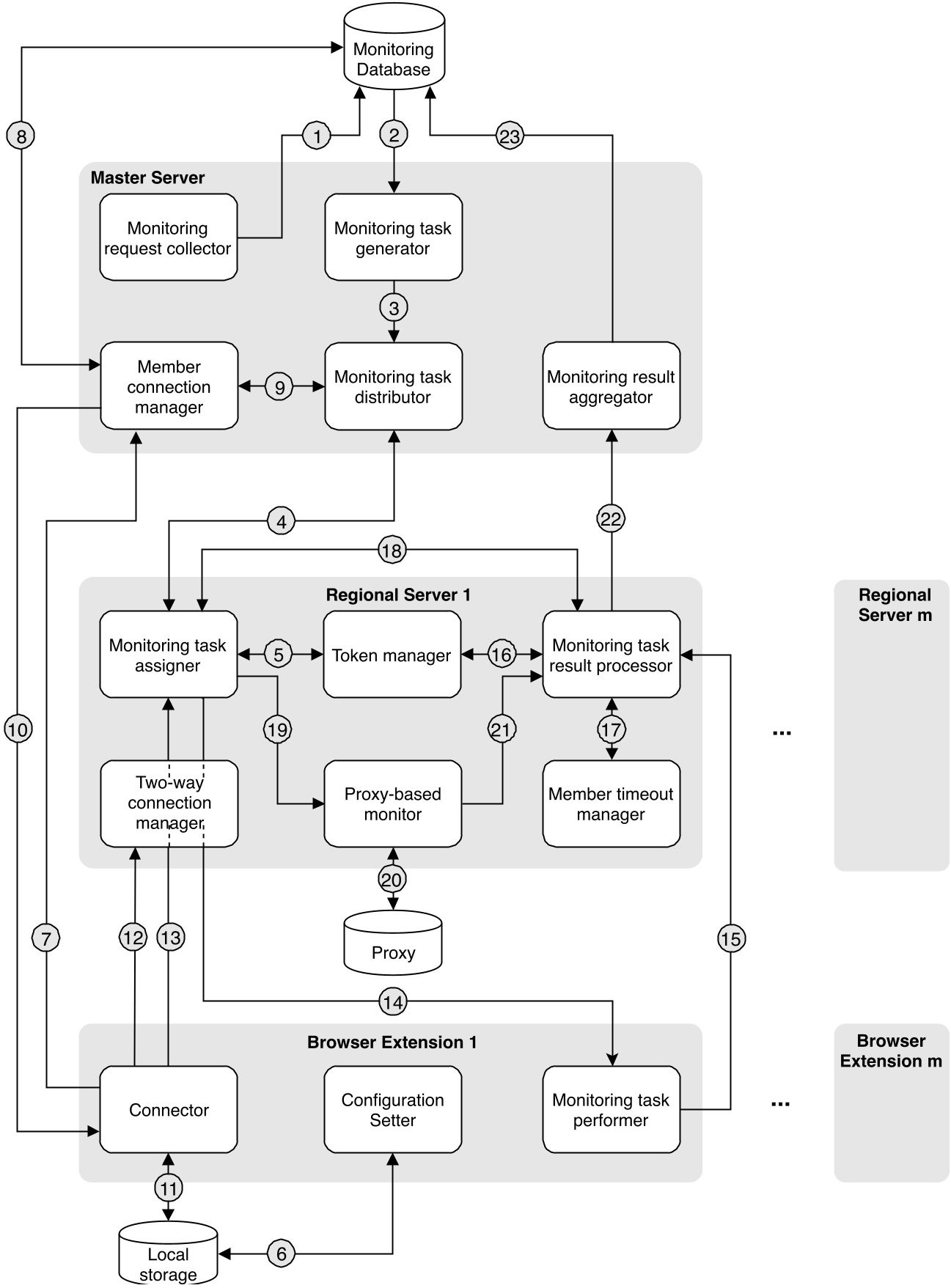
The authors propose a hierarchical architecture designed to manage the volatility of a "crowd" (where users connect and disconnect randomly).
1. The Architecture
The system is split into three layers:
- Master Server: Handles the high-level logic, request collection, and task batching.
- Regional Servers: These act as localized hubs to manage real-time connections with extensions, reducing latency and master-node load.
- Crowd Members: Users who install a lightweight Firefox/Chrome extension that performs background HTTP requests and reports resource timing.
2. Batch Processing for Efficiency
Instead of sending one request per task, the system uses a Batch Processing Technique. If three different webmasters want to monitor their sites from Vienna, the system packs these into a single "Task Batch" assigned to one user in Vienna. This minimizes communication overhead and maximizes the utility of each crowd member's session.
Managing Quality and Trust
One major concern in crowdsourcing is the "Malicious Participant" problem—individuals spoofing results to claim rewards. The authors implement a multi-layered verification strategy:
- Token Management: Unique tokens accompany every task to prevent replay attacks.
- Multiple & Repeated Checking: High-stakes alerts are only triggered if multiple independent crowd members in the same region report the same failure.
- Seed Members: Reliable "anchor" servers act as ground truth to verify crowd-reported anomalies.
Real-World Performance & Visualization
The prototype, integrated with the VNIST monitoring service, offers a level of granularity that standard dashboards lack. Webmasters can view Geographical Performance Heatmaps and drill down into ISP-specific latency.
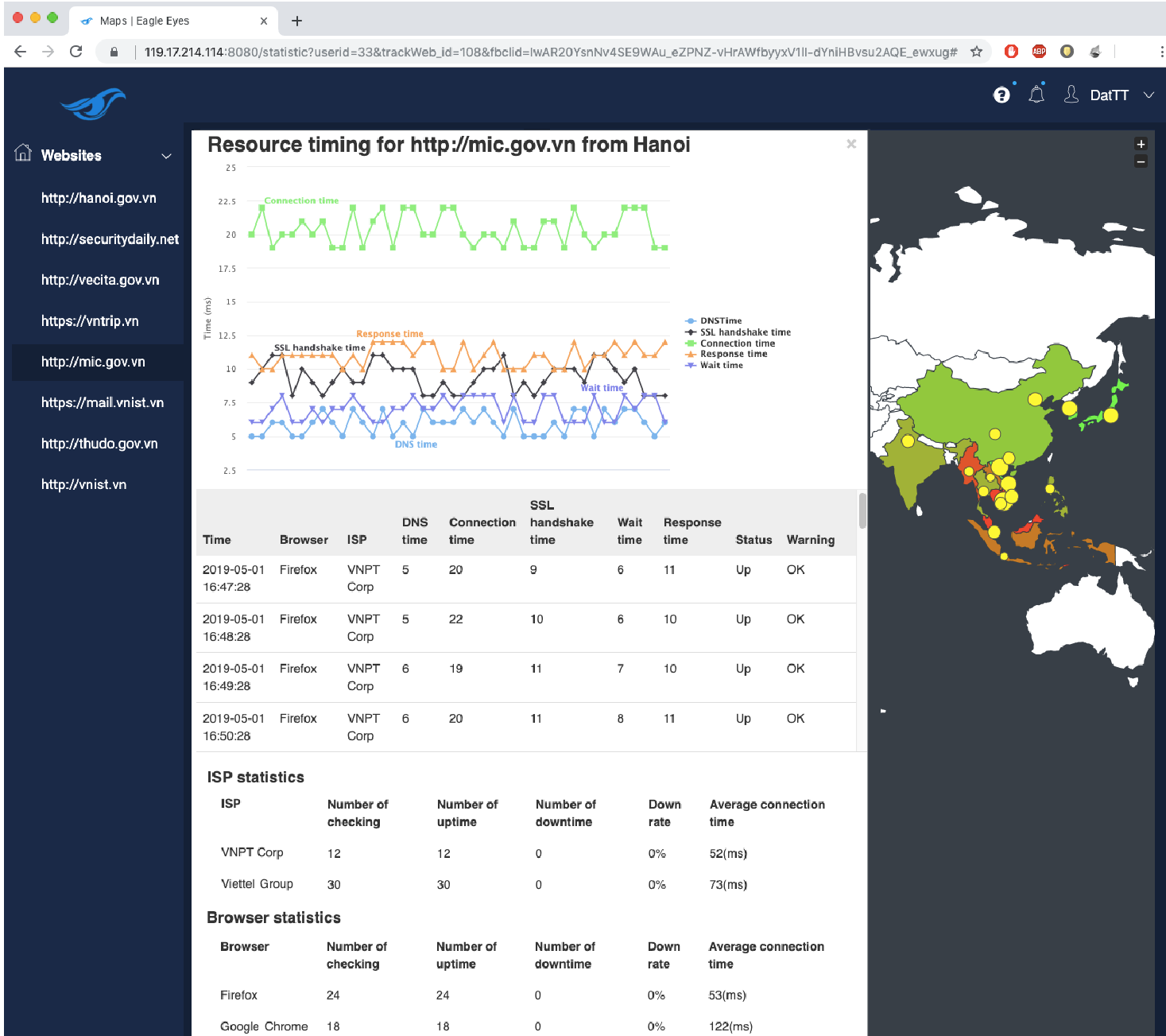
The results provide a breakdown of:
- DNS Time
- SSL Handshake Time
- Waiting/Response Time
This allows a webmaster to see, for example, that their website is slow in Thailand specifically due to a slow SSL handshake on a particular ISP, an insight nearly impossible to gain with standard global checkpoints.
Critical Insight & Conclusion
The brilliance of this work lies in its incentive alignment. Users monetize their idle bandwidth (which is less resource-intensive than crypto-mining), and webmasters get "Real User Monitoring" (RUM) data without having to inject heavy scripts into their own site's frontend.
Future Outlook: While the paper focuses on uptime, this extension-based model could be extended to Security Monitoring. A global crowd could detect "Man-in-the-middle" attacks or localized "DNS Poisoning" in real-time by comparing results across thousands of diverse entry points. The next challenge for this research is the automated optimization of regional server placement based on fluctuating crowd density.
Takeaway for Engineers
If you are building global-scale applications, stop relying solely on Pingdom-style pings. Look into decentralizing your observability stack—the most accurate data about your users' experience comes from the users themselves.