
Beyond the Numbers: Fusing BSC, Network DEA, and Linguistics for Intelligent Performance Forecasting
A BSC-based network DEA model equipped with computational linguistics for performance assessment and improvement
This paper proposes a fusion architecture combining Balanced Scorecards (BSCs) and Network Data Envelopment Analysis (NDEA) for multi-dimensional corporate performance assessment. The method integrates computational linguistics (readability indices) and AI techniques (Random Vector Functional Link networks and Genetic Algorithms) to enhance performance forecasting and provide human-readable decision logic.
Executive Summary
TL;DR: Traditional financial analysis is often "blind" to qualitative nuances and internal operational dynamics. This paper introduces a sophisticated fusion model that combines Balanced Scorecards (BSC), Network DEA, and Computational Linguistics to predict corporate success. By analyzing the "readability" of annual reports and opening the "black box" of efficiency models, the authors achieve superior forecasting accuracy and provide transparent decision rules for managers.
Academic Positioning: This work bridges the gap between traditional management accounting (BSC/DEA) and modern AI, specifically addressing the "interpretability" crisis in financial forecasting.
The "Black Box" Problem in Performance Evaluation
Why do most performance evaluation models fail? The authors point to two critical flaws:
- The Quantitative Trap: 80% of an annual report is narrative text, yet most models only use the 20% that is numerical.
- The Black Box of Efficiency: Standard Data Envelopment Analysis (DEA) tells you if a company is efficient, but not where it is failing internally (e.g., is it a marketing failure or a learning-and-growth failure?).
Methodology: Opening the Box with NDEA and AI
The proposed architecture is a four-stage pipeline designed to transition from raw data to actionable "human-readable" rules.
1. BSC-based Network DEA
Unlike traditional DEA, which treats a firm as a single input-output unit, Network DEA (NDEA) decomposes the firm into stages aligned with the four BSC perspectives: Financial, Customer, Internal Process, and Learning & Growth.
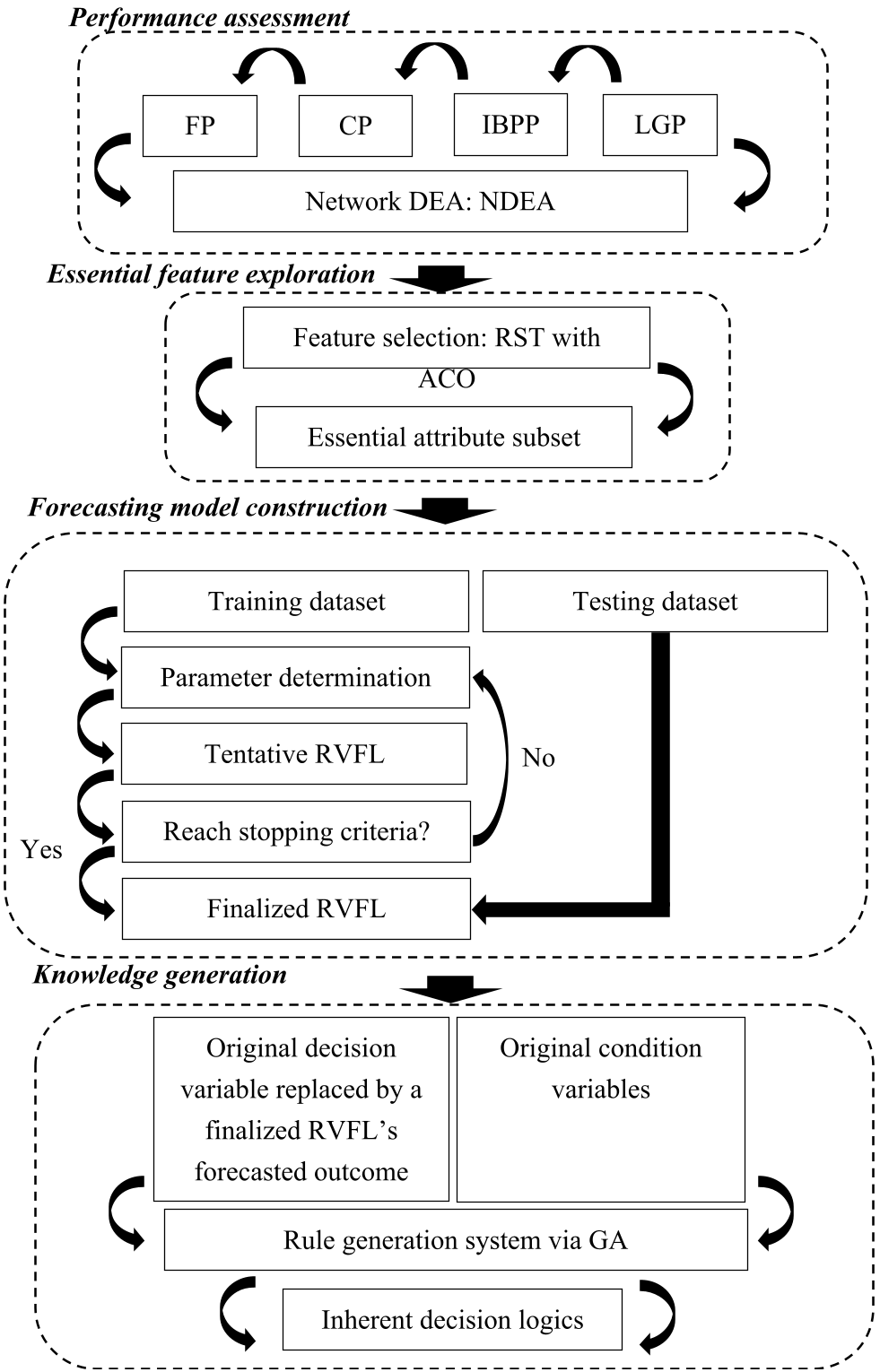 The interaction between BSC perspectives allows for a "cause-and-effect" analysis of efficiency.
2. The Linguistic Edge: Readability as a Feature
The authors argue that "complex disclosure" is often a smoke screen for poor management. They utilize the Gunning Fog Index (GFI) to measure the complexity of the "Letter to Shareholders." This qualitative metric proved to be a statistically significant predictor of corporate distress.
3. Rapid Forecasting with RVFL
For the prediction engine, the study employs the Random Vector Functional Link (RVFL) network. Unlike traditional back-propagation neural networks, RVFL uses random weights and direct links from input to output, allowing for significantly faster training and better avoidance of local minima.
Experimental Evidence & SOTA Results
Testing on the Taiwan electronics industry, the fusion model demonstrated clear superiority.
| Metric | Introduced Fusion Model | BPNN (Neural Net) | SVM |
|---|---|---|---|
| Overall Accuracy | 84.49% | 77.82% | 74.62% |
| F-Measure | 84.62% | 78.03% | 74.23% |
 Decomposition analysis: NDEA identifies that even "top ranked" firms may have specific weaknesses in internal processes that traditional DEA overlooks.
The "Explainability" Factor
To ensure managers actually trust the model, the authors used a Genetic Algorithm (GA) to extract symbolic rules. An example rule might look like:
- IF Total Debt/Total Assets is [25%, 33%] AND Gunning Fog Index is low [12, 14] THEN Company is Efficient.
Critical Insight & Conclusion
The true value of this paper lies in its validation of readability. The study confirms the "obfuscation hypothesis": managers experiencing bad operations strategically use jargon and complex sentence structures to mislead market participants.
Takeaway for Practitioners:
- Don't just watch the ROI; watch the readability of the CEO's letter.
- Use NDEA to identify the specific "internal link" where your resources are being wasted.
Limitations: The study is currently focused on the high-tech sector in Taiwan. Future research should test if these linguistic triggers hold same weight in more traditional industries or different cultural contexts.