
BTR: Bridging the Cold-Start Gap in Crowdsourcing with Bayesian Feature Mapping
BTR: A Feature-Based Bayesian Task Recommendation Scheme for Crowdsourcing System
The paper introduces Bayesian Task Recommendation (BTR), a hybrid scheme combining Content Filtering and Collaborative Filtering to address task cold-start issues in crowdsourcing systems. By mapping task features into a latent semantic space using neural networks, BTR achieves SOTA performance in recommending newly arrived tasks to appropriate workers.
TL;DR
In the fast-paced world of crowdsourcing (e.g., Amazon Mechanical Turk), tasks arrive and expire in the blink of an eye. This creates a "Complete Cold Start" problem where traditional recommendation algorithms fail. BTR (Bayesian Task Recommendation) solves this by using neural networks to map task features (like descriptions and rewards) directly into a latent preference space, achieving an AUC of 0.77 and significantly outperforming traditional collaborative filtering.
The Problem: The High Cost of Discovery
Crowdsourcing is supposed to be efficient, but for many workers, the search cost—the time spent finding a suitable task—is comparable to the task's actual duration.
- Timeliness: Tasks expire quickly; recommending an old task is useless.
- The Cold Start Trap: Most recommendation engines (like Matrix Factorization) need historical data for a specific Task ID. When a new task arrives, the system has no "memory" of it, making accurate matching nearly impossible.
Methodology: From IDs to Features
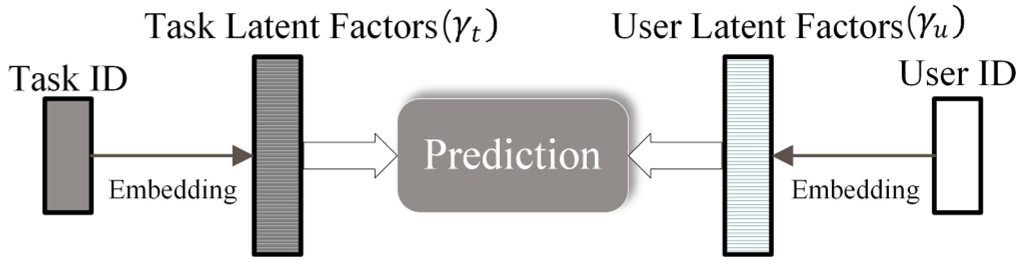
The core innovation of BTR is the shift from Task-ID-based learning to Feature-based learning. Instead of learning what "Task #402" is, the system learns what "a data labeling task with a $0.50 reward" represents in a latent semantic space.
1. Neural Semantic Embedding
BTR uses a neural network to process high-dimensional features. As shown in the architecture below, it takes task features (processed via Word2Vec and GloVe) and applies an embedding matrix to produce a -dimensional latent vector .
2. Bayesian Personalized Ranking (BPR)
The model is optimized using a pairwise approach. Instead of predicting a single score, it learns to rank tasks: if a worker performed task , the model ensures the predicted preference is higher than for any unobserved task .
Experiments and Results
The researchers tested BTR using real-world data from the NAACL 2010 AMT Workshop.
The "Anti-Intuitive" Finding
Initially, when splitting data strictly by time, all models performed poorly (barely better than random). The authors realized that in real crowdsourcing, the same "crowdsourcer" often posts similar tasks. By adjusting the dataset to reflect this—training on 75% of a requester's history and testing on the new 25%—the model's true power was revealed.
Performance Comparison
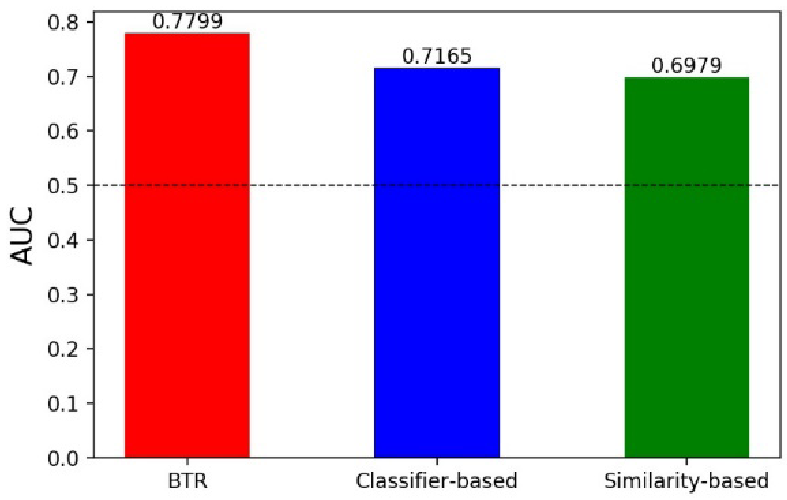
BTR consistently outperformed Similarity-based methods (TF-IDF) and Classifier-based methods (XGBoost).
- BTR AUC: ~0.77
- RAND AUC: 0.50 (Benchmark)
Critical Insight: Why BTR Works
The "magic" of BTR lies in its internal interpretation of task categories. Even if a platform doesn't explicitly categorize tasks (e.g., "Image Tagging" vs. "Translation"), BTR's embedding layer acts as a soft-classifier. It groups tasks with similar descriptions and reward structures together, allowing it to leverage "wisdom from similar past tasks" for every new item that enters the system.
Conclusion
BTR provides a robust framework for dynamic environments where "items" are ephemeral. By replacing static IDs with flexible feature embeddings, it effectively kills the cold-start problem.
Future Directions: The authors suggest integrating real-time interest capturing (to account for worker fatigue or hourly preference changes) and re-ranking strategies to ensure the recommended list isn't just accurate, but also diverse.