
Zig-Zag Algorithm: Optimizing the "Many-to-Many" Pulse of Video Crowdsourcing
Budget-Aware Video Crowdsourcing at the Cloud-Enhanced Mobile Edge
The paper introduces a budget-aware optimization framework for MEC-enhanced video crowdsourcing, specifically targeting "many-to-many" scenarios like distance education. It proposes the "Zig-Zag" algorithm to minimize system makespan (end-to-end delay) by jointly optimizing server placement and user association across cloud-enhanced mobile edge nodes.
TL;DR
In the era of TikTok and Zoom-based distance education, video crowdsourcing is moving from simple broadcasting to complex many-to-many interactions. This paper addresses a critical gap: how do we minimize the total time it takes for content from many creators to reach many viewers (makespan) when we have a strictly limited budget? The authors propose the Zig-Zag Algorithm, a framework that breaks down the NP-hard problem of server selection and user association into solvable mathematical pieces.
The "Locality" Fallacy in Crowdsourcing
Most edge computing research operates on a simple heuristic: Local is Best. If a user is near a base station, process their data there. However, in crowdsourcing—where data from Generator A and Generator B must be fused before being sent to Viewer C—relying solely on the nearest node can lead to massive inter-server traffic and bottlenecks.
The authors argue that "locality" must be balanced against "cost-effectiveness." Renting a VM at every local base station is expensive. Conversely, sending everything to a single central cloud increases latency. The challenge is finding the "sweet spot" within a budget constraint.
Methodology: The Four-Tier Architecture
The paper transforms the traditional server-client pairing into a more sophisticated four-tier structure:
- Generators: Content creators (e.g., students in a virtual class).
- UL Servers: Edge nodes that collect and aggregate raw data.
- DL Servers: Nodes that process the aggregated content and handle distribution.
- Viewers: The final consumers of the processed video.
Breaking Down the Math
To handle the complexity, the authors represent the system as a set of linear constraints. They use Mixed-Integer Linear Programming (MILP) to solve two decoupled problems:
- Optimal Viewer Association: Mapping viewers to DL servers to satisfy budget and time.
- Optimal Generator Association: Mapping creators to UL servers to minimize initial upload delay.
 Figure 1: The architecture demonstrates how generators and viewers are associated with different edge servers (UL and DL), highlighting the importance of server-server communication.
The Zig-Zag Algorithm
The core contribution is the Zig-Zag Algorithm, which adjusts its strategy based on the available budget ():
- High Budget: Favors the Distributed Scheme. It utilizes as many local resources as possible to slash latency.
- Medium Budget: Focuses on Generator Offloading. It uses a centralized DL server to save costs but distributes UL tasks to improve upload speeds.
- Low Budget: Falls back to Brute-Force Search across limited combinations to find any possible saving.
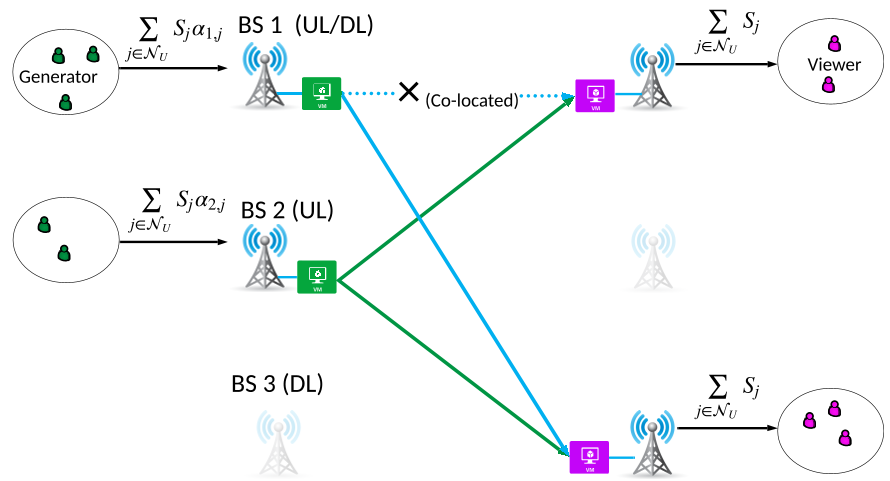 Figure 2: The timing diagram (makespan) shows the sequencing of uploading, processing, and downloading across multiple servers.
Experimental Insights
The researchers tested the algorithm against standard baselines:
- Centralized Case: One server for everyone.
- Distributed Case: Closest server for everyone (YouTube's typical strategy).
Key Findings:
- Scalability: As the number of Base Stations (BS) increases, the Zig-Zag algorithm provides significantly better makespan reduction (up to 40% improvement over centralized baselines in some scenarios).
- Budget Sensitivity: The algorithm successfully finds feasible solutions where the pure "Distributed Case" would fail due to excessive costs.
- Diminishing Returns: Once the budget is high enough to support full distribution, additional money doesn't significantly lower latency—proving that the "locality" limit is hard-coded into the physical network topology.
 Figure 3: Experimental results illustrate the makespan reduction across different user densities and base station counts.
Conclusion & Future Outlook
This work provides a rigorous mathematical foundation for the next generation of mobile video applications. By moving away from simple "nearest-node" heuristics and toward an optimization-centric, budget-aware approach, application providers can deliver high-quality, low-latency video without breaking the bank.
Future Work: The authors plan to integrate more sophisticated time-dependent wireless resource scheduling and examine more complex network topologies to further refine the efficiency of the Zig-Zag approach.