
Nucleus Decomposition: Precision Strikes in Budget-Constrained Influence Maximization
Locating Influential Agents in Social Networks: Budget-Constrained Seed Set Selection
This paper introduces k-nucleus decomposition as a tool for identifying influential agents in social networks under budget constraints. By leveraging clique-based dense subgraphs, the method locates a small, highly effective seed set that outperforms traditional k-core and k-truss techniques across multiple diffusion models (IC, LT, and SIR).
TL;DR
In the world of viral marketing and rumor control, identifying the right "seed" nodes is a billion-dollar problem. This paper moves beyond simple degree counts and triangle clusters, introducing k-nucleus decomposition (specifically 3,4-nuclei) to find the most influential agents. The result? Smaller, high-impact seed sets that are faster to compute and more effective at spreading information than traditional k-core or k-truss methods.
Background: The Cost of Influence
Most Influence Maximization (IM) research focuses on "What is the maximum spread I can get with nodes?" However, in the real world, the problem is often "I have a tiny budget; who are the absolute most potent individuals?"
Prior works relied on:
- k-core: Nodes with at least neighbors.
- k-truss: Edges that are part of at least triangles.
While useful, these often return a seed set that is too large or includes "fringe" nodes that happen to have many connections but lack the structural density to truly anchor an information cascade.
Methodology: The Power of the Nucleus
The core innovation here is the shift to Nucleus Decomposition. If a k-core looks at nodes (1-cliques) and a k-truss looks at edges (2-cliques), a k-nucleus looks at higher-order cliques (e.g., 3-cliques or triangles forming 4-cliques).
Why it works (The Intuition)
A k-(3,4)-nucleus represents a region where triangles are incredibly tightly packed into 4-node cliques (tetrahedrons). Nodes within these structures aren't just "well-connected"; they are part of the network's "nuclear" core. This density acts as a catalyst for diffusion models like Independent Cascade (IC) or Linear Threshold (LT) because the high internal connectivity ensures that once one person in the nucleus is "infected," the entire core activates and projects information outward with high pressure.
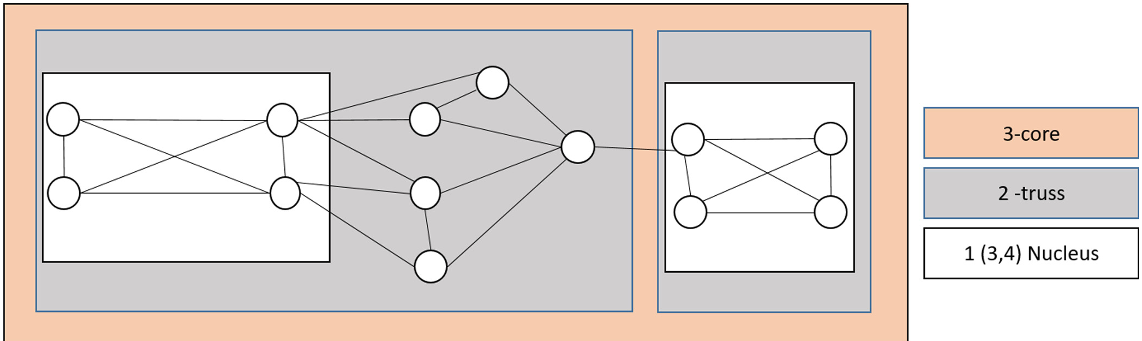 Figure 1: Illustration of how 1-nuclei and 2-trusses identify much tighter, more potent subgraphs compared to the 3-core.
Experiments: Superior Efficiency
The authors tested their approach on four datasets: WikiVote, Slashdot, Epinions, and EuEmail.
1. Seed Set Precision
The nucleus method naturally filters for quality over quantity. In the WikiVote dataset, the maximal k-core identified 332 nodes, while the k-nucleus narrowed it down to just 37. This 90% reduction in seed size is critical for budget-constrained applications.
2. Spreading Performance
Does a smaller set mean less spread? Surprisingly, no. The per-node efficiency of nucleus nodes was consistently higher. In the Linear Threshold model, nucleus nodes exhibited significantly higher activation rates compared to core and truss nodes.
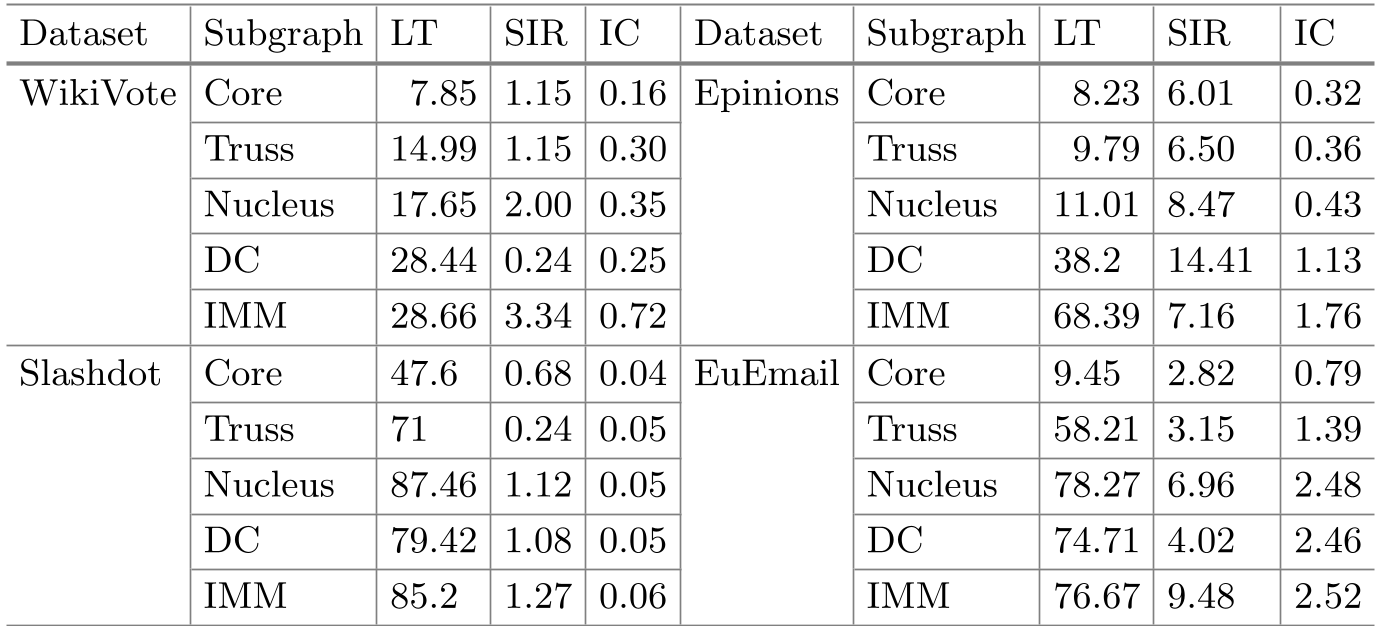 Table 4: Nucleus decomposition consistently outperforms lower-order decompositions across LT, SIR, and IC models.
3. Computation Speed: The Killer Feature
The state-of-the-art approximation algorithm, IMM, is highly accurate but painfully slow. For the Epinions dataset, IMM took over 1200 seconds, whereas Nucleus decomposition took only 126 seconds. For practitioners dealing with millions of nodes, this 10x speedup is a game-changer.
Critical Analysis & Conclusion
Takeaway
Nucleus decomposition is a "surgical" tool for social network analysis. By moving to higher-order clique structures, it identifies the most reputable and strategically positioned agents who can anchor a diffusion process.
Limitations
- Computation Decay: Moving beyond (3,4)-nuclei to (4,5) or higher offers diminishing returns while computation time spikes exponentially.
- Undirected Assumption: Most nucleus algorithms assume undirected graphs. The authors manually handled directionality, but a native "directed nucleus" theory is still maturing.
Future Outlook
The next step for this technology is Dynamic Nucleus Tracking. In real-time social media, the "nucleus" of a conversation shifts hourly. Adapting these decomposition methods to real-time streams could allow brands and governments to identify emerging influencers the moment a trend begins.
Senior Editor's Note: This paper effectively bridges the gap between pure graph theory and pragmatic social marketing. It challenges the "more is better" philosophy in seed selection, proving that a concentrated "nucleus" of influence is often more powerful than a broad, shallow "core."