
Beyond Seed Sets: Why Context and Budget Matter in Social Influence Maximization
Budgeted Influence Maximization with Tags in Social Networks
The paper introduces the Tag-Based Budgeted Influence Maximization (TBIM) problem, which optimizes the selection of both seed users and influential tags under cost constraints. It proposes three algorithms—EMIG-UT, EMIG-U, and EMIG-U-Pru—that leverage community detection and effective marginal influence gain to achieve SOTA influence spread on datasets like Last.fm and Delicious.
TL;DR
Social Influence Maximization (IM) is evolving. It’s no longer just about who you pick as a seed, but what context (tags) you use to reach them. This paper introduces the Tag-Based Budgeted Influence Maximization (TBIM) problem, providing a framework to select influential users and tags simultaneously under a strict budget. By focusing on community-specific tag popularity, the researchers achieved up to an 8% improvement over traditional community-based baselines.
Problem & Motivation: The Context Gap
Most existing IM research operates under a simplified assumption: if User A follows User B, the influence probability is a fixed value. In reality, influence is context-specific. A professional athlete might influence you regarding "sports gear" but has zero influence on your "political views."
Furthermore, real-world marketing isn't free. Both selecting a "seed user" (incentives) and promoting specific "tags" (platform advertising costs) incur expenses. The authors identify two major gaps in prior work:
- Lack of Cost Integration: Tags are rarely treated as costly resources.
- Global Bias: Tags that are popular across a whole network might be ignored in specific sub-communities, leading to wasted budget.
Methodology: The EMIG Framework
The core of the paper lies in three proposed methodologies based on Effective Marginal Influence Gain (EMIG). The EMIG is a submodular-inspired metric that measures the "bang for your buck"—the ratio of influence gain to selection cost.
1. Community-Wise Budgeting
The authors first partition the network into communities using the Louvain method. The global budget is then distributed among these communities based on their size, ensuring that diverse sub-groups are reached.
2. The MIA Model Integration
To calculate influence spread , they use the Maximum Influence in Arborescence (MIA) model. The key innovation here is the Independent Tag Aggregation formula, which computes the effective edge probability based on a set of selected tags :
3. Algorithmic Variations
- EMIG-UT: Simultaneously selects user-tag pairs. Highly accurate but computationally expensive.
- EMIG-U: Selects tags based on community frequency first, then optimizes for users. Much faster for large networks.
- EMIG-U-Pru: Introduces a pruning technique based on out-degree to cost ratios to skip low-potential nodes.
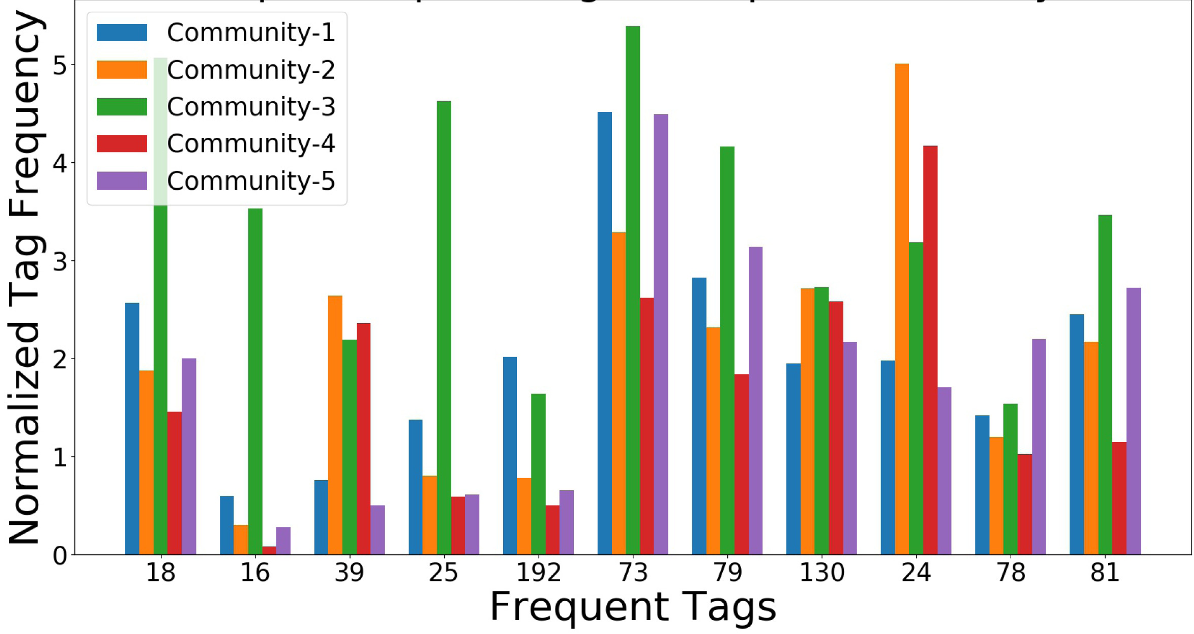 Figure 1: This chart demonstrates that tag popularity (e.g., Tag 16) varies wildly between Community 3 and Community 4, justifying the need for localized tag selection.
Experiments & Results
The researchers tested their approach on three datasets: Last.fm, Delicious, and LibraryThing.
Key Findings:
- Superior Reach: Across all cost settings (Trivalency, Weighted Cascade, Count), the EMIG-based methods consistently outperformed "High Degree" and "High Frequency" baselines.
- Efficiency: In the Delicious dataset, the proposed methods influenced over 800 nodes compared to the 744 reached by the best baseline (HN+HT+COM).
- Stability: Even with pruning (EMIG-U-Pru), the influence spread remained competitive while significantly reducing the execution time (up to 10x faster on larger datasets like LibraryThing).
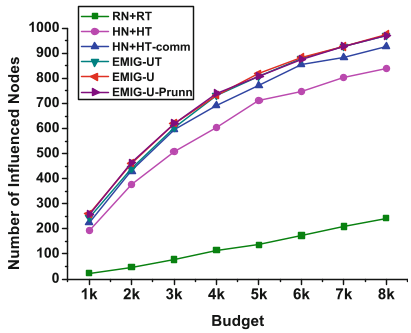 Figure 2: Performance comparison on the Last.fm dataset showing EMIG-UT leading in influence spread as the budget increases.
Critical Analysis & Conclusion
Takeaway
The TBIM framework proves that budget allocation must be content-aware. By treating tags as first-class citizens in the optimization loop, the authors bridge the gap between theoretical influence models and practical viral marketing.
Limitations
A notable observation in the LibraryThing dataset was that the pruning technique (EMIG-U-Pru) led to a drop in performance. This suggests that in very large, sparse networks, simple out-degree heuristics might overlook "bridge nodes" that possess high marginal gain despite lower local connectivity.
Future Outlook
This work opens the door for multi-campaign influence maximization, where multiple products with different tag sets compete for the same budget. Integrating reinforcement learning to dynamically adjust tag selection as the diffusion progresses could be the next frontier in this field.