
Scaling Influence Maximization: A Belief Propagation Approach to Budgeted Social Diffusion
On Budgeted Influence Maximization in Social Networks
This paper addresses the Budgeted Influence Maximization (BIM) problem in social networks, where nodes have arbitrary selection costs under a fixed total budget. The authors propose an improved greedy algorithm that guarantees a approximation ratio and introduce a novel Influence Spread estimation method by casting the problem as Belief Propagation (BP) on Directed Acyclic Graphs (DAGs).
TL;DR
Maximizing influence in a social network is no longer just about who is well-connected; it's about who gives you the best "bang for your buck." This paper tackles the Budgeted Influence Maximization (BIM) problem. It moves beyond slow Monte-Carlo simulations by mapping influence spread onto Bayesian Networks and using Belief Propagation (BP) to estimate reach. The result? A approximation guarantee and a massive speedup on large-scale graphs.
Background: Why "Naive Greedy" Fails in the Real World
In classic viral marketing literature, researchers often assume that picking any "seed" node costs the same. In reality, a celebrity with a million followers (e.g., a "hub") costs significantly more to recruit than a local enthusiast.
When we introduce arbitrary costs and a fixed budget, the standard Greedy algorithm breaks. For instance, it might pick a slightly cheaper node with much lower influence, failing to utilize the budget effectively. This paper proves that a modified approach—comparing the best greedy set with the single most influential node—restores a constant approximation ratio of approximately 0.39.
Methodology: The Architecture of Influence
The technical heart of this work is the transition from stochastic simulation to graphical model inference.
1. From Social Graphs to DAGs
Because social networks contain cycles (loops) that make exact probability calculation #P-hard, the authors propose two ways to simplify the graph into Directed Acyclic Graphs (DAGs):
- DAG1: Uses a topological order based on the shortest path weight from the seeds.
- DAG2: Takes the union of "Maximum Influence Paths" (MIP) and prunes edges that create cycles based on rank.
2. Belief Propagation as an Oracle
Once the graph is represented as a DAG, the authors observe that the active/inactive state of a node follows a probability distribution identical to a Bayesian network. They utilize:
- LBP (Loopy Belief Propagation): For higher accuracy.
- SPBP (Single Pass BP): For high-speed execution, calculating node activation in a single topological sweep.
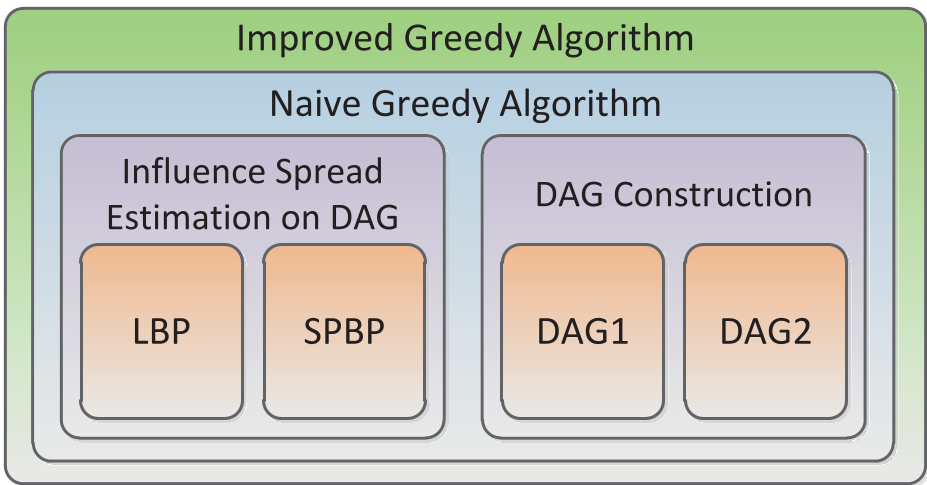 Figure 1: The building blocks of the proposed BIM algorithm, from graph pruning to BP inference.
Experiments: Superiority on Dense Networks
The authors tested their methods against CELF (the gold standard for greedy optimization) and PMIA.
Key Findings:
- Scalability: On the Amazon dataset (over 1.2M edges), the proposed DAG2-SPBP method was several orders of magnitude faster than simulation-based CELF.
- Accuracy in Density: Most heuristics (like PMIA) excel only in sparse networks. This paper’s BP approach remains robust even in dense networks like 'Email' exchange graphs.
- Structural Insights: The experiments revealed that when a network has high "skewness" (a few massive hubs), simple "Weighted Degree" heuristics perform well. However, in flatter, "fat-tailed" distributions, the proposed BP approach is necessary to find the optimal seeds.
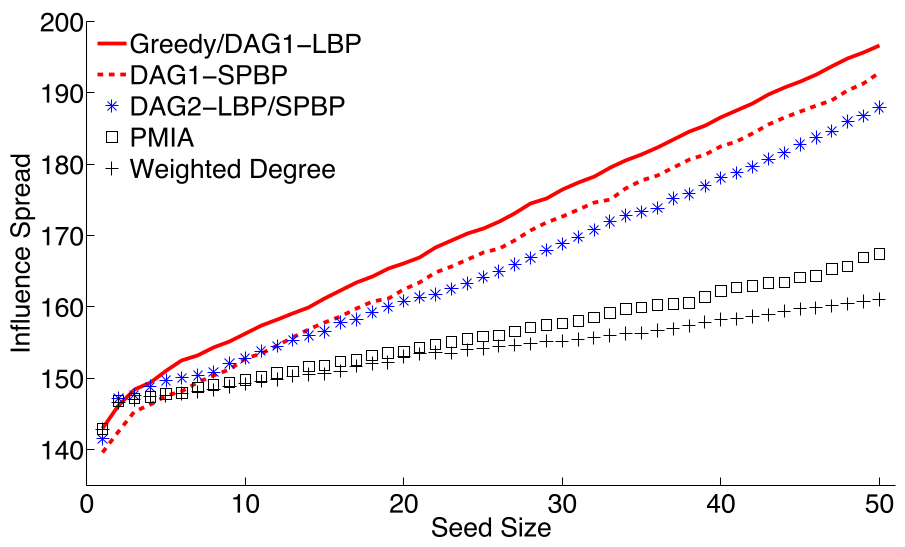 Figure 2: Influence spread comparison across different node costs and budgets. The proposed methods (DAG-based) consistently track or exceed the Greedy simulation baseline.
Critical Insight & Conclusion
The true value of this paper lies in its Inductive Bias. By assuming that influence primarily travels along "Maximum Influence Paths" and decays quickly, the authors safely prune the search space without losing significant accuracy.
Takeaway: If you are dealing with millions of users and varying costs, stop simulating and start inferring. Mapping the diffusion process to a DAG-based Bayesian network provides a principled way to scale influence maximization to production levels.
Limitations: While LBP is accurate, its complexity increases with node in-degree. The authors mitigated this by pruning low-probability incoming edges, but in hyperscale graphs with extreme connectivity, even SPBP may require further localization.