
Scaling the Social Airwaves: Decoding Buffer Occupation in Wireless Social Networks
Buffer Occupation in Wireless Social Networks
This paper investigates the scaling laws of buffer occupation and throughput in wireless social networks where the number of friends per node follows a power-law distribution. Utilizing percolation theory and two distinct transmission strategies ( and ), the authors establish the upper and lower bounds for buffer requirements and multicast throughput in large-scale networks.
TL;DR
Conventional wisdom suggests that as a network grows, each node needs more storage to handle the increasing relay traffic. This paper challenges that intuition. By modeling social connections with a power-law distribution and applying percolation theory, the authors demonstrate that with optimal transmission strategies, buffer occupation per node can actually remain constant even as the network approaches infinite size.
The Motivation: Why Your Theoretical Router is "Full"
In the realm of Wireless Social Networks (WSNs), nodes aren't just points; they are socially connected entities. Previous models (like the landmark Gupta-Kumar model) often assumed infinite buffers or ignored the social "gravity" that clusters traffic.
The authors identify a critical gap: Resource constraints. In a real-world ad hoc network, storage is finite. If a node cannot relay a packet immediately due to channel interference, it must buffer it. But how much buffer is "enough" when your social circle follows a power-law distribution (where a few "super-hub" nodes have many friends)?
Methodology: The and Duality
The paper introduces two transmission strategies to probe the limits of the network:
1. Strategy : The Buffer Minimalist
This strategy focuses on minimizing the "footprint" of data. It uses a spanning tree algorithm to keep the total length of transmission paths as short as possible.
- Intuition: By minimizing the distance a packet travels, you minimize the number of nodes that ever have to "touch" (and thus buffer) that packet.
2. Strategy : The Throughput Maximizer
Leveraging Percolation Theory, this strategy constructs "Highways"—paths of nodes that cross the network with high connectivity.
- Intuition: Packets are funneled from a source to the nearest highway, swept across the network at high spectral efficiency, and then delivered to the destination. While faster, this clustering of traffic on highways significantly increases the local buffer demand on highway nodes.
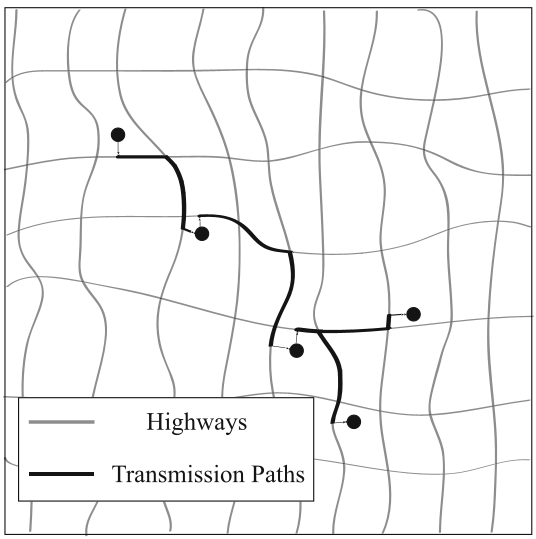 Figure: The construction of the highway system. Subsquares are checked for "open" status to form a backbone for high-speed data transfer.
The Core Physics: Power-Law Impact
The "Social" in WSN comes from the degree distribution . The parameter is the "hero" of the equations.
- When is small, the network is densely connected with many long-range multicast "friends."
- The authors meticulously calculate the Euclidean Minimum Spanning Tree (EMST) lengths for these groups, showing that the expected hop count scales with in ways that depend strictly on the social diversity ().
Results: The Counter-Intuitive Constant
The most striking result arises when the authors consider the relationship between the packet arrival rate and the network's throughput.
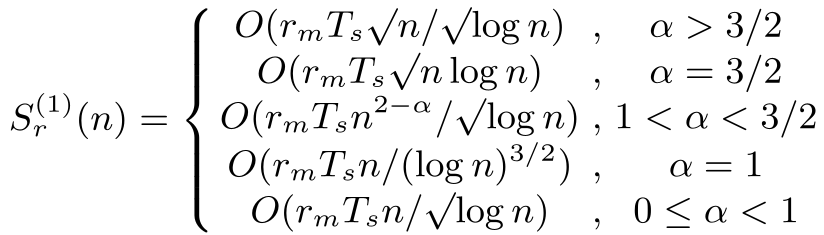 Table: Scaling laws for Strategy 1 showing the mathematical relationship between network size (n) and buffer occupation.
The "Magic" Discovery: As the network size , the throughput per node actually decreases. Because the network gets "slower" at the same rate the path lengths get "longer," the actual amount of data sitting in any single node's buffer at one time stays constant ().
Deep Tech Insight: The Trade-off
There is no free lunch. The paper proves a rigorous trade-off:
- Opt for high throughput? You need or buffer space.
- Opt for tiny buffers? You suffer a throughput penalty compared to the theoretical upper bound.
Critical Analysis & Conclusion
This paper provides a rigorous mathematical bridge between Social Network Analysis and Information Theory.
Takeaway: The fear that massive social networks will collapse under the weight of their own metadata/relay requirements is mathematically mitigated—provided our routing algorithms are smart enough to balance the "highway" load.
Limitations: The model assumes a static Poisson distribution of nodes. In reality, nodes move. Future research should apply these power-law insights to Mobile Social Networks (MSNs), where the "contact time" between nodes becomes a secondary stochastic variable.
Senior Editor's Note: This work is a cornerstone for anyone designing decentralized social mesh networks. It moves beyond simple "capacity" and looks at the industrial reality of hardware—specifically storage.