
Building Noise-Immune Classifiers with GMDH: Analyzing the AskaPatient Health Network
Building Classifiers with GMDH for Health Social Networks (DB AskaPatient)
This paper explores the application of the Group Method of Data Handling (GMDH) for opinion mining within the health social network AskaPatient. By employing GMDH-based classifiers and a One-Vs-All approach, the study categorizes patient reviews into practical combined classes to identify negative or extreme medical experiences.
TL;DR
This research investigates the Group Method of Data Handling (GMDH) to simplify and fortify sentiment analysis in health-related social media. By remapping the standard 5-star rating system into practical "combined classes" and leveraging GMDH’s unique inductive modeling, the authors achieved an F-score of up to 72%, maintaining high performance even when data is intentionally corrupted with noise.
Background & Motivation: Deep Learning isn't Always the Answer
Health social networks like AskaPatient are goldmines for identifying Adverse Drug Reactions (ADRs) and patient sentiments. However, social media data is notoriously messy—slang, typos, and subjective fuzziness create "noise." While Convolutional Neural Networks (CNNs) are the current SOTA, they often require massive datasets and can be prone to overfitting in noisy environments.
The authors pivot back to GMDH, a technology rooted in the "Method of Critical Variances." Why? Because GMDH doesn't just learn weights; it builds the structure of the model itself, selecting the optimal complexity to ignore noise and prioritize generalized features.
Problem Setting: The Need for Practical Classes
The study identifies that for a doctor or a regulator, the difference between a 4-star and a 5-star review is negligible. What matters is identifying the Extreme Negative Cases.
- 2-Class Task: Negative (1-2 stars) vs. Others (3-5 stars).
- 3-Class Task: Very Negative (1), Satisfactory (2-4), Very Positive (5).
Methodology: The GMDH Inductive Approach
The core of the approach lies in the One-Vs-All binary categorization within the GMDH Shell platform.
1. Feature Engineering
Data was transformed into a Bag-of-Words (BOW) using n-grams (up to ). The vocabulary was kept compact (100-800 terms) to maintain discriminative power without succumbing to the curse of dimensionality.
2. Model Evolution
GMDH functions as an inductive algorithm that generates a series of polynomial models (linear, quadratic, or neural-type). It uses "external criteria" (checking against a control set) to stop adding complexity before the model starts fitting to noise.
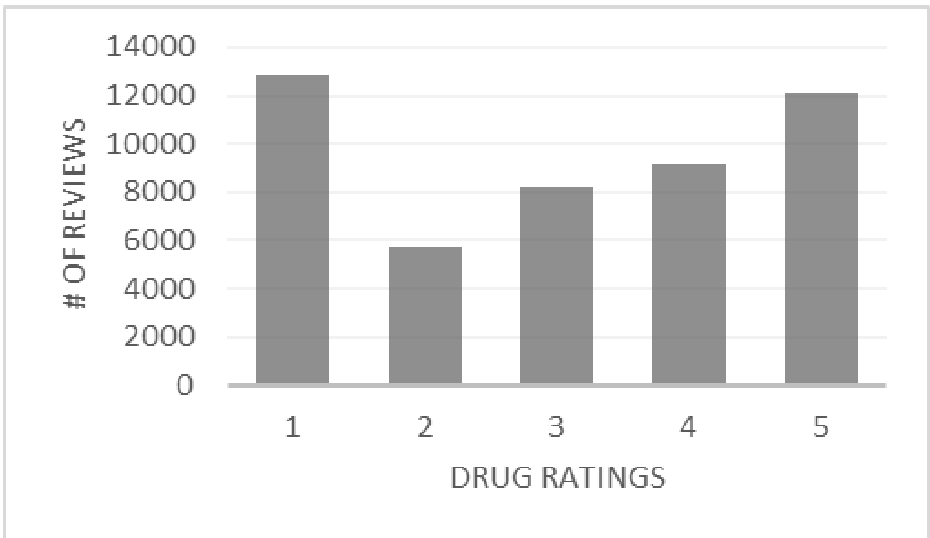 Fig 1: Rating distribution showing class imbalance that the GMDH-based approach had to navigate.
Experiments & Key Findings
The authors tested four variants: Combinatorial, Forward, Mixed, and Neural Networks (NN).
- The Winner: The Mixed Selection algorithm proved superior for binary tasks (72% F-score).
- Complexity Balance: Interestingly, balancing classes (a common practice) actually impaired result quality in this specific GMDH context.
- Noise Immunity: Perhaps the most impressive result is the stability. When white noise was added (), the F-score drop was minimal, confirming the "noise-immunity" property of GMDH.
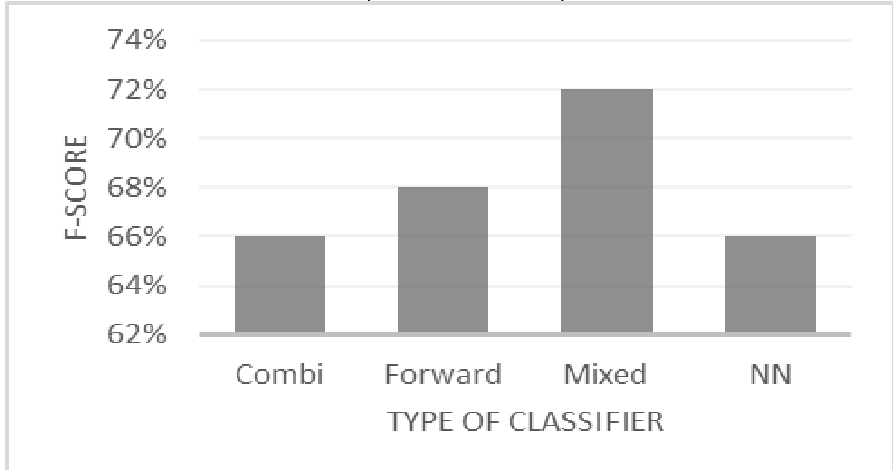 Fig 2: Comparison of F-scores across different GMDH selection algorithms.
Critical Insight: Why it Works
GMDH’s strength in this study comes from its Structural Inductive Bias. Unlike standard Neural Nets that might force a deep architecture on a shallow problem, GMDH finds the polynomial "surface" of least complexity. In health social networks, where the "signal" (symptoms/feelings) is often buried in "noise" (casual chat), a simpler, mathematically-grounded surface is more robust than a deep latent space.
Conclusion & Future Outlook
The study successfully demonstrates that GMDH is a powerful tool for health sentiment analysis, especially when identifying the "Extreme Cases" that matter most to medical safety.
Future Directions: The authors suggest integrating GMDH with fuzzy logic or modern CNN ensembles. Combining the structural robustness of GMDH with the feature-extraction power of deep learning could lead to the next generation of medical safety monitoring tools.
Takeaway for the Industry: For niche medical datasets where reliability under uncertainty is paramount, "Old-School" inductive modeling like GMDH may still outperform "Black-Box" deep learning models in terms of stability and interpretability.