
Building Noise-Immune Classifiers: Why GMDH Matters for Health Social Networks
Building Classifiers with GMDH for Health Social Networks (DB AskaPatient)
This paper explores the application of the Group Method of Data Handling (GMDH) for sentiment classification within health social networks, specifically using the AskaPatient database. By employing GMDH-based algorithms like Mixed and Forward Selection within the GMDH Shell platform, the study achieves high-accuracy health opinion mining (reaching a 72% F-score) that significantly outperforms baseline class distributions.
TL;DR
The proliferation of health-related social media (like AskaPatient) provides a goldmine for medical insights, but mining this data is notoriously difficult due to extreme noise and informal language. This paper introduces the Group Method of Data Handling (GMDH) as a specialized tool for health opinion mining. By moving beyond standard 5-star ratings into "practical" combined classes, the authors achieve F-scores up to 72% and prove that GMDH models maintain high stability even when data quality degrades.
Background & Positioning
In the spectrum of NLP, most researchers today gravitate toward deep learning (CNNs, Transformers). However, this paper looks back at a powerful paradigm: Inductive Modeling. GMDH serves as a "noise-immunity" technology. Unlike deep models that might overfit to the quirks of internet slang, GMDH seeks the "optimal complexity" of a model, making it uniquely suited for the messy, high-stakes domain of medical sentiment analysis.
The Problem: The Noise in Health Talk
Medical social media data suffers from two main issues:
- Granularity Mismatch: A 5-star scale isn't helpful for a doctor looking for "dangerous side effects" versus "general dissatisfaction."
- Noise Sensitivity: Text from patients is filled with non-standard grammar. Typical classifiers often see their accuracy plummet when the input features are inconsistent.
Methodology: The Power of Self-Organization
The core of the paper lies in using GMDH Shell, a platform that implements inductive self-organizing algorithms.
The GMDH Philosophy
Instead of pre-defining a rigid network architecture, GMDH "grows" the model. It uses a One-Vs-All approach to convert multi-class problems into binary ones, identifying the best polynomial equations to represent the boundaries between classes.
The Workflow:
- Parameterization: Instead of simple words, they used N-grams (n=1,2,3) and Bag-of-Words (BOW).
- Combined Classes: They simplified the 5-star scale into actionable groups:
- 2-class scale: Negative (1-2) vs. Others (3-5).
- 3-class scale: Very Negative (1), Satisfactory (2-4), Very Positive (5).
- Noise Injection: To prove the "noise-immunity" claim, the authors intentionally added white noise to normalized data vectors to see if the model would break.
Experimental Results
The results confirm that simpler, structurally optimized models can outperform complex baselines in specific contexts.
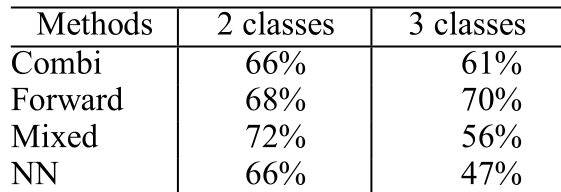
- Binary Task: The Mixed Classifier reigned supreme with a 72% F-score.
- 3-Class Task: The Forward Selection algorithm was the winner, hitting 70%.
- The "Noise Proof": When noise was added (), the F-score only dropped from 72% to 63%. In the world of data science, this level of stability is highly desirable for production environments.
Critical Analysis & Conclusion
Takeaway: GMDH provides a "defensible accuracy." It might not always beat a massive GPU-hungry Transformer on a clean dataset, but in the "dirty" reality of medical forums, its ability to ignore noise and find the structural "truth" of the data is invaluable.
Limitations: The study used a relatively small sample (1000 texts) for the primary experiments to maintain computational simplicity. While the results are promising, scaling this to millions of tweets might require more robust hardware acceleration.
Future Work: The authors aim to blend GMDH with CNNs and fuzzy logic, potentially creating a hybrid model that captures both the linguistic nuance of deep learning and the structural stability of inductive modeling.