
Beyond the Privacy Divide: Leveraging Community Collective Efficacy for Older Adults
Towards Building Community Collective Efficacy for Managing Digital Privacy and Security within Older Adult Communities
This study investigates "Community Collective Efficacy" as a sociotechnical framework for managing digital privacy and security among older adults. By surveying 67 individuals across two communities, the authors demonstrate that group-level beliefs in collective capacity are strongly correlated with individual self-efficacy, technology power usage, and community belonging.
TL;DR
Instead of merely simplifying interfaces for older adults, this paper argues for building Community Collective Efficacy—the shared belief that a group can manage digital threats together. Using social network analysis across two distinct communities, the authors prove that individual confidence and community belonging are the engines of collective safety, especially when "Key Players" (like facility employees) are strategically embedded to facilitate tech expertise.
Positioning: Moving from "Deficit" to "Empowerment"
For years, the academic narrative regarding older adults (65+) and technology has been one of individual deficit. Researchers highlighted their status as "late adopters" and focused on building "nanny-state" systems that limit features to protect users.
This paper flips the script. It positions digital security as a socially negotiated practice. By introducing the concept of Community Collective Efficacy from social psychology into the HCI domain, the authors argue that we shouldn't just be asking "Is this person capable?" but "Is this community capable of protecting its members?"
The Analytical Lens: Social Network Analysis (SNA)
The researchers didn't just look at individuals; they mapped the "social topography" of two groups:
- A Residential Community: High interconnectedness, supported by staff.
- A Social Community: Looser ties, supported by volunteers.
By using Quadratic Assignment Procedure (QAP)—a method that accounts for the fact that network data isn't statistically independent—they visualized how "power users" (those comfortable with tech) influence those around them.
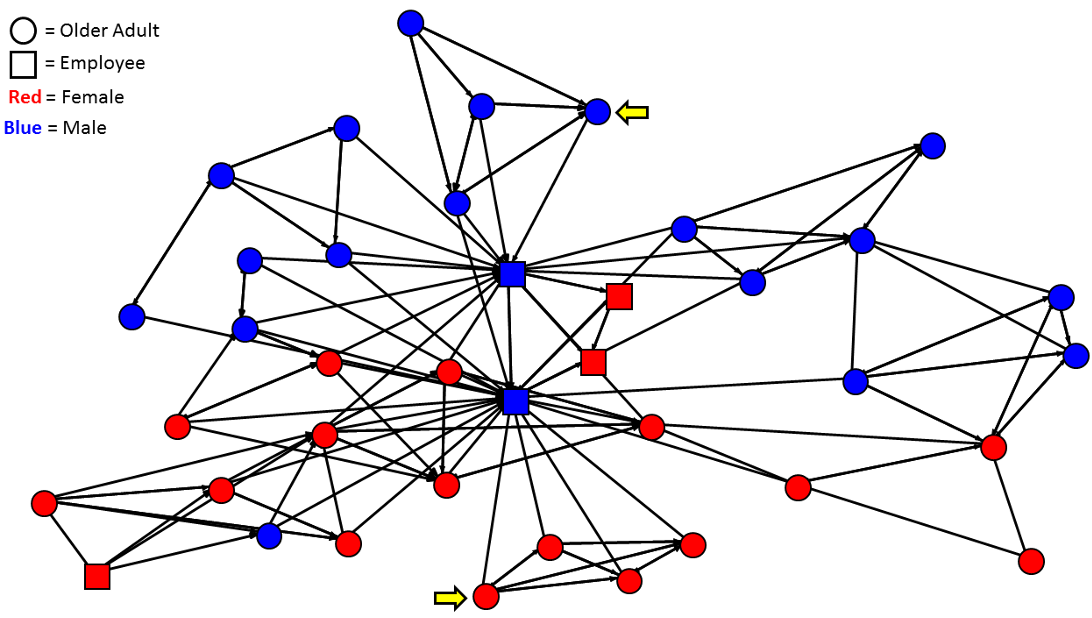 Fig 1: Sociogram of the Residential Community, showing how links (daily interactions) form clusters of collective support.
Methodology: The "Secret Sauce" of Group Safety
The study validated a framework where three pillars support Community Collective Efficacy:
- Self-Efficacy: "I think I can learn this."
- Power Usage: "I actually use and explore tech features."
- Community Belonging: "I am part of this tribe."
The most striking finding? Homophily—the tendency for birds of a feather to flock together. People with similar tech expertise tend to cluster. This creates a risk: if a cluster has low collective efficacy, it remains a "vulnerability island" unless an external facilitator is introduced.
Results: The Power of the "Key Player"
The study analyzed what happens when you remove key facilitators (employees or volunteers) from the network.
- Fragmentation: In the social community, removing volunteers caused network fragmentation to jump from 74% to 95%.
- The Facilitator Effect: The residential community had much higher collective efficacy because the employees were not just "tech support"—they were embedded influencers who boosted the group's overall confidence.
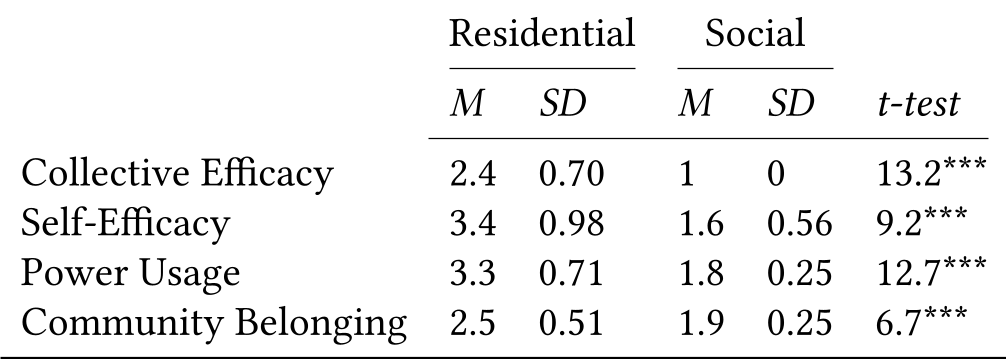 Table 1: Significant differences in efficacy scores between the Residential and Social communities.
Critical Insight: The "Social Cybersecurity" Shift
This paper serves as a foundational call for Social Cybersecurity. The primary takeaway is that the most effective way to protect a community isn't necessarily a more complex firewall or a simpler icon; it's training the central nodes.
If we identify "Key Players"—the high-centrality individuals who everyone speaks to—and invest in their security training, that knowledge diffuses naturally. This is far more scalable than trying to reach every single user individually.
Limitations & Future Outlook
While the study is pioneering, the sample size (N=67) is localized. However, the framework opens a massive door for future research:
- Cross-Generational Oversight: How do families provide this efficacy?
- Product Design: Can we design "Community Dashboards" where a tech-savvy family member provides "oversight" rather than "control"?
Conclusion
We must stop viewing older adults as isolated, vulnerable targets. Instead, by fostering a Sense of Belonging and strategically injecting expertise into their social networks, we can build communities that are collectively resilient against the digital threats of the 21st century.