
Beyond Follower Counts: A Hybrid Approach to Building Influence in Social Networks
Building Influence for Online Social Networks
The paper introduces a hybrid influence model for Online Social Networks (OSNs) that integrates Global Influence (follower-based) and Local Influence (community-based). By utilizing Gaussian Kernel Density Estimation (KDE) and community recognition metrics, it achieves high precision in predicting personal influence on the Flickr dataset.
TL;DR
In the world of Online Social Networks (OSNs), influence is often reduced to a single number: followers. However, this paper argues that true influence is a binary of Global Reach (who sees you) and Local Authority (who trusts you). By combining Gaussian Kernel Density Estimation with community-specific recognition metrics, the authors provide a more granular way to identify "Opinion Leaders" in environments like Flickr and WeChat.
The "Centrality" Trap: Why Follower Counts Lie
Most prior works rely on PageRank or Degree Centrality to identify influencers. While effective for celebrities, these methods fail for the "expert next door."
- The Gap: A wine expert might have only 500 followers, but if those 500 people are the top sommeliers in the world, that user is more influential in their niche than a generalist with 50,000 followers.
- The Intuition: Social influence follows a Power-law distribution. A few people are "global giants," but most influence happens in tight-knit, virtual communities where "Personal Capability" and "Recognized Degree" matter more than raw numbers.
Methodology: The Global-Local Hybrid Model
The authors propose that total Influence is a weighted linear combination:
1. Global Influence (The Gaussian View)
Instead of simple counting, the model uses Gaussian Kernel Density Estimation (KDE) to map follower relationships. This allows the model to stabilize the flux of social relations, focusing on users who maintain a high density of followers relative to the network's mean () and variance ().
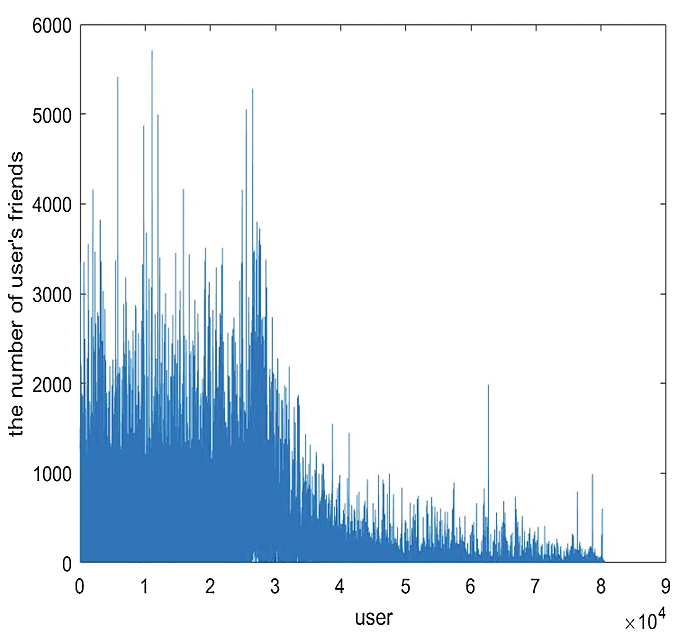 Fig 1: User follow relations demonstrating the Power-law distribution where few users hold the majority of connections.
2. Local Influence (The Community View)
Local influence is defined by how a user performs within a specific virtual group. It consists of:
- Recognized Degree: The ratio of friends a user has within a specific community divided by the total community size.
- Personal Capability: A weighted sum of user features (actions, content quality, and labels).
Experimental Insights from Flickr
The model was tested on a massive Flickr dataset containing over 80,000 users and 195 interest groups.
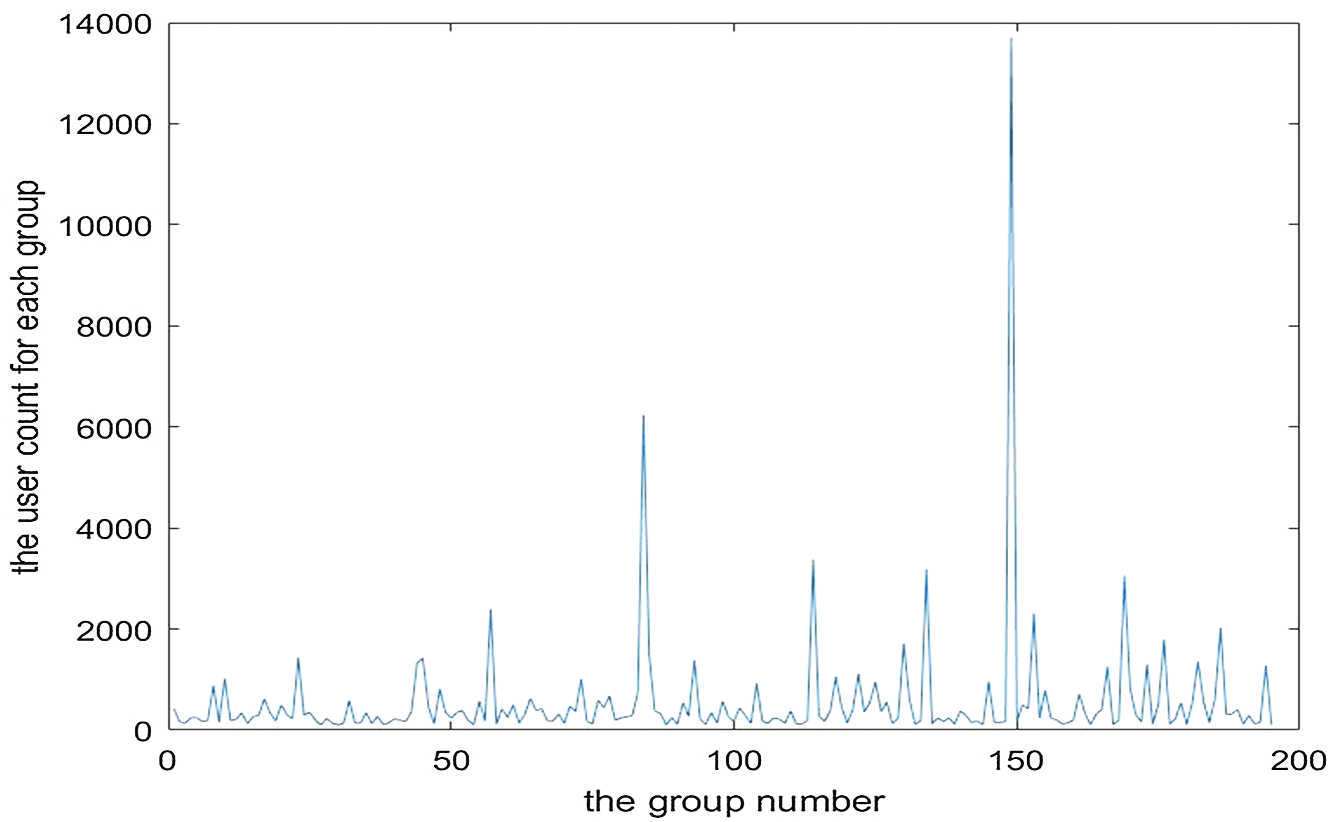 Fig 2: Distribution of users across various virtual communities, indicating that most influence is exerted in smaller, specialized groups.
Key Findings:
- For the "Elite": Global influence is the primary driver. If you have 5,000+ followers, your global density score dominates your profile.
- For the "Majority": Since most users have fewer followers than the average, Local Influence is the only accurate way to measure their impact. Their influence is built through long-term participation and "inner features" rather than location-based proximity.
Critical Analysis & Conclusion
The strength of this paper lies in its dual-perspective. It acknowledges that OSNs have removed the "location restriction" of the real world, allowing influence to be built purely on professional expertise.
Limitations:
- The model assumes a bidirectional relationship is more "valuable," which might not apply to platforms like X (Twitter) or TikTok where unidirectional "following" is the norm.
- The weight factor is crucial but requires manual tuning or platform-specific heuristics.
Takeaway: If you want to build influence in the modern age, focus on your "Local Authority" within specific communities. In the long run, your professional capabilities (rUser) will naturally build the global density (gInfluence) that current algorithms crave.