
Beyond Keywords: Engineering a Computing Domain Ontology for Smarter Information Extraction
Building Information Extraction System Based on Computing Domain Ontology
The paper introduces a hybrid Information Extraction (IE) system specifically designed for the Computing domain. By integrating NLP, Machine Learning, and Information Gain statistics, the system constructs a multi-layered domain ontology (CDO) from Wikipedia, WordNet, and ACM Digital Library to improve information retrieval from unstructured text.
TL;DR
Researchers have developed a hybrid Information Extraction (IE) framework that moves beyond simple keyword matching. By building a four-layer Computing Domain Ontology (CDO)—leveraging the ACM classification, Wikipedia, and WordNet—the system can extract structured knowledge from massive unstructured technical corpora with precision reaching over 97%.
Contextualizing the Knowledge Gap
While general-purpose NLP tools are powerful, they often falter in specialized technical domains where terms like "Java" or "Bus" have highly specific meanings. The challenge isn't just finding the words; it's understanding the semantic hierarchy and syntactic relations (who is doing what to whom). Existing systems often lack the "domain common sense" required to interpret complex technical sentences correctly.
The Core Methodology: Building the CDO
The system's backbone is the Computing Domain Ontology (CDO), which acts as a structured brain for the extractor. It is organized into four distinct layers:
- Topic Layer: 170+ categories based on the ACM hierarchy.
- Ingredient Layer: 800,000+ instances (e.g., "Support Vector Machine") sourced from Wikipedia.
- Synset Layer: Linguistic variations and synonyms derived from WordNet.
- Sentence Layer: Real-world syntactic relations (SVO) captured during preprocessing.
Architectural Pipeline
The workflow begins with Sentence Chopping and POS Tagging using the Stanford Lexical Dependent Tree. By identifying Subject-Verb-Object (SVO) relations, the system filters out noise and focuses on the "actionable" parts of the text.
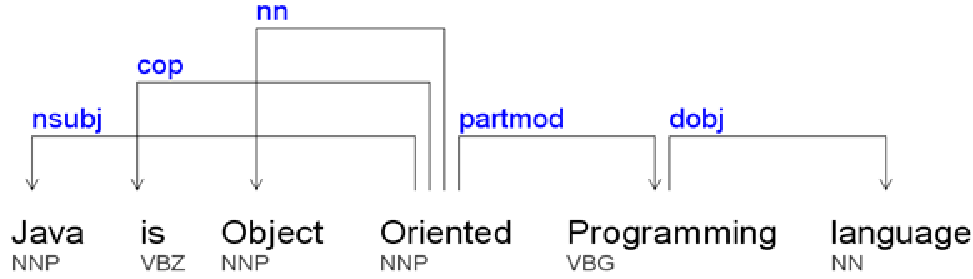 Figure 1: The dependency tree for "Java is an object-oriented programming language" illustrates how the system maps grammatical relations.
Validating the Insight: Experiments and Results
To prove the efficacy of the CDO-based approach, the authors compared it against the widely used Key Exchange Algorithm (KEA).
SOTA Comparison
In categories like Artificial Intelligence and Software Engineering, the system showed remarkable accuracy. The statistical filter (Information Gain) played a crucial role in ensuring that only high-value keywords were promoted to the final output.
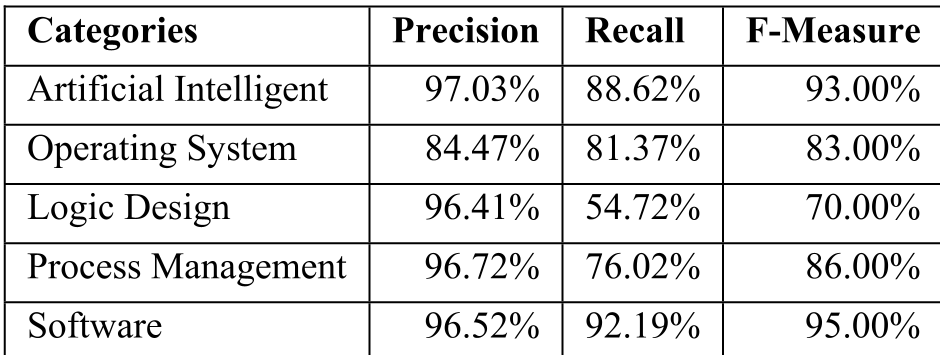 Figure 2: Precision and Recall metrics across different computing sub-domains.
Key Findings:
- High Precision: Consistently above 84%, with several categories exceeding 96%.
- Superiority Over KEA: In the "Operating Systems" category, the proposed system achieved an F-Measure of 83% compared to KEA’s 74%.
Deep Insight & Future Outlook
The success of this system lies in its hybrid nature. It doesn't rely solely on the "black box" of Machine Learning; it grounds its learning in the "silver standard" of existing human-curated knowledge (ACM and Wikipedia).
Limitations & Open Questions
Despite the high precision, the Recall in specific areas like "Logic Design" (54.72%) suggests that the ontology might still be missing niche terminologies or that the syntactic parsing rules are too rigid for certain technical styles.
Professional Conclusion
This work provides a robust blueprint for building "Knowledge-Aware" AI. By bridging the gap between raw text and structured ontologies, the system paves the way for advanced semantic search engines and automated technical summarizers that don't just "read" but actually "understand" the computing landscape.