
Bridging the Gap: Automated Predicate Recognition for Ontology Learning
Building of the Predicate Recognition System for the NLP Ontology Learning Module
The paper presents a specialized system for recognizing Description Logic (DL) predicates within natural language sentences. By combining the Link Grammar Parser (LGP) with the Protégé-OWL API, the system employs a Naive Bayes classifier to identify binary predicates and their associated roles (Subject/Object) for automated ontology learning.
TL;DR
Building intelligent agents requires them to "understand" the world through text. This paper introduces a system that transforms natural language sentences into logical predicates using a combination of Link Grammar Parser, Naive Bayes, and the Protégé-OWL API. By treating verbs as potential semantic relations, the system autonomously populates a knowledge base with structured facts.
Background: The Hierarchical Recognition Problem
In Natural Language Processing (NLP), the ultimate goal is not just to recognize words or phrases, but to understand statements—the fundamental "bricks" of an intelligent agent's world model. Most prior systems are brittle, limited to pre-defined semantic relations (like a hard-coded Consist-of.java class). The authors aim to move beyond this by teaching agents to recognize any free-form relationship expressed by a verb.
Methodology: From Syntax to Description Logic
The core of the system is the Predicate Recognition System, which follows a rigorous 6-step pipeline:
- Parsing: Use the Link Grammar Parser to break down the sentence.
- Verb Extraction: Identify the "Verb Group" as the potential predicate.
- Role Identification: Isolate the Subject (the actor) and the Object (the target of the action).
- Vectorization: Represent the relation as a 10-dimensional vector of "triples" (Subject -> Meta-link -> Object).
- Statistical Learning: Use a Naive Bayes Classifier to determine the probability of a specific semantic link existing based on training data.
- Ontology Integration: Use Protégé-OWL API to inject these findings into the agent's Knowledge Base.
 Figure 1: The structural representation of a predicate within the system.
The Bayesian Insight
Why use Naive Bayes? The authors argue that it is extremely fast and effective for clustering semantic bond signs. The system evaluates the Maximum A Posteriori (MAP) hypothesis to decide if a sequence of words represents a specific relation (like "is-a" or "has-property").
The probability calculation follows: Where is the vector of signs and is the hypothesis of a semantic connection.
Architecture and Schema
The system relies on a complex hierarchy of Java classes (e.g., GSL, Pattern, SemLinkDescriptor) to manage the transition from raw text to OWL individuals.
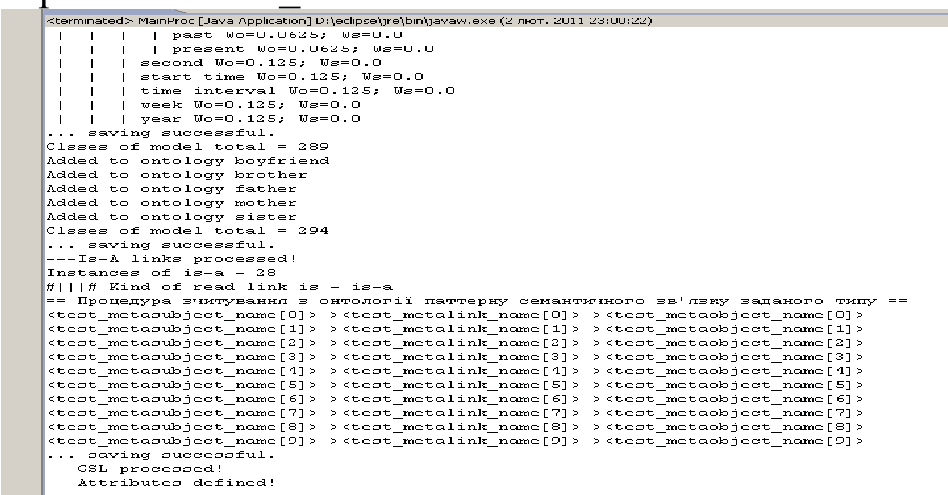 Figure 2: The ontology schema used to store patterns and learned semantic relations.
Experiments & Key Findings
The researchers tested the system on its ability to learn "is-a" relations. In the ontology, statistics are stored as "default" instances. For example, if "Tomato" appears as a subject for "is-red" 34 times, the system updates its statistical weights accordingly.
- High Confidence: The system identified that the first three elements of its 10-descriptor pattern (e.g., Subject -> Meta-link -> Object) are the most significant for defining 'is-a' relationships.
- Autonomous Expansion: When an unknown concept is encountered (e.g., "Ivan smokes X"), the system can infer that "X" is a substance that can be smoked and add it to the ontology automatically.
Critical Analysis & Conclusion
Takeaway
This work provides a solid bridge between linguistic parsing and formal knowledge representation. By using a statistical approach (Bayes) on top of a syntactic one (Link Grammar), it offers more flexibility than purely rule-based systems.
Limitations & Future Work
While robust, the system currently handles primarily binary predicates. Real-world language often involves n-ary relations or complex conditional logic. The authors propose using SWRL (Semantic Web Rule Language) in the next phase to allow the system to interpret the "meaning" of links—transforming a "sum" relation into a mathematical operation within the agent's logic.
Final Thought
As we move toward agents that learn from the web, systems that can turn "What they read" into "What they know" without human supervision are essential. This paper outlines the blueprint for such a transition.