SWM: Building Social World Models via Posterior-Guided LLM Distillation
Building Social World Models with Large Language Models
This paper introduces the Social World Model (SWM), a generative framework and LLM-driven architecture designed to predict collective belief evolution in response to social events. By leveraging real-world prediction market data from Kalshi and Polymarket (SWM-Bench), the model treats belief shifts as state transitions and achieves state-of-the-art performance, including a 4% improvement in directional accuracy over GPT-5.5.
TL;DR
Researchers have introduced the Social World Model (SWM), a framework that leverages Large Language Models to simulate how societal beliefs (captured via prediction markets) shift in response to specific news events. By using a novel "hindsight" training mechanism, SWM outperforms giant models like GPT-5.5 in predicting market directions on the new SWM-Bench, offering a glimpse into a future where AI can run "what-if" simulations for global policy and economic shocks.
Moving Beyond "What" to "Why": The Social Attribution Gap
Traditional time-series models are excellent at identifying what happened—e.g., "the price of Bitcoin dropped." However, they are historically blind to why it happened. In the social realm, transitions are driven by semantic shocks (news, breakthroughs, elections).
The authors identify three core challenges:
- Quantifiability: Unlike physics, "social state" is hard to measure.
- Semantic Complexity: Belief shifts follow psychological and cultural rules, not symbolic equations.
- Lack of Labels: We see the market move, but we don't have a dataset that explicitly says "Event X caused Shift Y."
To bridge this, the authors turn to Prediction Markets (Kalshi and Polymarket). In these markets, people "vote with their wallets," creating a high-fidelity, numerical proxy for collective human belief.
The Methodology: LLMs as the "Transition Engine"
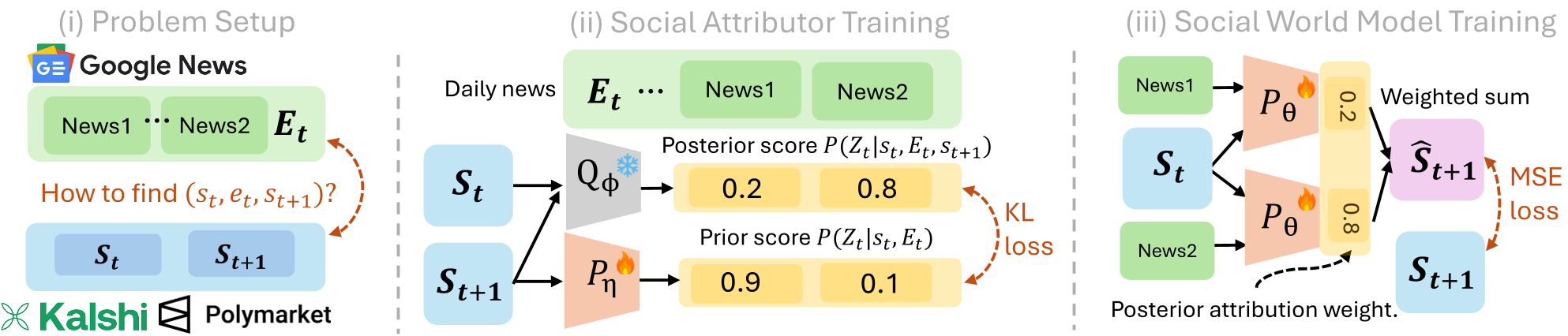
The SWM framework defines the social state as a trajectory of recent beliefs and treats events as exogenous shocks. The transition is modeled as:
The technical breakthrough lies in the Posterior-Guided Training.
- Hindsight (Teacher): A frozen, ultra-large LLM (Qwen 3.5 397B) looks at the market move after it happened and scans candidate news to identify the culprit.
- Foresight (Student): Two smaller models—a Prior Attributor and the World Model—are trained to replicate this causal link. The Attributor learns to pick the likely news event before the move, and the World Model predicts the numerical magnitude of the shift.
Experimental Victories
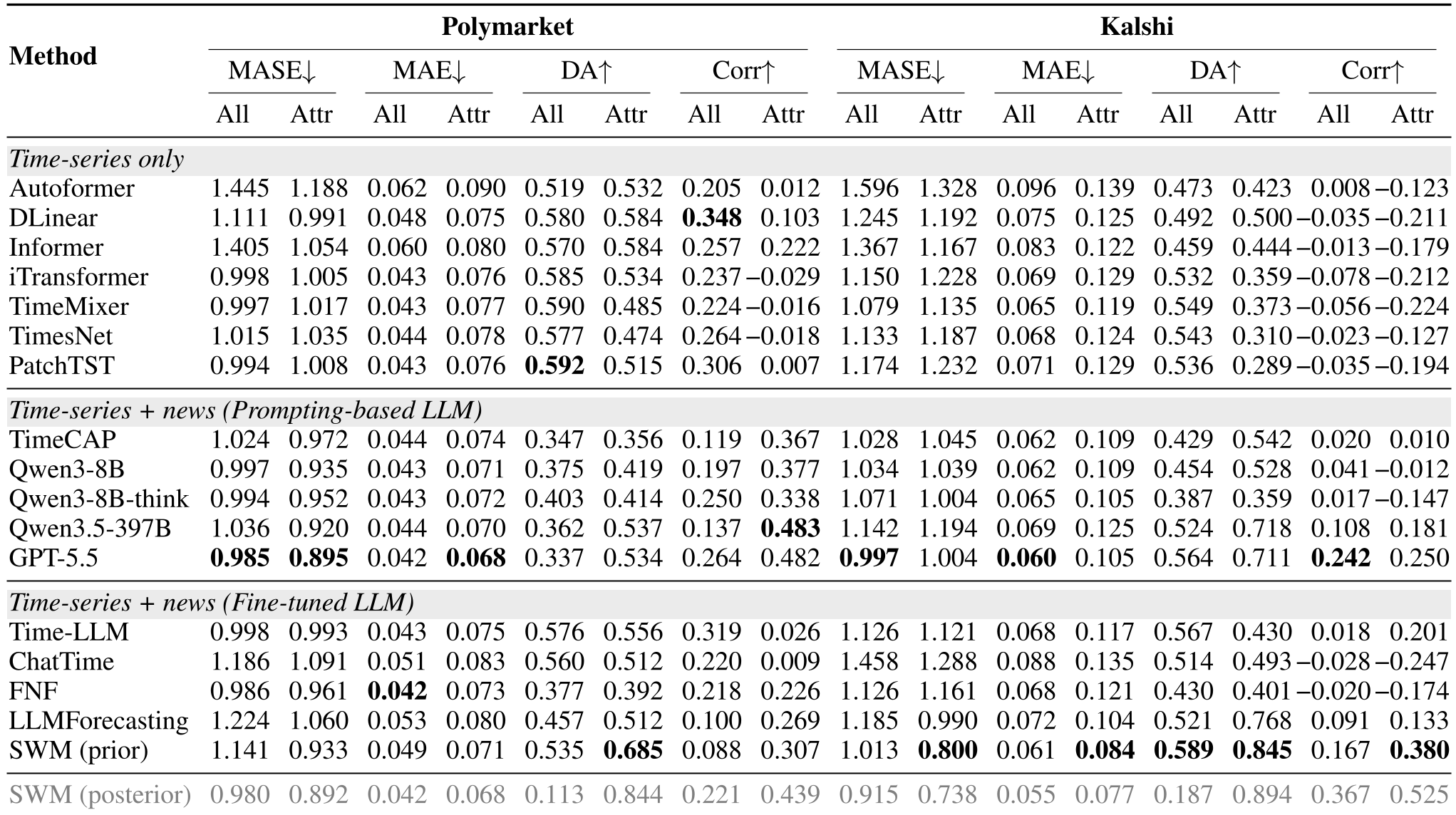
The authors tested SWM against a battery of baselines, including specialized time-series models (Autoformer, iTransformer) and frontier LLMs.
Key Findings:
- Directional Accuracy (DA): SWM achieved a staggering 84.5% DA on Kalshi data, beating GPT-5.5 (71.1%) and LLMForecasting (76.8%).
- Sparsity Matters: Performance peaks when the model focuses on a single, high-impact "causal" event rather than trying to digest the entire daily news cycle.
- Scaling the "Mind": There is a clear scaling law; increasing the backbone from 0.6B to 8B drastically reduced MASE (error) and improved correlation.
Deep Insight: Forecasting vs. Simulation
One of the most powerful features of SWM is its dual-mode operation:
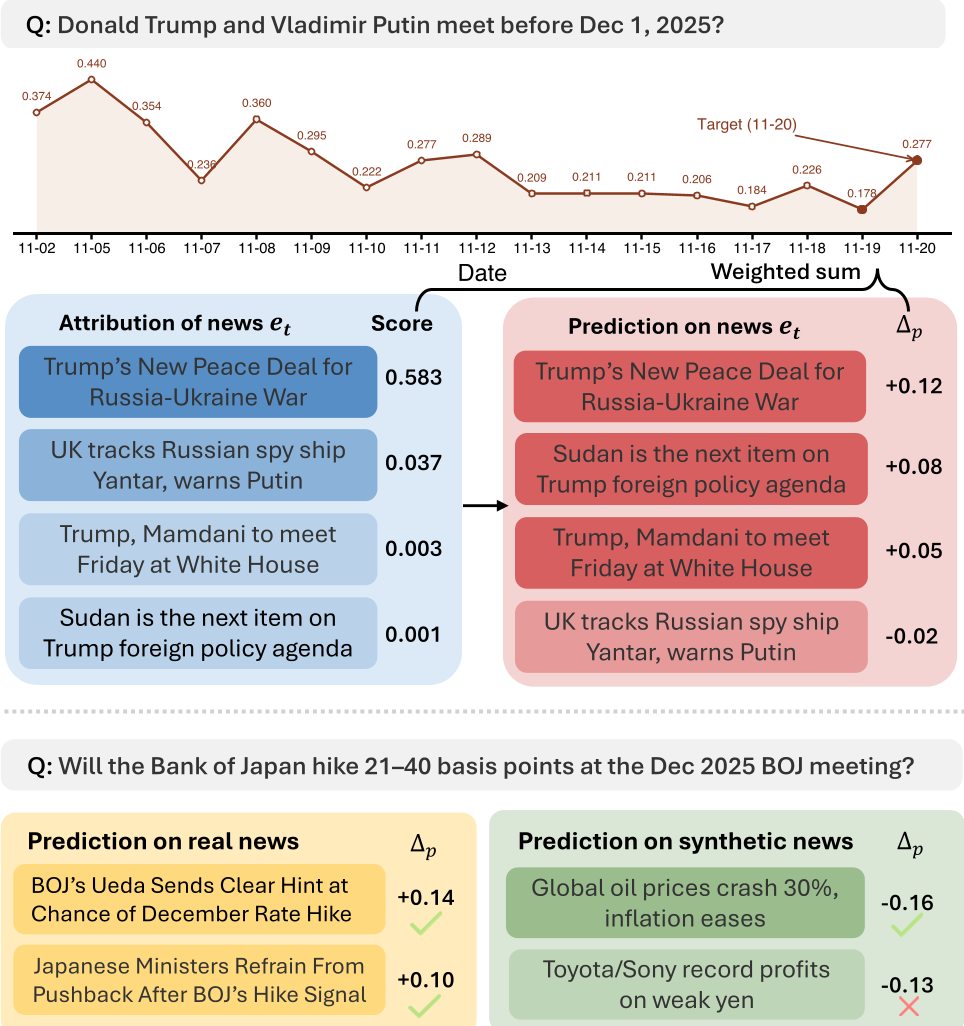
- Forecasting (Passive): The model scans current news and predicts the move. It correctly identified that news of a Russia-Ukraine peace deal would jump the probability of a Trump-Putin meeting.
- Simulation (Interventional): This is the "What-If" engine. You can feed the model a hypothetical event—like a synthetic 30% crash in oil prices—and the model will estimate the shift in central bank policy beliefs.
Limitations: The model still relies on "surface-level heuristics" in complex economic scenarios. For instance, it failed to realize that corporate profits on a weak currency actually increase inflation pressure, wrongly predicting a rate hike pause instead of an increase.
Conclusion: A Simulator for the Human Collective
SWM represents a shift from agent-based modeling (simulating individual "sims") to Macro-Dynamics modeling (simulating the aggregate consensus). While the ethical risks of "weaponized social engineering" are real, the defensive potential for detecting coordinated influence operations and helping policymakers anticipate public reactions to crises is a major step forward for digital sociology.